 Angryturtle
What are GBP Posts?
The feature was originally called Google Posts, and a lot of writing still uses that name. Google Posts and GBP Posts describe the same thing, so a search for either is looking for what this entry covers.
GBP Posts, sometimes still called Google Business Posts, are short-form content updates published directly to a business's Google Business Profile. They show up in the "Updates" section of the GBP panel on Search and Maps, and for some categories they appear prominently right in the local panel rather than tucked below the fold.
The four post types
What's New covers general updates — new service launches, announcements, recent achievements. It's the most flexible post type and, in practice, the one used most often, since almost any update fits under it.
Offers are promotional posts with a defined validity window, a redemption code, and stated terms. They get a special badge in the GBP panel and can carry a "Get offer" call-to-action button, which makes them the most conversion-oriented post type available.
Events are for anything with a specific start and end date — open days, workshops, launches, concerts, sports fixtures. The event dates display prominently, which helps for time-sensitive promotion that would otherwise get lost in a general update feed.
Products showcase individual items from the GBP product catalogue with a photo, name, price, and description — particularly useful for retail, for hospitality showcasing specific dishes, and for education highlighting individual courses.
Why posting activity affects local SEO at all
Posts function as a recency signal. A GBP that posts regularly tells Google the business is actively managed and operating, which sits alongside review recency and profile update frequency as one of the general activity signals Google's local algorithm weighs. Posts also add keyword surface area — post text gets indexed — and, for offers and events specifically, they create a direct path from search result to conversion action that a static profile description can't offer.
How long a post stays visible
What's New and Offer posts stay visible for roughly seven days before expiring. Event posts remain active through the event's end date rather than on a fixed timer. That lifespan is the reason a cadence of one to two posts per week keeps the GBP's content layer consistently fresh — post less than that and there are visible gaps where the "Updates" section looks stale.
What actually makes a post perform
- A clear call-to-action button — Call now, Book, Get offer, Learn more — rather than leaving the post as pure information with no next step
- Specific, keyword-relevant language in the post text itself, not vague marketing phrasing
- A photo on every post; posts with images get meaningfully higher engagement than text-only ones
- For offer posts, specificity about the discount amount, validity date, and exact redemption terms — vague offers convert worse and risk looking like spam
- Festival and seasonal posts published 5-7 days ahead of the date, not on the day itself, so there's time for the post to be seen before the relevant moment passes
Common mistakes
The most common mistake is posting in bursts — five posts in one week, then silence for a month — rather than maintaining a steady weekly cadence; irregular posting undercuts the recency signal that consistent posting is supposed to build. The second is publishing offer posts with vague terms ("special discount available") instead of a specific number, which both converts worse and can read as unreliable to a customer comparing it against a competitor's clearly stated offer.
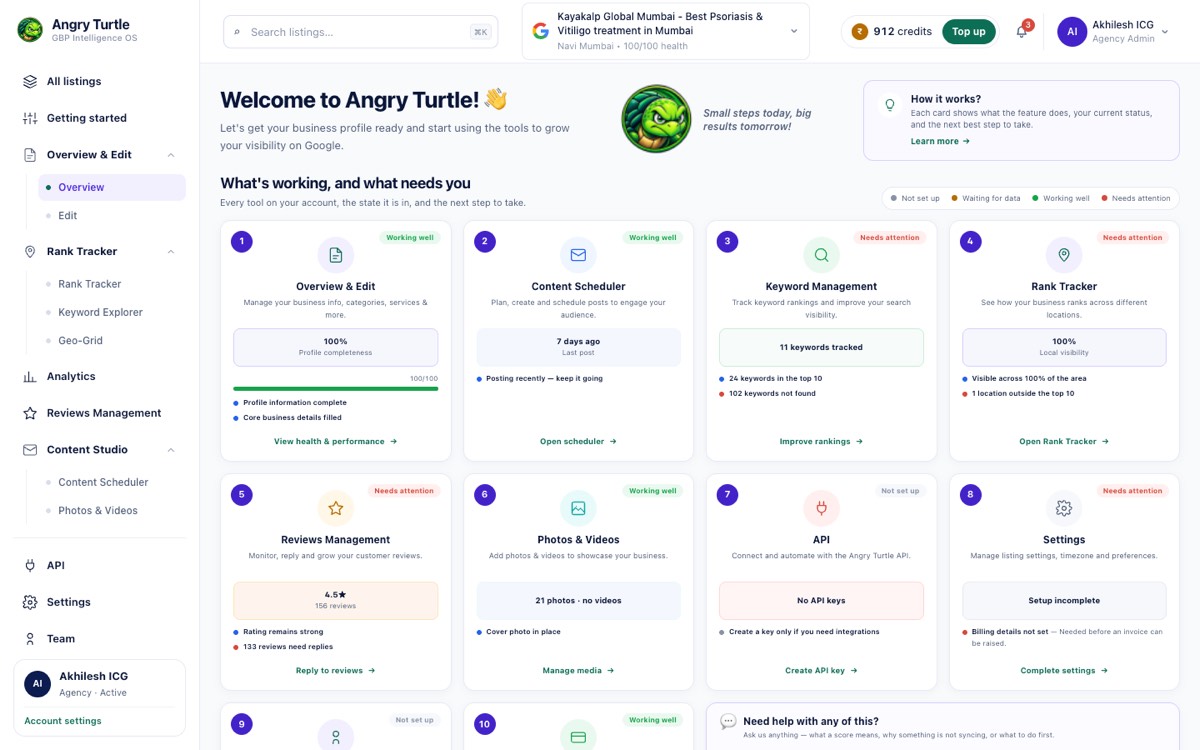
How Angryturtle handles posts: Angryturtle's platform plans, schedules, and publishes 2-4 posts per location per month on an annual content calendar, run either self-serve or fully managed, with confirmed write-back to Google across every managed profile.
Related terms: GBP Attributes → · GBP Insights → · GBP Messaging → · GBP Post Ideas blog → · GBP Posts Frequency blog → · GBP Posting Content Cadence →
Related glossary terms
A score you can argue with, not a black box
Rank OS gives every profile a 0–100 score built from five weighted dimensions — Relevance, Review Health, Freshness, Entity Authority and AIO Readiness — and the weights are tunable. Underneath it sits a ranked list of the fixes that move the number, each with the point lift it unlocks.
Ready to have this run for you?
Book a free audit — we'll show you where you stand in 48 hours.