 Angryturtle
What is GBP messaging?
GBP messaging is a Google Business Profile feature that lets customers send a direct message to a business straight from the GBP panel on Google Search and Maps. Once enabled, a "Chat" or "Message" button appears on the listing, and messages land in the GBP dashboard and the Google Maps app used by whoever manages the profile. Some businesses still call it "GBP chat," which refers to the same feature under a different name.
The feature sits inside the Business Information API's messaging surface, and Google exposes it as an opt-in toggle rather than something on by default. A business turns it on, and from that point forward, a message button is one more way a searcher can reach out before ever picking up the phone.
The mechanism: how a message actually reaches the business
A customer taps the message button on the GBP panel, types a question, and it's delivered to the Google Maps app tied to whichever Google account manages the listing — not to a separate inbox, and not to the business's own phone number unless that account happens to be on the manager's phone. That routing detail matters more than it sounds: a business that verified its GBP under an old employee's personal Google account, and never changed it, may have messages arriving somewhere nobody checks.
Who actually owns the inbox
This is the question that decides whether messaging helps or quietly damages a listing, and most businesses never answer it explicitly before turning the feature on. The inbox lives inside the Google Maps app on whichever phone or account is signed in as the profile manager — not in a shared team tool, not in an email inbox, not anywhere a manager would naturally check as part of a daily routine unless someone has deliberately made it part of one. In a single-owner business, that's usually fine by default, because the owner's phone is the Maps app. In anything larger than that — a clinic with a front-desk team, a multi-location chain, an agency managing the profile on a client's behalf — ownership has to be assigned on purpose, in writing, to a specific person with a specific check-in frequency. "Someone will see it" is not an ownership model; it's how messages sit unread for a week.
The agency case deserves its own mention: if an agency manages a client's GBP under its own Google account rather than the client's, every message goes to the agency first, and the client never sees it unless the agency has a defined process for forwarding messages the same day. Clients discovering months later that unanswered messages piled up under an agency's account is a real, recurring failure mode, and it traces back to exactly this ownership gap.
What happens to response-rate visibility when nobody replies
Google tracks and can display a response rate and typical response time for profiles with messaging enabled, visible to anyone viewing the listing. A business that enables messaging and then goes quiet doesn't just miss individual customers — it accumulates a visibly poor response rate that sits on the public listing for every future visitor to see, which is a worse outcome than never having enabled the feature at all. A profile with no messaging option prompts no expectation. A profile with messaging enabled and a bad response record actively signals unreliability to everyone who checks it afterward, turning a feature meant to build trust into evidence against it.
Why enabling messaging you cannot staff is worse than leaving it off
The asymmetry here is worth stating directly: a business gains very little by having messaging available if nobody's watching it, and loses a specific, visible amount of trust once Google's response-rate data reflects the neglect. There is no neutral middle state — messaging is either staffed, in which case it's a genuine advantage, or unstaffed, in which case it's actively worse than not having it, because the button itself invites an action that the business then fails to follow through on. A business unsure whether it has the staffing to check messages within the response window is better served leaving the feature off until that changes, rather than treating "we'll figure it out once it's live" as a plan.
When enabling messaging makes sense
Messaging works well when three things are true at once. The business can respond within a few hours rather than days. The business type generates genuine pre-visit questions — pricing, availability, appointment booking, directions — that a short message can actually answer. And there's a specific person responsible for checking and replying. A clinic fielding "do you have a slot today" messages benefits from all three being true. A business with nobody assigned to watch for them doesn't, no matter how useful the feature looks on paper.
When it doesn't
If responses will routinely take more than 24 hours, enabling messaging does more harm than leaving it off. An unanswered message creates a worse impression than no messaging option at all, and Google tracks response rates closely enough that it can disable the feature outright for businesses that consistently miss the window. Solo practitioners and unstaffed locations without the operational bandwidth to monitor messages are usually better off leaving it disabled until that changes.
The response SLA and what happens if it's missed
Google requires responses within 24 hours to keep messaging eligibility active. Consistently missing that window puts the feature at risk of being disabled by Google rather than the business choosing to turn it off, which is a worse outcome than never enabling it, because a customer sees the message option, uses it, and gets silence.
Automating the first reply
GBP supports an automated welcome message that fires the moment a customer starts a chat — something like "Thanks for your message. We typically respond within 2 hours during business hours." That single automated line does real work: it confirms the message was received and sets an expectation, which reduces the chance a customer gives up and calls a competitor instead while waiting. It isn't a substitute for an actual reply, just a bridge until one arrives, and it does nothing to fix the underlying ownership gap if the real reply still never comes.
Messaging against WhatsApp in the Indian market
WhatsApp is the dominant messaging channel for most consumer categories in India, and many customers will reach for it over GBP messaging once they know a business's number. But GBP messaging catches a different moment — a customer who found the business through a Google search and wants to ask something before they've located a WhatsApp number at all. The two channels aren't competing for the same customer moment. GBP messaging covers the earlier point in the journey; WhatsApp covers the follow-up. Running both, rather than picking one, tends to capture more of the total inquiry volume than either alone — provided both are actually staffed, since the ownership problem applies equally to a WhatsApp number nobody checks.
What GBP messaging is not
It's worth being direct about the feature's limits, because a lot of marketing around GBP treats it as more than it is. It's not real-time chat in the sense of a live-support widget on a website — Google doesn't guarantee instant delivery, and a business checking the Maps app twice a day will experience it as an inbox, not a live conversation. It's also not exposed through the Business Information API for automated reply management the way posts or reviews are; a business (or a platform managing a GBP on its behalf) can't fully automate GBP messaging responses the way it can schedule a post or draft a review reply, because Google doesn't expose a programmatic reply endpoint for it. Any tool that claims full automated messaging management for GBP is describing something Google's current API doesn't actually support.
GBP messaging and GBP Q&A: a related but separate feature
GBP messaging is sometimes confused with GBP Q&A →, the older feature that let anyone post a public question on a listing for the business or other users to answer. They're different mechanisms serving different needs — messaging is private and one-to-one, Q&A was public and crowd-answered — and it's worth knowing that GBP Q&A is being deprecated by Google and should be treated as legacy going forward. Messaging isn't affected by that deprecation; it's a separate, currently active feature, though anyone building a workflow around either one should track Google's own product announcements rather than assume permanence.
Messaging and near-me search intent
A meaningful share of messages arrive from near-me searches → rather than branded lookups — someone comparing three nearby options and firing off the same question to each one before deciding who to call. That's a different local search intent → than a branded search, and it's part of why response speed matters more for messaging than it does for, say, replying to a review: the customer messaging three competitors at once will typically book with whichever one answers first.
Common mistakes
The most common mistake is enabling messaging as a box-ticking exercise during GBP setup without assigning ownership for responses. The button goes live, a customer uses it within days, and nobody notices the message for a week. The second is disabling messaging reactively after Google flags a low response rate rather than proactively deciding not to enable it in the first place; by the time Google steps in, the business has already accumulated a run of ignored messages that hurt more than a feature that was simply never turned on. A third, less obvious mistake is assuming the automated welcome message covers the gap indefinitely — it buys a few hours of goodwill, not days. A fourth is letting messaging stay enabled after the person responsible for it leaves the business, which is how a profile ends up with a two-week-old unanswered message and a suspension risk flag from Google that nobody saw coming — see GBP suspension → for how that risk compounds with other neglected signals.
How Angryturtle handles GBP messaging
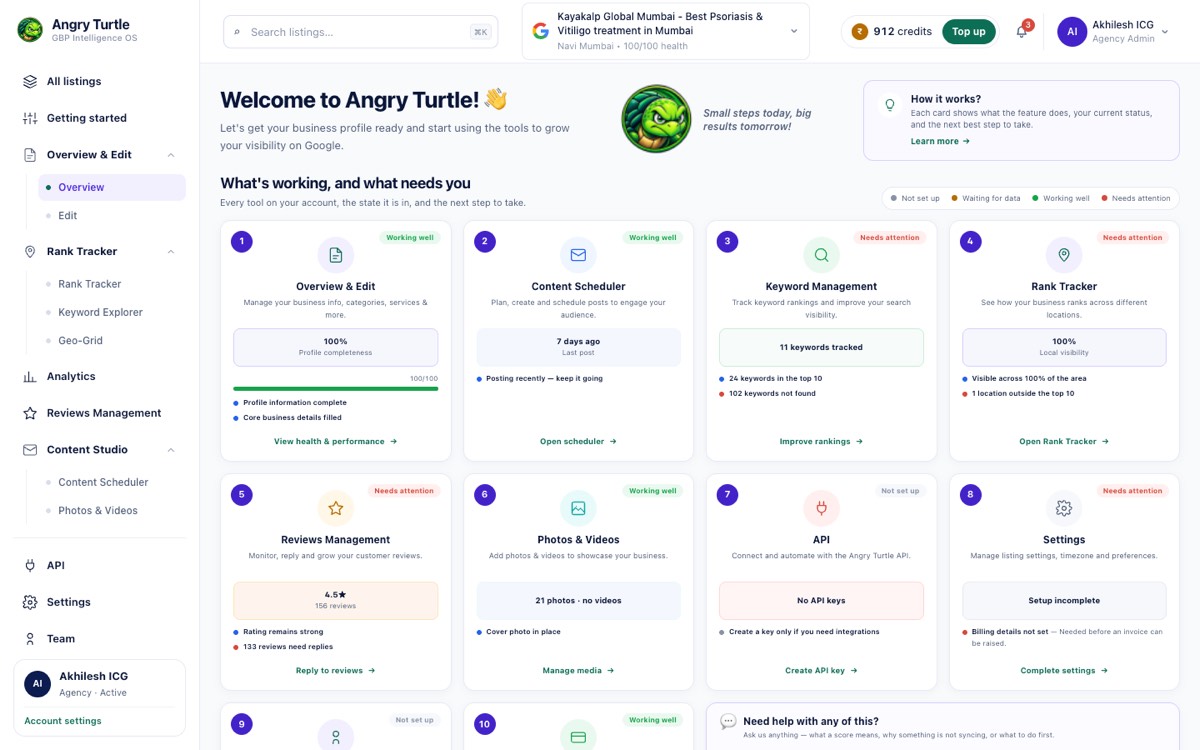
Angryturtle's platform surfaces new GBP messages inside the same dashboard used for reviews and posts, so a business or its managing agency isn't checking a separate Maps app inbox on top of everything else. Because Google doesn't expose a reply-automation endpoint for messaging, the response itself still needs a person — what the platform removes is the risk of a message getting missed because nobody thought to check. For multi-location businesses managing messaging across dozens of profiles at once, that visibility is the difference between catching a missed message in hours versus finding it during a monthly audit of every location →.
Related terms: GBP attributes → · GBP Q&A → · GBP insights → · GBP posts → · GBP API → · GBP suspension → · Conversational search → · Near-me searches → · Local search intent → · Google Business Profile →
More on this: Responding to reviews (learning centre) → · Products, services & attributes (learning centre) → · Claiming and verifying a GBP → · Managing multiple locations → · GBP Management Services →
Related glossary terms
A score you can argue with, not a black box
Rank OS gives every profile a 0–100 score built from five weighted dimensions — Relevance, Review Health, Freshness, Entity Authority and AIO Readiness — and the weights are tunable. Underneath it sits a ranked list of the fixes that move the number, each with the point lift it unlocks.
Ready to have this run for you?
Book a free audit — we'll show you where you stand in 48 hours.