 Angryturtle
What is Speakable schema?
Speakable schema is a schema.org markup type that identifies which sections of a webpage are suitable for text-to-speech extraction, telling a voice assistant or AI system exactly which paragraph or element to read aloud as the answer to a query. Rather than leaving a voice assistant to guess which part of a page is the actual answer, Speakable marks it directly.
Picture a voice assistant asked "what are Sharma Skin Clinic's hours on Sunday." Without Speakable, the assistant, or the AI system behind it, has to parse an entire page looking for something answer-shaped, and it frequently picks the wrong paragraph, or none at all. With Speakable pointing at a specific answer-capsule element, the assistant reads back exactly that sentence and nothing else.
How Speakable schema works
Speakable schema markup uses CSS selectors to point at the specific elements on a page that contain the most extractable, voice-suitable content, written as JSON-LD the same way most other schema.org markup is:
{
  "@type": "WebPage",
  "speakable": {
    "@type": "SpeakableSpecification",
    "cssSelector": [".answer-capsule", "h1 + p", ".direct-answer"]
  }
}
The elements identified this way should contain a direct, self-contained answer to the page's primary question, run roughly 40 to 70 words, a length that works for voice-optimised delivery without dragging on, and use specific, factual language rather than marketing copy. A paragraph full of vague reassurance ("we're committed to excellence") is a poor Speakable candidate even if it's technically marked up correctly, because there's no actual answer in it to read aloud.
The markup itself does no writing. It's a pointer, not a generator, so the quality of what gets read back depends entirely on the quality of the paragraph it's pointing at. Marking up a weak paragraph as Speakable doesn't strengthen it; it just makes a weak answer more likely to get read aloud faster.
Do you need a Speakable schema generator, or can you write this by hand?
Some people searching for Speakable arrive looking for a speakable schema generator, a tool that spits out ready-to-paste JSON-LD. It's worth being straight about what a generator actually does here, because the honest answer disappoints most people who search for one: a Speakable schema generator can only produce the wrapper shown above, the @type, the SpeakableSpecification, and a cssSelector array. It cannot write the answer sentence the selector points at, and it cannot know which CSS class or element on a specific page actually holds that answer, since that depends entirely on how the page's template is built.
In practice, most local businesses don't need a dedicated generator at all. The JSON-LD block is short enough to copy from the example above, swap in the actual CSS selector for the answer element on the page in question, and paste into the page's <head> or via a tag manager. The genuinely useful work isn't generating the schema, it's deciding which one or two paragraphs on the page actually deserve to be marked Speakable in the first place, and writing them so they hold up as a standalone spoken answer.
It's also worth saying plainly that Speakable is a narrow, largely news- and article-oriented schema type at its origin, and most local business pages simply don't need it. If a service page or homepage has no single sentence that reads as a complete voice answer, the more useful fix is writing that sentence, not finding a generator to wrap it.
Adoption status
Speakable is most actively used by Google's systems, and support elsewhere is uneven. Some other AI systems process it to varying degrees; adoption is growing across the broader schema ecosystem but it isn't universal the way, say, basic LocalBusiness schema is. That doesn't make it worth skipping, but it does mean it shouldn't be the first or only structured data a business implements.
This is a case where documented behaviour and widely repeated claims genuinely diverge, and it's worth separating the two. What's documented: Google introduced Speakable for eligible content types and has expanded its use over time. What's widely repeated but not independently verifiable in the way a business owner might hope: exact citation-rate lift from adding Speakable to a given page. No public source publishes that number for local business pages specifically, so this entry doesn't invent one.
Priority for AEO
Implement Speakable after FAQPage and LocalBusiness schema are already in place, not before. It amplifies the impact of existing direct-answer content, it doesn't create AEO value on its own if the underlying page has nothing worth extracting. A page with no clear answer capsule gains little from wrapping empty prose in Speakable markup; the markup is a pointer, not a content generator.
The practical sequencing that tends to work: get LocalBusiness schema and NAP data correct first, since that's the foundation everything else references. Add FAQPage schema once the page has genuinely useful, specific FAQ content, not filler questions written just to have an FAQ section. Only then add Speakable, pointed at the strongest one or two answer capsules already on the page. The broader sequencing across a full site is covered under structured data & schema.
Speakable and the wider structured-answer stack
Speakable works best paired with an answer-capsule paragraph written specifically to be extracted: a tight, self-contained answer positioned right under the H1 or H2, with the supporting detail, caveats, and context following afterward. This is the same content shape that structured answers rely on more broadly, and FAQPage schema often marks up the same or adjacent content in a complementary format. None of these schema types substitute for the others; they layer.
The relationship to answer capsules specifically is worth being precise about. An answer capsule is a content pattern, a way of writing a paragraph. Speakable is the markup that flags that paragraph to voice systems. A page can have a good answer capsule with no Speakable markup, and it still works fine for featured snippets and human readers; it just isn't flagged for text-to-speech extraction specifically. The two reinforce each other but aren't the same thing.
Speakable, the Knowledge Graph, and AI Overviews
Speakable operates at the page-content level, marking a paragraph. It's a different layer from the Knowledge Graph, which represents the business itself as an entity independent of any one page. The two connect in practice: an AI Overview answering a voice-style query often draws on both, entity data confirming who the business is and where it's located, and a Speakable-marked or otherwise well-structured passage supplying the actual sentence read back. Strong entity data without a clear answer passage still leaves the AI system needing to construct the answer itself, which is exactly the gap Speakable and answer capsules exist to close.
How to check whether Speakable is working
There's no dedicated public dashboard that reports "Speakable citation rate" the way Search Console reports impressions for organic queries. The practical check is manual: run the page's primary question through a voice assistant or a voice-enabled AI system and listen to what actually gets read back. If it reads back the intended answer-capsule sentence cleanly, the markup and the content are both working. If it reads back something else, or nothing, or a garbled fragment, the selector is likely pointed at the wrong element, or the intended element doesn't actually contain a self-contained answer.
A bad reading looks like Speakable technically validating in Google's Rich Results Test while the actual voice read-back pulls the wrong paragraph, because the CSS selector matched more than one element on the page and the assistant picked whichever one it judged more relevant. Validation passing is necessary but not sufficient; the real test is what gets read out loud.
When Speakable isn't worth implementing
Speakable isn't worth the effort on a page that has no single, self-contained answer to extract in the first place, a long-form comparison article weighing five options, a narrative case study, or a page whose value is in the reading rather than in one liftable sentence. Forcing an answer capsule onto content that's genuinely discursive by nature usually produces a stunted, out-of-place paragraph that serves the schema instead of the reader. It's also not worth prioritising on very low-traffic pages where the engineering time to maintain accurate selectors across template updates outweighs any plausible benefit, since a stale selector pointing at a moved or renamed element is worse than no markup at all, it's a silent failure that looks fine in code review and reads back nothing useful in practice. The honest test is simple: if a page doesn't already have a sentence worth reading aloud on its own, write that sentence first, or skip Speakable for that page entirely.
Common mistakes
Marking an entire page, or a whole article body, as Speakable defeats the purpose, since a voice assistant reading out several paragraphs isn't a usable voice response. The CSS selector should point at the specific short answer, not the article. Another common mistake is writing the answer capsule in vague or promotional language and then marking it Speakable anyway, assuming the schema itself will make weak content sound authoritative when read aloud. It won't; if the sentence doesn't actually answer the question when read on its own, no markup fixes that. A third mistake, easy to miss during a template rollout across many pages, is reusing the same generic CSS selector across pages that don't actually have that element, which produces valid-looking JSON-LD pointing at nothing.
India context
Hindi and regional-language voice search is growing quickly in India, and Speakable schema isn't limited to English content. It supports voice extraction in any language the page is written in, including Hindi, Tamil, and Telugu, which makes it a genuinely useful tool for Indian businesses building vernacular voice-query content rather than something that only benefits English-language sites. A clinic with a Hindi-language FAQ answering "Sharma Skin Clinic mein appointment kaise book karein" can mark that answer Speakable the same way it would an English one, and a Hindi-language voice query gets a Hindi-language read-back rather than a mismatched or English fallback.
Example
A clinic's service page includes an answer capsule: "Laser hair removal at Sharma Skin Clinic takes 15 to 45 minutes per session and typically requires 6 to 8 sessions for 80 to 90% permanent reduction." Speakable markup on this paragraph identifies it as the direct answer for voice and AI extraction, so a voice assistant reading it back gives a complete, self-contained response rather than a fragment.
What good Speakable content actually looks like
Content marked as Speakable works best around 40 to 70 words, since voice and AI extraction both optimize for brevity over completeness. It should begin with a direct answer rather than a lead-in like "that's a great question," be understandable on its own without needing the surrounding paragraph for context, and use specific, factual language rather than vague reassurance. This is close to the same shape an answer-capsule is built around, and the two concepts overlap heavily in practice.
Where this connects to voice search specifically
Because Speakable was built for voice originally, it pairs naturally with voice-local-search work and, for Indian businesses, with the kind of vernacular voice content covered at ai-overviews-hindi-india. A page answering "how long does a root canal take" in a clean, speakable block serves a Hindi voice searcher and an AI Overview citation at the same time, since both draw on the same short, self-contained passage.
Frequently asked questions
Is Speakable required for AI Overviews or ChatGPT citations? No. It's a Google-originated schema type most actively used by Google's own voice and AI systems. It can help but its absence doesn't disqualify a page from other AI systems' citations, which typically rely more on general content clarity than on this specific markup.
Does Speakable need to point at an entire FAQ block? No, and it usually shouldn't. Point it at the single strongest, most self-contained answer sentence or short paragraph, not a whole block of Q&A pairs.
How many Speakable elements should one page have? Usually one or two. A page with five or six Speakable-tagged elements is a sign the selectors are too broad, not a sign of thoroughness.
Do I need a separate page just for Speakable content? No. Speakable marks specific elements within a page that already exists, usually the direct-answer sentence at the top of a section, rather than requiring its own page or template. If a page has nothing that reads as a direct answer, the fix is to write that sentence, not to build a new page around the schema.
Does Speakable schema affect local pack ranking? Not directly. Speakable clarifies which passage a voice or AI system should extract; it isn't a ranking factor in the local pack the way review health, citations, and profile completeness are. Its job is entity and answer clarity for AI surfaces, not moving position in the three-pack.
Is there a tool that generates Speakable schema markup automatically? Generic JSON-LD generators exist for the Speakable wrapper itself, but none of them can identify which paragraph on a specific page deserves the markup or write that paragraph. For most local businesses, copying the example JSON-LD above and pointing the selector at a genuinely self-contained answer is simpler and more reliable than any generator.
Related terms: FAQPage schema → · Answer Capsule → · Voice Local Search → · Structured Data → · Structured Answer → · LocalBusiness schema → · Featured Snippet → · Schema.org → · JSON-LD → · Knowledge Graph → · AI Overview →
Angryturtle implements Speakable and the surrounding schema layer as part of managed AEO Services → engagements, alongside the GBP AI Optimization → work that feeds the same underlying entity data, the Ask Maps / AIO Readiness → scoring that tracks it, and the broader Gemini & Google AI Mode Optimization → work that covers how these signals surface in Google's newer AI-driven search surfaces.
Related glossary terms
A score you can argue with, not a black box
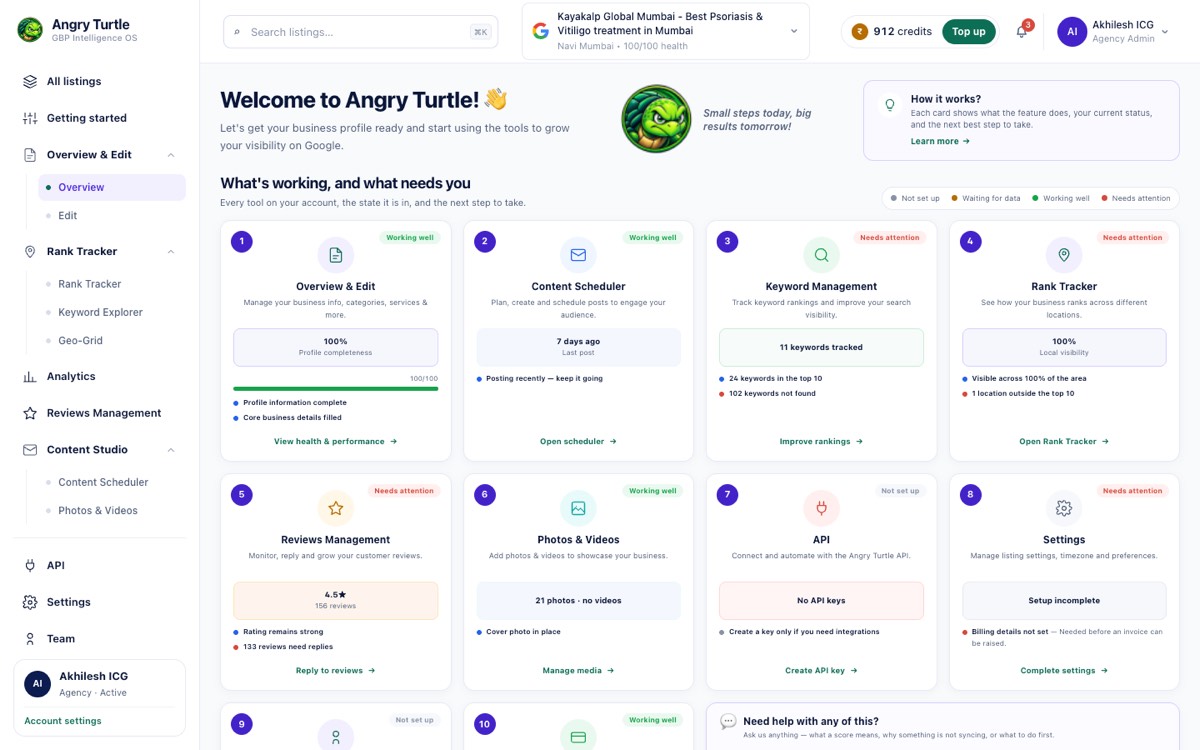
Rank OS gives every profile a 0–100 score built from five weighted dimensions — Relevance, Review Health, Freshness, Entity Authority and AIO Readiness — and the weights are tunable. Underneath it sits a ranked list of the fixes that move the number, each with the point lift it unlocks.
Ready to have this run for you?
Book a free audit — we'll show you where you stand in 48 hours.