 Angryturtle
How to Do a Local SEO Audit
A practical, do-it-yourself checklist for auditing your Google Business Profile and local search presence before you decide what to fix first.
A local SEO audit is a checklist, not a guess
A local SEO audit tells you exactly which parts of your Google Business Profile and citation footprint are costing you visibility. Do it right and you get a prioritized fix list, not a vague sense that "something's off." This guide walks through the nine checks that matter, what "good" looks like at each one, and the fix if you're not there. Run it yourself with a spreadsheet, or use Angryturtle's free audit to get the same checklist scored automatically.
If you manage more than one or two locations, the manual version below will take a full day per listing. Worth knowing before you start.
Table of contents
- GBP completeness and verification
- Category accuracy
- NAP consistency and duplicates
- Review profile health
- Geo-grid rank across your service area
- Competitor benchmark
- Website NAP and local pages
- Suspension-risk red flags
- AIO / AI-answer readiness
- Turning this into one score
- FAQ
GBP completeness and verification
Start with the basics because they're the ones businesses skip. Open your Google Business Profile and check every field: business name, primary category, secondary categories, phone, website, hours (including holiday hours), service areas, attributes, description, and at least one photo per week for the last month.
Good looks like this: verified status shows a badge, not "pending" or "suspended." Hours are current, including this month's holiday closures. The description uses your actual services, not filler. Photos are recent — Google's own data shows profiles with fresh photos get more direction requests than stale ones.
The fix, if fields are missing or stale, is to fill them directly in GBP or through a tool that writes back to Google. Angryturtle's editor shows a live preview of exactly how the profile looks on Google before you push a change, which matters because some fields (attributes especially) are category-specific and Google will silently reject a bad value rather than error out.
Category accuracy
Your primary category is one of the heaviest-weighted local ranking signals Google uses, and most businesses picked theirs years ago and never revisited it.
Pull up Google's current category list for your primary category and ask whether a more specific option now exists. A "general contractor" that does mostly kitchen remodels should probably be a "kitchen remodeler." Secondary categories should genuinely describe services you offer, not every adjacent category you can find.
Fix: change the primary category only if the more specific one is clearly what you do, since Google flags erratic category-switching. Add secondary categories that map to real service pages on your site. /product/rank-os in Angryturtle weighs relevance, including category fit, as 25 of its 100 points, so this one check alone can move the needle.
NAP consistency across Google and Indian directories
NAP means name, address, phone. Pull your NAP from Google, then check it against JustDial, Sulekha, Practo (if you're in healthcare), and IndiaMART if you list products. A four-way mismatch — different suite numbers, an old phone line, a shortened business name — confuses Google's entity matching and quietly caps how much authority those citations pass through.
Good looks like this: identical formatting everywhere, not just the same information. "Suite 4B" and "Ste 4B" read as consistent to a human and inconsistent to a matching algorithm.
Also check for duplicate listings — a second, unclaimed GBP for the same address is one of the most common causes of a stalled profile, because Google splits reviews and signals across two entities instead of consolidating them into one.
The fix is a directory-by-directory cleanup: claim duplicates and merge or delete them, update each directory to match one canonical NAP format, and log what's fixed so you're not redoing the same audit blind in six months. /product/citations-nap handles the discovery and duplicate-finding part of this automatically rather than by hand-searching nine directories. Worth saying plainly: citations are directory listings, not backlinks — they help local entity confirmation, they don't pass link equity the way a backlink does.
Review profile health
Four numbers matter here: average rating, total review count, review velocity (new reviews per month), and response rate.
A 4.6 average with 40 reviews and three new ones a month is healthier than a 4.9 average sitting on 8 reviews from two years ago — volume and velocity carry real weight, not just the star average. Response rate should be near 100%, and responses should read as written by a person who read the actual review, not a copy-pasted "Thank you for your feedback!"
If velocity has flattened, the fix usually isn't a review-gating gimmick (that's against Google's policy and a fast way to get your profile flagged). It's a simple ask built into your service flow — a QR code at checkout, a follow-up text — plus faster, specific replies to what's already coming in.
Geo-grid rank across the service area
Checking your rank from one point, usually your own office, tells you almost nothing. A geo-grid pulls your rank at a set of points spread across your actual service area, so you can see where you're strong and where you disappear three miles out.
Good here isn't a specific rank number — Angryturtle won't promise you a #1 spot, and no honest tool should. Good is a grid with no dead zones: consistent visibility everywhere a real customer might search, not a bullseye pattern where you only rank next to your own address.
The fix depends on what the grid shows. A weak zone near a competitor's location often points back to their stronger citation footprint or review density there, not something wrong with your profile in isolation. /product/geo-grid maps this automatically across your service radius so you're not guessing at which zip codes to check.
Competitor benchmark
Pick your top five local rivals, the ones actually showing up when you search your own keywords. For each, log their rating, review count, review velocity, and which citation directories list them that don't list you.
The citation gap is usually the most actionable part of this. If four of five competitors are listed on a directory you're missing, that's a specific, fixable to-do rather than a vague "do more SEO." /product/competitors builds this comparison automatically, including the citation-gap view, so you're not manually cross-referencing five businesses across nine directories by hand.
On-page and website NAP
Your website's footer, contact page, and any location pages need to match your GBP NAP exactly. Check for schema markup too — LocalBusiness structured data on your homepage or location pages helps search engines and AI answer systems confirm the same entity Google already has verified.
If you serve multiple neighborhoods or cities, each should ideally have its own page with genuinely different content, not the same paragraph with the city name swapped. A directory of ten near-identical "service in [city]" pages reads as thin to both users and Google.
Suspension-risk red flags
A handful of patterns predict a profile getting suspended or demoted before it happens: recent bulk edits to business name or category, an address that doesn't match a real, staffed location, keyword-stuffed business names ("Joe's Plumbing - Best Plumber Delhi NCR 24x7"), and a spike in flagged or removed reviews.
None of these guarantee a suspension. They raise the odds, and they're all fixable before Google notices. Revert a stuffed business name to what's actually on your signage. Confirm your listed address matches a location customers can actually visit. If reviews are getting removed at an unusual rate, check whether they were solicited in a way that violates Google's policy.
AIO and AI-answer readiness
Local search increasingly gets answered inside Google's AI Overviews and by tools like ChatGPT rather than a traditional ten-blue-links page. Whether your listing gets pulled into those answers is a separate readiness question from classic ranking.
Check whether your GBP's Q&A section (a legacy feature Google is winding down, worth noting) and your website's FAQ content actually answer the specific questions people ask about your business and category. Structured FAQ schema helps here. So does having your website content phrased as direct answers rather than marketing copy.
This is a newer, less-charted part of an audit — most local SEO checklists don't cover it yet. Angryturtle's AIO layer checks whether your profile shows up as a citable answer when these systems are asked, which most legacy audit tools simply don't measure.
How Angryturtle turns this into one score
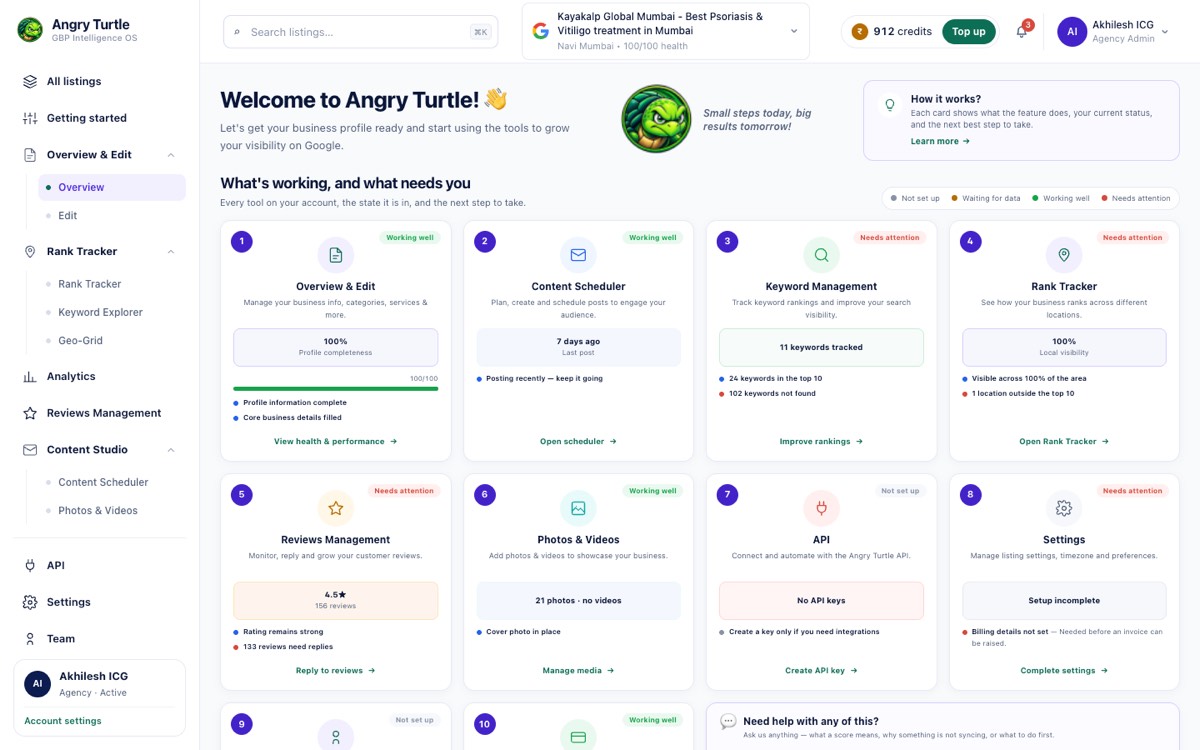
Running all nine checks by hand across even a handful of listings takes real time, and a spreadsheet doesn't tell you which fix to do first. Angryturtle's Rank OS collapses the audit into a single 0-100 score built from five weighted dimensions: relevance (25 points), review health (25), freshness (20), entity authority (15), and AIO readiness (15). The weights are visible and tunable, not a black box.
Underneath the score sits a Profile Elements grid that scores every field by presence, risk, and ranking impact, so a missing-but-low-risk attribute doesn't get the same urgency as a missing category. The competitor view maps the citation landscape automatically instead of asking you to cross-reference five businesses by hand.
None of this promises a ranking outcome. Google's algorithm isn't something any tool, including this one, controls or guarantees. What the score gives you is a prioritized, ranked list of the fixes most likely to move your profile, in the order that's most likely to matter.
You can run this audit two ways. Self-serve, where you fix things yourself inside the platform using the same scoring engine. Or managed, where Angryturtle's team handles the fixes, the citation cleanup, and the ongoing monitoring for you — see /gbp-management-services if that's the better fit for your team's bandwidth. Both paths use the same Rank OS score underneath; the difference is who's doing the fixing.
Start with the free audit if you want the checklist above scored against your actual listing rather than done by hand.
FAQ
What's the difference between a local SEO audit and a GBP audit? A GBP audit looks only at your Google Business Profile fields. A local SEO audit is broader — it includes GBP, but also citations, competitor benchmarking, on-page NAP, and increasingly AI-answer readiness.
How often should I run a local SEO audit? Quarterly for a single active location, monthly if you're managing several listings or you're in a competitive category where rivals are actively updating their profiles.
Can I do this audit myself, or do I need a tool? You can do every check above manually with a spreadsheet and some patience. A tool like Angryturtle mainly saves time and catches things (duplicate listings, category-specific attribute errors) that are easy to miss by eye.
Will fixing everything on this checklist guarantee a #1 ranking? No, and any tool or agency that promises a specific rank is overselling what anyone can control. Google's algorithm weighs signals no outside tool has full visibility into. This checklist improves the factors within your control; it isn't a guarantee.
Are citations the same as backlinks? No. Citations are directory listings of your business name, address, and phone. Backlinks are links from other websites to yours. Citations support local entity confirmation; they don't pass link equity.
What's JustDial and why does it matter for an Indian business? JustDial is one of India's largest local business directories, alongside Sulekha, Practo, and IndiaMART depending on your category. NAP consistency across these carries real weight for Indian local search the way Yelp does in the US.
More how-to playbooks
A score you can argue with, not a black box
Rank OS gives every profile a 0–100 score built from five weighted dimensions — Relevance, Review Health, Freshness, Entity Authority and AIO Readiness — and the weights are tunable. Underneath it sits a ranked list of the fixes that move the number, each with the point lift it unlocks.
Ready to have this run for you?
Book a free audit — we'll show you where you stand in 48 hours.