 Angryturtle
How to Remove a Fake or Policy-Violating Google Review
A practical, honest guide to flagging policy-violating Google reviews — since not every bad review can be removed.
Short answer
You can't delete a genuine bad review just because you don't like it. Google will only remove a review if it breaks their policies, things like a fake experience, spam, a conflict of interest, off-topic ranting, or harassment. To remove a fake or policy-violating Google review, flag it from your Google Business Profile, then escalate through GBP support with evidence if it doesn't come down on its own. Some reviews get pulled in days. Plenty never come down at all, even when they clearly should.
This guide covers what actually qualifies for removal, the exact steps to flag one, how long it realistically takes, and what to do with the review while you wait, because you'll probably be waiting.
What Google will actually remove
Google's review policy bans a specific list of things. If a review falls into one of these buckets, you have a real shot at removal. If it doesn't, you don't, no matter how unfair it feels.
Removable: reviews from someone who never used your business (a fake or "not a real visit" review), spam or gibberish content, reviews posted by a competitor or an employee (conflict of interest), reviews that are entirely off-topic (ranting about a landlord dispute on your restaurant's listing), reviews containing hate speech, threats, or someone's personal information, and reviews that are clearly duplicated or posted in bulk.
Not removable, no matter how much it stings: a genuine customer who had a bad experience and said so, even harshly. A one-star rating with no written comment. A review that's factually accurate but unflattering. A review left by someone who misunderstood your policy. Google has been direct about this for years, and it hasn't changed: legitimate negative feedback stays up. The system is built that way on purpose, so businesses can't scrub every complaint.
If you're not sure which bucket a review falls into, read it again and ask one question: did this person actually interact with the business? If the answer is yes, don't flag it. Respond to it instead.
Step 1: flag the review from your profile
Open the review from your Google Business Profile (or from Google Maps if you're checking as a consumer), click the three-dot menu next to it, and select "Flag as inappropriate." Google will ask you to pick a reason, choose the one that actually matches the violation rather than the closest-sounding option. A mismatched flag gets rejected faster than an accurate one.
This submits the review into Google's moderation queue. You won't get a case number or a clear timeline from this step alone, it's a fire-and-forget submission the first time.
Step 2: escalate with evidence if nothing happens
If two or three weeks pass with no change, the flag alone probably isn't enough. Escalate through Google Business Profile support directly (chat or the help community, depending on what's available for your account) and attach specifics: the reviewer's name if it doesn't match any customer record, the date and time in question, screenshots, and a short explanation of exactly which policy line the review breaks. Vague complaints ("this seems fake") get ignored. Specific ones ("no customer named X was on our schedule that week, and our POS shows zero transactions matching this review's description") get read.
If the review came from a direct competitor, some businesses have had success reporting it through Google's legal/policy removal request form rather than the standard flag, since that route documents intent rather than just content.
Step 3: legal action, as a genuine last resort
If a review is defamatory, meaning it states a false fact as though it were true, not just a harsh opinion, and Google won't remove it after escalation, a cease-and-desist letter or small-claims filing against the reviewer is sometimes the only remaining lever. This is slow, it costs money, and it only makes sense for reviews doing real, measurable damage. It is not a first move, and it's not guaranteed to change anything even if you win, since a legal judgment against a reviewer doesn't automatically force Google's hand.
How long removal actually takes
There's no fixed timeline. Some clearly spam reviews vanish within 48 hours of being flagged. Others sit in the queue for months. A meaningful share of flagged reviews, even ones that genuinely violate policy, never get removed at all. Google's moderation is automated first and human-reviewed second, and neither layer is fast or perfectly consistent.
Don't build a business plan around a review coming down by a specific date. Build one around what you do while it's still there.
What to do while you wait
Respond to the review publicly, calmly, and without admitting to something that didn't happen. A short, professional reply does two things: it shows every other person reading your profile that you handle criticism like an adult, and it gives Google another data point that the review is being contested, not ignored. Avoid arguing in the reply itself. State the facts you can verify, offer to resolve it offline, and stop.
If you're getting several suspicious or fake-looking reviews in a short window, that pattern itself is worth documenting, since a cluster of near-identical fake reviews is easier to argue as a coordinated attack than one review in isolation.
Where Angryturtle fits in
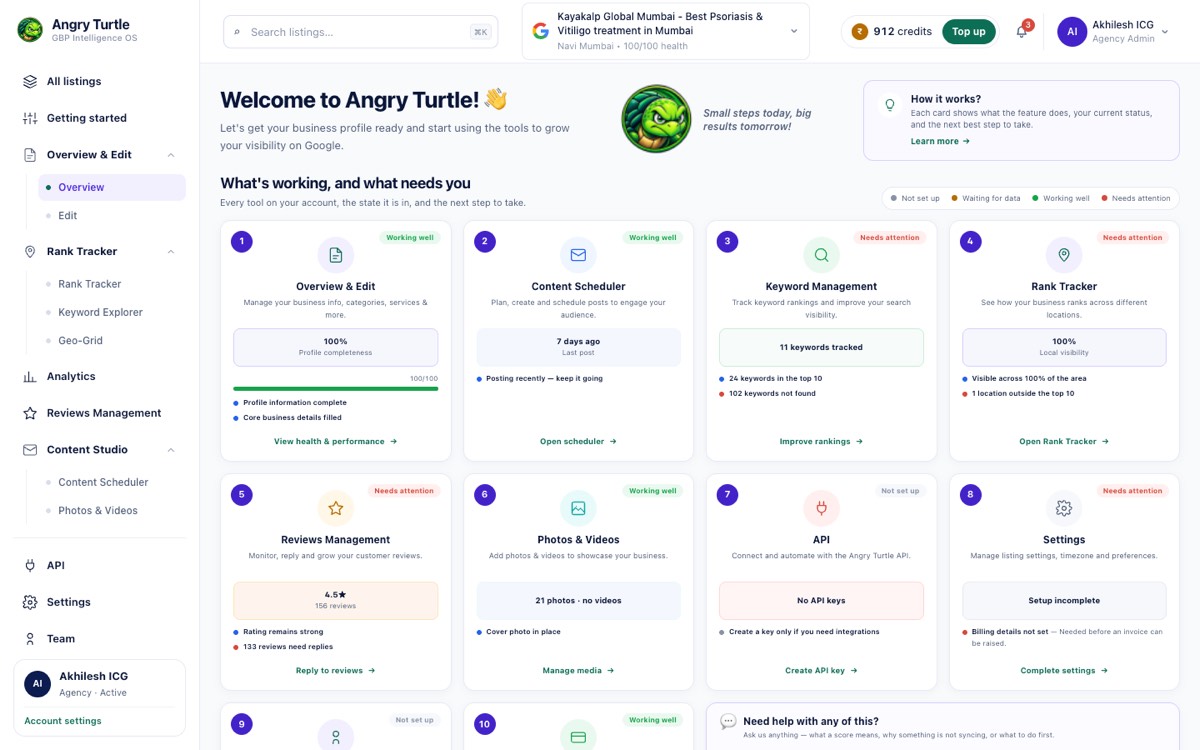
Angryturtle's review tools won't get a legitimate bad review deleted, nobody's will, but they cover the parts of this process that are easy to lose track of manually. Review integrity monitoring flags when a review disappears or gets edited, so you have a record of what happened and when, which matters if you ever need to show Google or a lawyer a timeline. The platform also supports the flag workflow directly from the dashboard instead of hunting through Google's own menus listing by listing, useful the moment you're managing more than one profile.
For the reviews that are staying up, and most will, Angryturtle drafts professional public replies grounded in the actual review content, so you're not starting from a blank box every time a one-star review lands at 11pm. That's available self-serve if you want to write and approve replies yourself, or fully managed if you'd rather a team handle review response as part of ongoing GBP management. Either way, we won't gate reviews, buy them, or help you go after a review that's simply negative but true. That's not what this is for.
See respond to negative Google reviews for the reply-writing side of this in more depth, or the full review management platform for how the monitoring and drafting tools work together. If you'd rather have a managed team run the whole review and profile workflow, that sits under GBP management services.
FAQ
Can I pay to remove a bad Google review? No. Nobody, including Angryturtle, can pay Google to remove a review. Anyone offering guaranteed removal for a fee is either lying or planning to do something against Google's terms that could get your listing suspended.
How long does Google take to remove a flagged review? There's no set window. Clear spam sometimes disappears within a couple of days. Anything more ambiguous can take weeks, and a real portion of flagged reviews are never removed even when they should be.
What if the review is from someone who was never a customer? That's one of the stronger cases for removal, a review describing an experience that never happened. Flag it as a fake or "not a real experience" review and include whatever records you have (booking system, POS, appointment log) when you escalate.
Should I ask happy customers to leave reviews to balance out a bad one? Asking real customers to share honest feedback is fine and normal. Offering incentives for reviews, or asking only people you expect to leave five stars, crosses into review-gating, which violates Google's policy and can get your whole profile penalized.
What if the reviewer posts personal information about me or my staff? That's removable under Google's harassment and personal-information policies regardless of whether the rest of the review is accurate. Flag it under that specific category and mention the personal-information issue explicitly when you escalate.
More how-to playbooks
A score you can argue with, not a black box
Rank OS gives every profile a 0–100 score built from five weighted dimensions — Relevance, Review Health, Freshness, Entity Authority and AIO Readiness — and the weights are tunable. Underneath it sits a ranked list of the fixes that move the number, each with the point lift it unlocks.
Ready to have this run for you?
Book a free audit — we'll show you where you stand in 48 hours.