 Angryturtle
Answer Engine Optimization for Retail Businesses in India
AEO for retail in India covers fashion, electronics, jewellery, grocery, and specialty retail. Primary AI citation opportunities: "near me" product availability queries ("where can I find [product] near me in [city]"), category recommendation queries ("best [store type] in [area]"), and informational queries ("is [brand] available in [city]?"). Key levers: GBP product listings, Google reviews, inventory-specific FAQ content, and attribute completeness (UPI payments, parking, store hours).
The Retail AI Search Landscape in India
Indian retail AI search spans a wide range: from hyperlocal convenience queries ("grocery store near me open now") to high-consideration purchase queries ("best jewellery store in Mumbai for diamond engagement ring"). AI is reshaping retail discovery particularly for:
Category exploration: "What are the best electronics stores in Bengaluru for laptops?" — AI compares options rather than defaulting to e-commerce suggestions.
Local availability: "Where can I buy [specific brand/product] in [city/area]?" — consumers use AI to avoid e-commerce delivery wait times for immediate need purchases.
Pre-purchase research: "Is [brand product] available in any store near [area]?" or "Which stores in Gurgaon carry [luxury brand]?"
Occasion shopping: "Good jewellery stores in Chennai for wedding shopping," "clothing stores in Mumbai with latest kurta collections"
The GBP Product Listing Advantage for Retail
Retail businesses have a unique AEO lever that healthcare and education businesses don't: GBP product listings. Each product listed in GBP creates a named product entity that AI systems can match against product-specific local queries.
The mechanism: A user asks ChatGPT: "Where can I buy a North Face puffer jacket in Bengaluru?" ChatGPT browses local search results and crawls relevant pages. A retailer with "North Face Puffer Jacket" listed as a GBP product has created an AI-matchable product entity.
Product listing strategy for retail AEO:
For fashion retail: Feature current season's top-selling items. Update monthly for new arrivals. For electronics: Feature current flagship products from major brands stocked. For jewellery: Feature signature collections and key product categories (diamond rings, gold necklaces). For specialty retail: Feature the most distinctive, query-generating products in the inventory.
Product listing format for AI extraction:
- Product name: Specific, brand-inclusive where applicable ("Lakme Absolute Mousse Foundation" not "Foundation")
- Price: Current ₹ price (update when prices change)
- Description: 1–2 sentences with specific attributes
- Photo: High-quality, well-lit product photo
The DCG Framework for Retail AEO
Diagnosis:
Retail AEO audit covers:
- GBP completeness: product listings, all applicable attributes
- Review count and recency relative to the retailers currently ranking and cited in the same category and city
- Hours accuracy (critical for "open now" and "open today" queries)
- Payment attribute completeness (UPI, cards, cash-only?)
- Online presence on relevant platforms (Flipkart, Amazon for large retailers; their own website)
Review signal by retail category:
There's no published review-count threshold for any retail category. What's directionally true: high-consideration categories (jewellery, consumer electronics, fashion) tend to sit in more contested markets with a higher competitive bar, while grocery/convenience and specialty/niche retail are usually thinner fields where a modest, well-maintained review count can lead the local category. Check the businesses actually cited for your query and city before setting a target — that's the real benchmark, not a fixed number.
Cost Optimization:
Priority 1: GBP product catalogue — list 10–20 key products with photos and prices. Zero cost, immediate AI citation eligibility for product-specific queries.
Priority 2: Attribute completeness — UPI payment, parking, hours, wheelchair access. Each attribute enables additional filter-specific AI recommendations.
Priority 3: Review building — at point of sale (QR code on receipt, billing counter), during post-purchase follow-up via WhatsApp.
Growth:
Festival product content published before each major Indian shopping festival (Diwali, Dussehra, wedding season, New Year). "New arrivals" GBP posts. Brand/category FAQ content for pre-purchase decision queries.
Retail-Specific AI Citation Opportunities
"Open now" queries:
"Pharmacy open near me now" or "supermarket open on Sunday near me" are time-sensitive AI queries with high conversion. Accurate GBP hours — including holiday hours updated proactively — are the primary enabler.
For maximum "open now" AI citation coverage:
- Set special hours for every Indian public holiday in advance
- Enable "Always open" for 24/7 businesses
- Update hours for major Indian holidays (each state has different holidays)
Price comparison queries:
AI systems sometimes answer price comparison queries by browsing retail listings. Businesses with current, accurate prices in GBP product listings are more likely to be cited for "price comparison" style queries.
Brand availability queries:
"Which stores in [city] sell [brand]?" is a query type that retail businesses can capture. The mechanism: if your GBP product listings and website content mention the specific brand names you carry, AI systems browsing for brand availability queries can extract this information.
Indian Retail Directories for AI Citations
Nykaa: For beauty and personal care retailers — Nykaa pages rank for beauty product queries and are browsed by AI systems.
Flipkart/Amazon seller pages: Large retailers with seller profiles on Flipkart and Amazon have their product listings accessible to AI systems browsing e-commerce queries.
Brand India.in: For artisan and handloom retail, Brand India directory is an AI-citable source.
Local market directories: City-specific shopping directories (Sarojini Nagar Delhi, Commercial Street Bengaluru directories) — lower DA but browsed for specific market queries.
FAQ Section
Q: Should retail businesses compete with e-commerce for AI citations? A: Retail's AI citation advantage over e-commerce is immediacy and experience — "available today," "can try in store," "physical browsing experience." Frame AI-citable content around these physical retail advantages rather than trying to compete on price with e-commerce.
Q: How does seasonal inventory affect GBP product listings? A: Update GBP product listings seasonally. Diwali collection → Diwali products listed in October; summer collection → summer products in March. Outdated product listings (showing discontinued items) reduce AI citation accuracy and may lead to customer frustration.
Q: Is neighbourhood retail different from mall retail for AI search? A: Yes — significantly. Mall retail benefits from the mall's own GBP and foot traffic. Neighbourhood retail relies entirely on its own GBP, reviews, and proximity signals for AI citations. Neighbourhood retail AEO is generally more impactful (more to gain) than mall retail AEO.
Get retail AEO from Angryturtle →
Internal links: Retail Local SEO · AEO Services · GBP AI Optimization
Retail & AI Search — Questions Answered
Q1. How do Indian retail businesses appear in AI search for "shop near me" queries?
Answer capsule: Indian retail businesses appear in "shop near me" AI queries by: verifying GBP with precise retail category (not generic "Store"), building a Google review count competitive with the shops currently cited for that category and city, listing current products in GBP product catalogue, ensuring accurate store hours including Sunday and holiday hours, and completing all UPI/payment attributes. Review standing relative to the local field and accurate hours are the two highest-impact signals for retail "near me" AI citations.
Expanded answer: "Shop near me" is the most proximity-sensitive retail AI query. AI systems resolve this through:
Proximity: GBP address coordinates determine which shops appear for "near me." Precise coordinates (right-click on the actual store entrance in Google Maps) ensure maximum proximity accuracy.
Category relevance: "Clothing Store" matches "clothing shop near me." "Store" doesn't. Category precision is the relevance gate.
Review standing: The competitive bar for retail "near me" citation is generally lower than for healthcare or restaurants. A clothing store in a residential neighbourhood may be the most-reviewed clothing retailer in that specific micro-area with a comparatively modest review count — meeting the local bar by default because the field is thin.
Hours accuracy: "Open now near me" and "shop near me open today" are high-frequency retail AI queries. Incorrect hours in GBP create AI citation friction — AI may recommend a shop as "open" that is actually closed.
Q2. Do GBP product listings help retailers appear in product-specific AI queries?
Answer capsule: Yes — significantly. GBP product listings create named product entities that AI systems can match against product-specific local queries ("where can I buy [product] in [city]"). A retailer with "Air Jordan Retro" listed as a GBP product is eligible for AI citations for "where to buy Air Jordan near me" that a retailer without product listings isn't.
Expanded answer: Product-specific local queries are an underexploited retail AI citation opportunity. Most Indian retailers don't use GBP product listings — creating a low-competition opportunity for those who do.
The mechanism: ChatGPT or Perplexity browsing "where to buy [specific product] in [city]" may browse retail GBP results pages and read GBP product listings. Retailers with the specific product listed are extracted as potential sources.
Product listing best practices for retail AEO:
Brand-inclusive product names: "Nike Air Force 1 Sneakers" not "Sneakers." Specific product names enable brand-specific query matching.
Current inventory focus: List currently available products. Outdated product listings (products no longer in stock) reduce AI citation accuracy.
Price accuracy: Current prices in GBP product listings. AI systems browsing for "price of [product] near me" extract this pricing data.
Category tags: Ensure each product is tagged with the correct category. Categories help AI systems match product queries to category-specific searches.
Q3–Q10 (Retail Q&As 3–10 — condensed):
Q3. How important is Nykaa for beauty retail AI citations? For beauty and personal care retailers, Nykaa is an important AI citation source for product-specific queries. Nykaa pages rank for beauty product queries that AI systems browse. A beauty retailer with a Nykaa seller presence has products visible on AI-browsed Nykaa pages. Additionally, Nykaa has high DA and its editorial content (beauty guides, product comparisons) is frequently cited by AI systems for beauty informational queries.
Q4. What review count do Indian jewellery stores need for AI citations? There's no published number. Jewellery is a high-consideration category, and AI systems generally treat a stronger review profile as a legitimacy signal for high-value purchases — so the effective bar tends to sit higher than in most other retail categories. The reliable method is checking the review counts of the jewellery stores actually cited for "near me" and "best" queries in your city and targeting parity with them. For wedding jewellery shopping queries specifically, review content mentioning wedding purchases ("helped us with complete bridal jewellery set for our daughter's wedding") is particularly high-value entity enrichment regardless of raw count.
Q5. How should electronics retailers approach AI search for brand/product queries? Electronics retailers have a unique AI citation opportunity: brand availability queries. "Where can I buy [specific brand] laptop in [city]" is a query that retailers stocking that brand can capture through: GBP product listings (brand listed), website content (brands stocked listed), and answers to GBP Q&A ("Q: Do you stock Dell laptops? A: Yes — we are an authorised Dell reseller with full range of Dell laptops, desktops, and accessories.").
Q6. What is the most important GBP attribute for retail stores? Store hours — including Sunday, holiday, and late-night hours — are the most important GBP attributes for retail. "Open now near me" is one of retail's highest-frequency AI queries. Accurate hours enable AI citations for these time-sensitive queries; inaccurate hours generate negative customer experiences. Update hours for every Indian public holiday (national and state-specific) proactively.
Q7. How does seasonal inventory affect retail AEO? Seasonal inventory changes require AEO maintenance: update GBP product listings for each season (Diwali collection → Diwali products in October; summer collection → summer products in March). Outdated product listings create AI citation inaccuracy — AI may recommend a retailer for a product they no longer carry. Monthly product listing review is the maintenance cadence for most Indian retailers.
Q8. Should kiranas and neighbourhood grocery stores invest in AEO? Yes — "grocery store near me open now" and "kirana near me" are high-frequency, hyperlocal AI queries with very low competition. A neighbourhood kirana store with a modest review base and accurate hours is often the only well-reviewed grocery option in its immediate radius — earning default AI citations for all local grocery queries because so few competitors have bothered to build even a small review base. Low investment, high proportional return.
Q9. How does e-commerce affect physical retail AI search in India? E-commerce has reduced overall retail foot traffic but increased the value of AI citations for physical retail — because the consumers who specifically want to buy in-store (for immediacy, for experience, for authenticity) are now more often using AI to find where to go. Physical retail's AI positioning should emphasise: "available today," "try before you buy," "authorised dealer," "expert staff" — attributes that differentiate from e-commerce.
Q10. What is the best way to build Google reviews for a retail store? Point-of-sale review generation is most effective for retail: QR code on the receipt ("Happy with your purchase? Review us here: [QR]"), QR code at the billing counter, and — for larger purchases — a WhatsApp follow-up the next day ("Hope you're enjoying your [product]. If you're happy, a quick Google review helps other shoppers find us: [link]"). Festival season purchases (Diwali, wedding season) create natural review generation opportunities with higher-than-average customer satisfaction.
A score you can argue with, not a black box
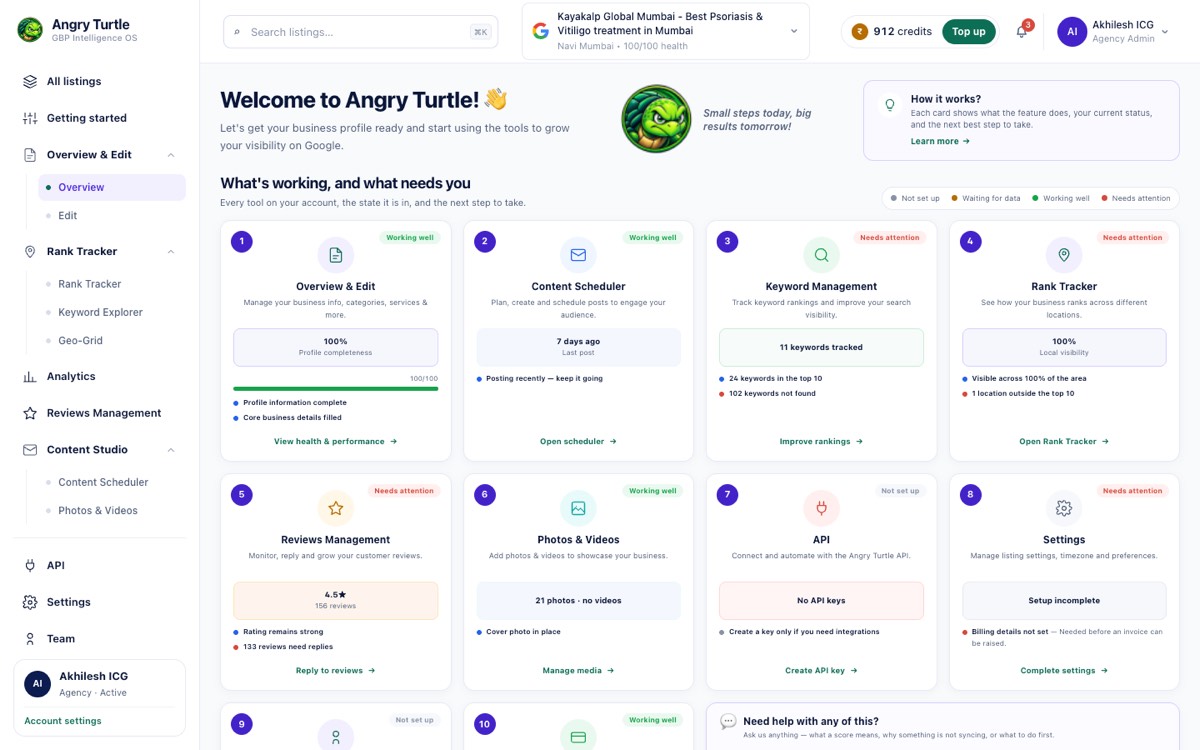
Rank OS gives every profile a 0–100 score built from five weighted dimensions — Relevance, Review Health, Freshness, Entity Authority and AIO Readiness — and the weights are tunable. Underneath it sits a ranked list of the fixes that move the number, each with the point lift it unlocks.
Ready to have this run for you?
Book a free audit — we'll show you where you stand in 48 hours.