 Angryturtle
Responding to Reviews at Scale
How to respond to Google reviews consistently at scale. SLA framework, response templates for positive and negative reviews, and the escalation protocol.
Lesson 2: Responding to Reviews at Scale
Learning objectives
By the end of this lesson you'll be able to set response SLAs by review type, write responses that read as genuine rather than templated, build a response library your whole team can use consistently, and know when a review needs to go above the standard process.
Every one of these skills builds on the review generation engine from the previous lesson — a business generating reviews without a plan to answer them is building a liability, not an asset.
Why response rate is a signal, not just good manners
Google's own guidance treats an actively managed profile as one where the owner responds. Businesses with consistently high response rates read as under active management; ones with reviews sitting unanswered for months read as abandoned, and that impression reaches customers before it reaches any ranking system. This is part of what review velocity and review health measure together — not just how many reviews arrive, but whether the business engages with them.
The customer-facing effect is arguably larger. Someone deciding between three clinics reads negative reviews more carefully than positive ones — that's just how trust works when the stakes involve a doctor or a large purchase. A calm, specific response to a one-star review often does more to convert that reader than ten five-star reviews sitting silently above it. An unanswered negative review, by contrast, is the last word on the page, and it's not yours.
The target worth holding yourself to is 100% — not "respond to negatives," all reviews, positive included, on a defined schedule.
The SLA framework
| Review type | Target response | Maximum |
|---|---|---|
| 5-star positive | 48 hours | 72 hours |
| 3–4 star mixed | 24 hours | 48 hours |
| 1–2 star negative | 12 hours | 24 hours |
| 1-star with a specific complaint | 4 hours, flagged to a manager | 8 hours |
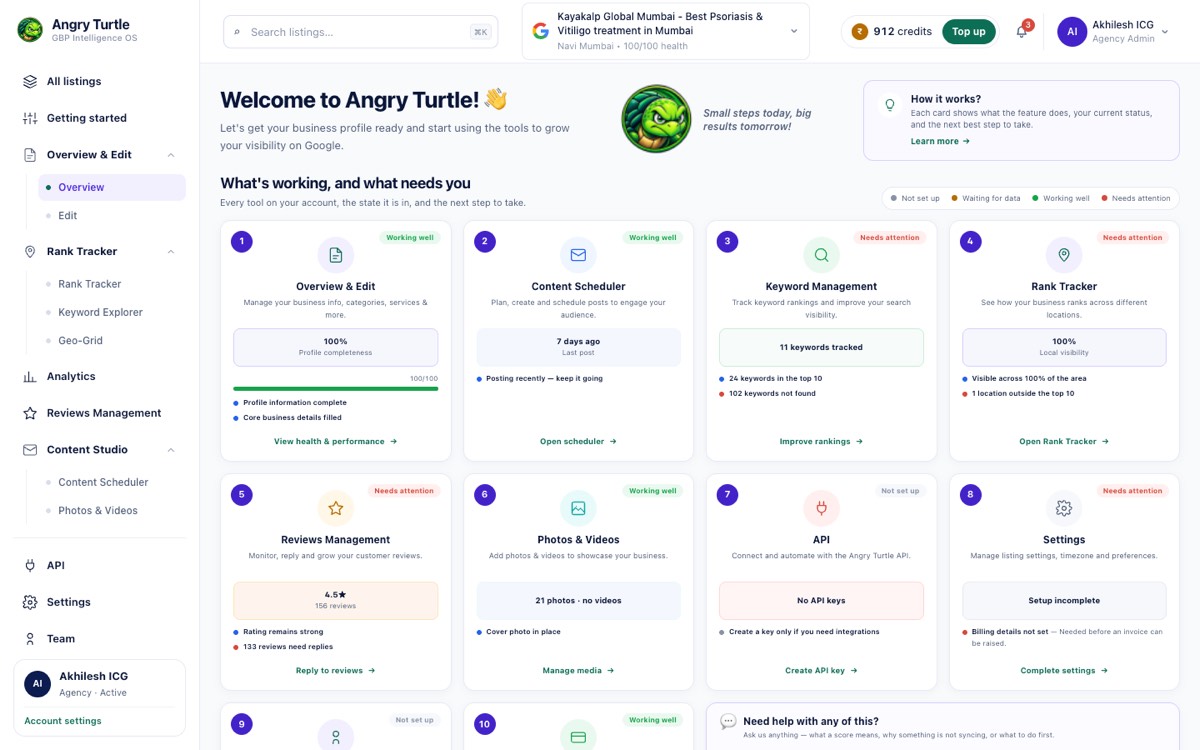
A daily or twice-daily check is enough for most single-location businesses. Multi-location brands running review volume across ten or more profiles typically need either a dedicated team member checking each morning, or a platform that surfaces new Google reviews across every profile in one place rather than requiring someone to open each listing separately — this is one of the areas where Angryturtle's review product drafts a response and routes it for one-click publishing rather than requiring a fresh login per profile.
The mechanism behind a good negative response
A response that works follows a specific order, and the order matters more than the wording: acknowledge first, explain briefly second, offer a concrete next step third. Reversing the order — explaining first, acknowledging as an afterthought — reads as defensive even when the words themselves are polite, because the reader's first impression is "this business is justifying itself" rather than "this business heard me."
A Gurgaon physiotherapy clinic got a two-star review complaining about a 40-minute wait past the scheduled appointment time. The response that worked: "Priya, we're sorry your appointment ran 40 minutes late — that's not the standard we hold ourselves to, and we understand how valuable your time is. We've adjusted our scheduling buffer for evening slots to prevent this. If you'd like to discuss further, please reach us at [contact]." Notice what's absent: no explanation of why the clinic was running behind, no mention of how busy the day was, nothing that shifts any of the blame back toward circumstance. The explanation that matters to a reader is what's being done differently, not why it happened.
Responding to positive reviews without sounding automated
The single most visible tell of neglect isn't unanswered negatives — it's a wall of identical "Thank you for your kind words! We appreciate your feedback!" replies stacked under every five-star review. A prospective customer scrolling through sees the pattern in seconds, and it reads worse than no response at all.
The fix is cheap: reference the one specific thing the reviewer actually said. If they named a dish, name it back — "so glad you enjoyed the mutton biryani, it's one of our chef's favourites too." If they named a staff member, use their name — "thank you for mentioning Dr. Priya, she'll love to hear this." Sixty to eighty words is plenty. The personalisation, not the length, is what separates a genuine response from a template.
Building a response library
Rather than writing every response from scratch, most businesses do better building eight to ten templates covering their most common review categories, each roughly 70% pre-written structure and 30% space for the one personal detail. For a clinic, that's typically: general positive, positive naming a specific doctor, positive despite a wait, negative about wait time, negative about billing, negative about staff behaviour, mixed (good service, minor complaint), and suspected fake or competitor review. The template handles the structure and the tone; the personalisation slot is what keeps each individual response from reading as copy-pasted.
For businesses with the same complaint category appearing repeatedly — wait times being the most common across healthcare and hospitality — the template is worth revisiting every few months, because a stale apology for the same unresolved problem starts to read as insincere on its third or fourth appearance.
When a review needs to skip the template
Some reviews are not standard-response material. Escalate to senior management within four hours for a one-star review alleging a safety incident, any review mentioning a potential legal issue (negligence, fraud, assault), a cluster of one-star reviews landing within 48 hours that looks coordinated rather than organic, or a review that's started getting shared publicly. For regulated categories, a healthcare review referencing specific clinical outcomes, or a BFSI review referencing specific financial advice, should go to a compliance reviewer before any public response is posted — the standard "acknowledge, explain, offer contact" template isn't built for that liability.
Everything else — the overwhelming majority of reviews any business receives — is standard template territory, personalised and published on the SLA above.
What practitioners get wrong
The most common mistake is arguing the facts in public. Even when the business is genuinely right and the reviewer's account is wrong, disputing it in the response reads badly to every future reader who wasn't there — they can't verify either version, so a defensive tone alone shifts sympathy toward the reviewer. The second is using the word "but" anywhere in a negative response — "we're sorry you had this experience, but our policy is..." — which cancels the acknowledgement that came before it. The third is treating handling fake or clearly policy-violating reviews the same way as genuine negative ones; the two require different processes, covered in the next lesson. A fourth, easy to miss, is skipping the monthly measurement step that would catch a response rate quietly slipping below the SLA.
FAQ
Should the same person always write review responses, or can it be split across a team? Splitting across a team works fine as long as everyone's using the same template library and tone guide — inconsistent tone across responses (one warm and personal, the next clipped and formal) is more noticeable to readers than most businesses expect.
Is it worth using AI to draft responses? Drafting with AI assistance and then reviewing before publishing is a reasonable way to keep response volume manageable at scale, particularly across multiple locations. The review step matters — AI drafts should be checked for accuracy and tone before anything goes live on a real profile, especially for negative reviews where the wrong word choice has more downside.
Do responses to reviews affect Google local ranking directly? Response activity is one of several signals that feed into overall entity authority and review health scoring rather than acting as an isolated ranking factor on its own. The larger effect is on the reader deciding whether to become a customer, which matters regardless of any direct ranking impact. See reviews and AI search visibility for how the same signal plays into AI citation.
What happens if I respond to a review and the customer replies again, escalating further? Take it to a private channel at that point — provide a direct contact (phone, email, WhatsApp) in your first public response so the conversation can move off the review thread once the customer engages. Continuing a back-and-forth publicly rarely helps and often looks worse to other readers than either party intends. If the pattern repeats across directories beyond Google too, the same private-channel approach applies there.
Next lesson: Handling fake and negative reviews →
A score you can argue with, not a black box
Rank OS gives every profile a 0–100 score built from five weighted dimensions — Relevance, Review Health, Freshness, Entity Authority and AIO Readiness — and the weights are tunable. Underneath it sits a ranked list of the fixes that move the number, each with the point lift it unlocks.
Ready to have this run for you?
Book a free audit — we'll show you where you stand in 48 hours.