 Angryturtle
A business with 4.6 stars and 320 reviews converts noticeably more searchers than one sitting at 3.9 stars and 40 reviews, even when the second business ranks higher. That gap is what Google Reviews actually do for a business — they're customer feedback submitted directly to a Google Business Profile, showing up prominently in both Search and Maps as an average star rating plus individual written reviews, and for most local businesses in India they're the single most visible trust signal a searcher sees before deciding to call.
How reviews affect local rank
Reviews influence local pack position through two separate mechanisms, and both matter independently. Review count and velocity — how many reviews a profile has and how steadily new ones keep arriving — function as a ranking factor inside Google's local algorithm. Average rating operates as a separate quality signal layered on top. A profile with high review velocity but a mediocre average rating will still underperform one with both high velocity and a strong rating; neither factor substitutes for the other.
Responding to reviews is itself a ranking signal
Responding to reviews, positive and negative alike, functions as a GBP engagement signal. Profiles that respond to ninety percent or more of their reviews tend to outperform profiles that ignore reviews entirely, holding other factors roughly equal. Google's own local best-practice guidance explicitly encourages review response, which is a stronger hint than most ranking factors ever get from Google directly.
This is also where response quality starts to matter beyond just the SEO mechanism. A generic "Thank you for your feedback!" copy-pasted across every review reads as neglect dressed up as engagement — a specific response that names what the customer mentioned does more for both rank and trust than volume of responses alone.
Removing or flagging a review
Google allows flagging a review for removal only when it violates actual review policy — fake reviews, spam, off-topic content, or a clear conflict of interest, such as a competitor posting a one-star review with no evidence of ever visiting. Legitimate negative reviews, even ones that are harshly worded or describe a genuinely bad experience, cannot be removed just because the business disagrees with them. The only appropriate response to a legitimate negative review is a professional, solution-oriented public reply — not an attempt to get it taken down.
Businesses that try to flag every negative review as fake, hoping something sticks, tend to waste the credibility they'd need for the rare case where flagging is actually justified.
Fake reviews are a growing problem in Indian local search
Fake review fraud runs in both directions — purchased fake positive reviews meant to inflate a struggling profile's rating, and fake negative reviews submitted by competitors trying to drag a rival down. Google's detection systems catch a meaningful share of this activity, but not all of it, and enforcement lags behind the volume in some categories more than others. The most reliable defence isn't chasing down every suspicious review individually; it's building genuine review velocity fast enough that a handful of fake reviews, in either direction, gets diluted into statistical noise rather than swinging the average.
Review generation as an ongoing process, not a campaign
Treating review generation as a one-time push — asking every customer for a month, then stopping — produces a visible spike followed by a visible plateau, and Google's velocity signal rewards steady accumulation more than a burst. A dental clinic that asks every patient for a review as a routine part of checkout, every week, builds a healthier long-term trend than one that ran a single review drive eighteen months ago and hasn't asked since.
Angryturtle's review generation engine is built around that steady-cadence principle rather than campaign spikes, and the handling fake and negative reviews guide covers the flagging process in more detail than fits here.
How Angryturtle handles reviews
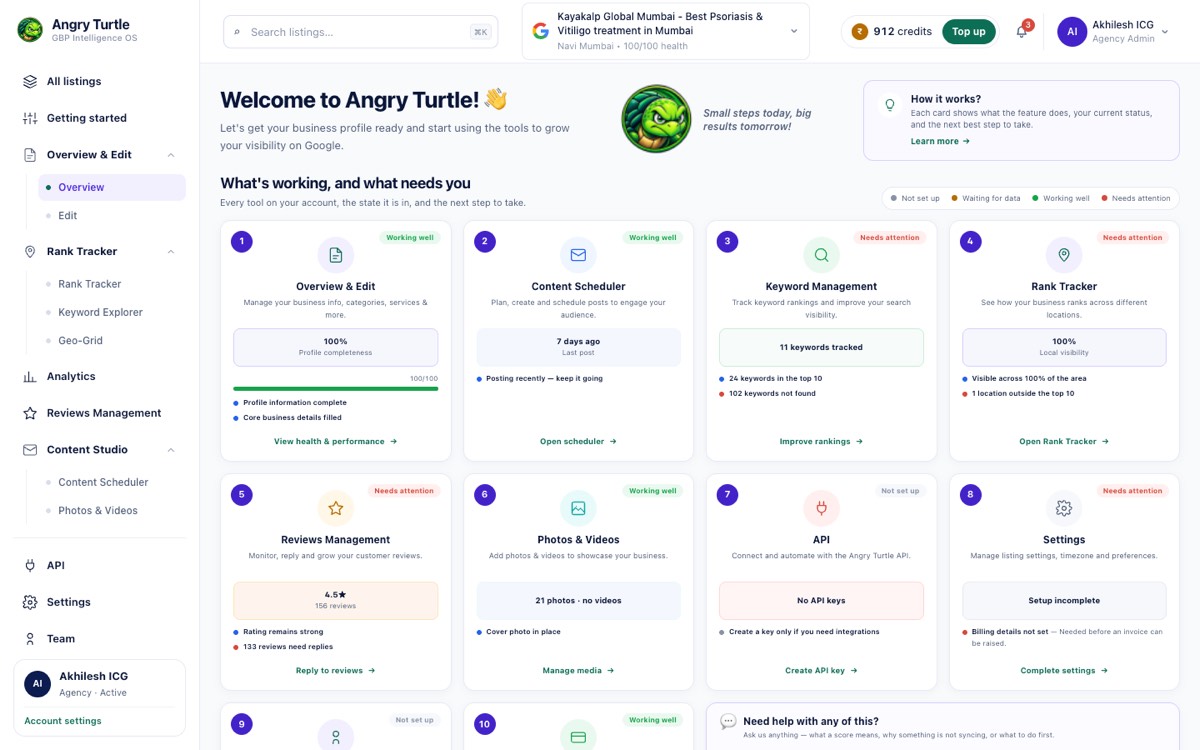
Angryturtle's platform handles the full review lifecycle — generation flows that prompt customers at the right moment, AI-assisted responses drafted within a set SLA, and fake-review flagging when something looks off — available self-serve or fully managed. This same review data also feeds directly into geo-grid analysis, since weak proximity signals in a specific zone often trace back to a lack of reviews from customers in that exact neighbourhood.
Related terms: Review velocity → · Review sentiment → · Review schema → · Geo-grid → · GBP suspension → · Google Business Profile →
India context: A Jaipur wedding photography studio's rating dropped from 4.8 to 4.3 within a week after a competitor apparently coordinated a batch of one-star reviews with near-identical wording. Flagging the pattern with Google, combined with a fast push for genuine reviews from recent clients, restored the rating within three weeks — faster than waiting on Google's review alone would have.
Related glossary terms
A score you can argue with, not a black box
Rank OS gives every profile a 0–100 score built from five weighted dimensions — Relevance, Review Health, Freshness, Entity Authority and AIO Readiness — and the weights are tunable. Underneath it sits a ranked list of the fixes that move the number, each with the point lift it unlocks.
Ready to have this run for you?
Book a free audit — we'll show you where you stand in 48 hours.