 Angryturtle
How to Stop Your Branches Competing in Local Search
When two nearby branches chase the same keywords with near-identical profiles, Google can only rank one of them.
You stop branches competing in local search by making each location's Google Business Profile distinct instead of a copy of the others: different primary and secondary categories where the real service mix differs, unique descriptions and photos, a correctly pinned address and service area per branch, and separate rank tracking per location so you can actually see which one is losing to the other. Do that and Google stops treating your two outlets as duplicate answers to the same query.
Why nearby branches end up competing with each other
This is a real, common problem, not a rare edge case. Most multi-location businesses set up every branch the same way: same category list, same boilerplate description with the city name swapped, same keyword targets on the website's location pages. Two branches five kilometers apart end up looking, to Google, like nearly identical answers to the same search. When that happens Google has to pick one to rank and suppress the other, or split visibility so both underperform. Franchise groups feel this hardest, since the store manual usually mandates identical setup across every location, which is exactly the wrong move for search. Multi-location-seo covers the underlying mechanics.
Catchment overlap makes it worse. If a customer sits roughly equidistant between two of your branches, both profiles compete for the same "near me" impression, a dynamic driven by proximity. Add near-duplicate location landing pages on the website, same 300 words, same service list, city name swapped, and you've built cannibalization into the site structure too, not just the GBP layer.
The fixes that actually separate two branches
Per-location relevance tuning is the first lever. Each branch should carry the categories that reflect what that specific location actually does, not the group's full service catalogue, a distinction laid out at gbp-categories. A branch that doesn't do same-day service shouldn't claim the category that implies it. Descriptions, primary category order, and service-area boundaries all need branch-specific edits, not a shared template.
Distinct location landing pages on the website matter just as much as the GBP fix. Each page needs its own copy, actual staff, actual hours, actual parking situation, real local landmarks a customer would recognize, not a mail-merge of the flagship page. Multi-location local SEO as a discipline exists mostly to solve this overlap problem at scale.
Service-area accuracy and pin placement close the loop. A pin sitting in the wrong part of town, or a service-area radius overlapping a sister branch's territory more than it needs to, pushes both listings into the same competitive set for no reason. Tightening the radius to match where the branch genuinely draws customers from usually recovers visibility for both locations rather than just one.
Separate geo-grid tracking per branch is what tells you the fix worked. Aggregate rank tracking across a whole account hides cannibalization; you need branch A's grid and branch B's grid side by side to know whether they're still stepping on each other a few cells outside the boundary between them.
How Angryturtle handles this
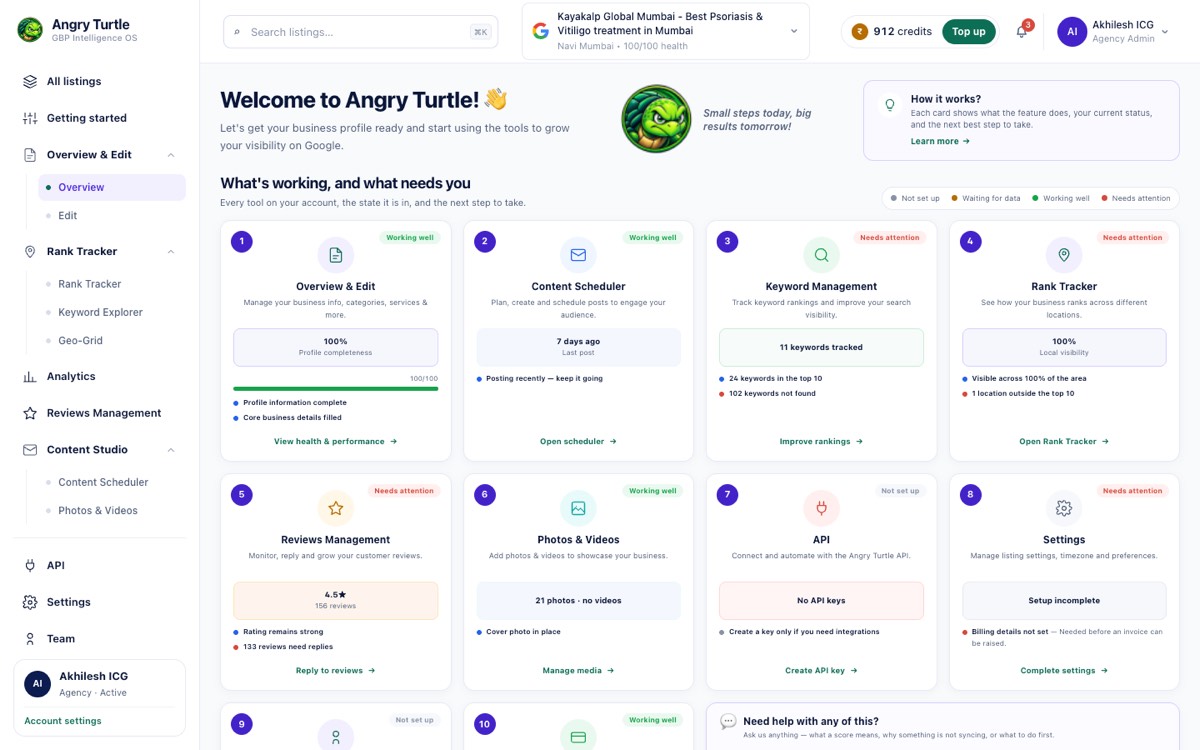
Angryturtle scores every location separately through Rank OS, so branch A and branch B each get their own score across relevance, review health, freshness, entity authority, and AI-answer readiness, rather than one blended account number that hides which location is actually losing ground.
Geo-grid tracking runs per listing too, not per account, so you can pull up branch A's heatmap next to branch B's and see exactly where the overlap sits. Geo-grid is where that comparison happens. On the editing side, category, description, and service-area changes get made inside the tool and pushed straight to the Google profile per branch through edit-to-google, so the fix isn't stuck in a spreadsheet waiting for someone to log into each listing by hand. A solo owner running two locations can do this alone; an agency managing dozens of branches for a franchise client can run it at scale with white-label reporting per location, either self-serve or through Angryturtle's managed gbp-management-services.
None of this comes with a ranking guarantee. Google's algorithm and the competitive set both shift, and fixing cannibalization improves the odds, it doesn't fix a number to a date.
FAQ
Can two branches of the same business ever rank for the same keyword without hurting each other? Yes, if the query is genuinely broad enough that both locations serve real demand for it and their service areas don't meaningfully overlap. The problem isn't shared keywords, it's shared keywords plus overlapping catchments plus identical setup.
How do I know if my branches are already cannibalizing each other? Pull rank data by branch and by grid cell, not by account average. If branch A's visibility drops in the exact cells closest to branch B, and branch B's rises in the same spot, that's the signature.
Does directory listing overlap cause the same problem? It can contribute. Duplicate or near-identical directory listings for two branches, on JustDial for instance, feed into the same NAP confusion that category overlap causes, so cleaning up categories without also checking citation consistency across directories leaves part of the problem in place.
More questions answered
A score you can argue with, not a black box
Rank OS gives every profile a 0–100 score built from five weighted dimensions — Relevance, Review Health, Freshness, Entity Authority and AIO Readiness — and the weights are tunable. Underneath it sits a ranked list of the fixes that move the number, each with the point lift it unlocks.
Ready to have this run for you?
Book a free audit — we'll show you where you stand in 48 hours.