 Angryturtle
How to Audit a Competitor's Google Business Profile
·
Open the competitor's listing before you open anything else
Auditing a competitor's Google Business Profile is mostly a matter of looking at the same fields Google gives you access to and comparing them systematically against your own, rather than anything requiring special tools or scraped data. This guide is a runnable checklist, in the order it's actually useful to work through, for figuring out what a competitor is doing that's earning them the local pack spot, the review trust, or the AI citation a business wants for itself.
What you need before starting
A working Google account signed into Maps or Search, the competitor's exact business name and approximate location, and roughly thirty minutes are all that's required. No special software or paid tool is necessary for the core audit, though a spreadsheet to log findings across multiple competitors makes the comparison easier to act on later.
The audit steps
- Search the target query on Google Maps, not just Google Search, and note where the competitor ranks in the local pack relative to the business running the audit. Local pack position is the single clearest signal of how Google currently weighs the competitor's overall profile.
- Open the competitor's listing and record their primary category and every secondary category listed. A competitor ranking above a business for a query it seems less relevant to often turns out to have a broader or more precisely matched category setup. Choosing a GBP category has the detail on why this field carries more weight than it looks like it should.
- Check the completeness of their attributes — accessibility, payment methods, service options like delivery or outdoor seating — since attribute completeness is one of the more commonly neglected fields even among otherwise strong listings. GBP attributes that convert lists what to check for specifically.
- Read their posting history and photo activity. A profile posting regularly and adding fresh photos signals to Google, and to an AI system checking for freshness, that the business is active. GBP posts frequency covers what a reasonable posting cadence actually looks like, useful as a benchmark once the competitor's cadence is logged.
- Read a representative sample of their reviews, not just the star rating. Note whether owner responses exist, how recent the most recent reviews are, and whether reviews mention specific, checkable details versus generic praise. Review response management and how to get Google reviews cover the two halves of what to look for here.
- Check their Q&A section for unanswered questions and for whether the business itself has seeded useful questions and answers rather than leaving the section to whatever users happen to post. GBP Q&A management covers this specific, easy-to-overlook field.
- Search the competitor's name alongside the target category-plus-location phrasing in ChatGPT, Perplexity, or Gemini, and note whether they're cited in the AI-generated answer and what specific detail from their listing or site the citation seems to draw from. Getting cited by ChatGPT, Gemini and Perplexity covers reading that citation for clues about what worked.
- Check their website, if listed, for the specific content formats that tend to earn AI citation — named credentials, specific numbers, FAQ sections — rather than just general page quality. Content formats AI engines lift from is the checklist to run against their site directly.
- Check for the competitor's presence on relevant third-party directories — JustDial, Practo, Sulekha, or IndiaMART depending on category — since a competitor's advantage sometimes lives outside GBP entirely, in a directory layer that's easy to overlook during a GBP-only audit. Business listing sites in India has the directory landscape to check against.
- Log every finding against the business's own current listing, field by field, and flag the three or four gaps that look most fixable first rather than trying to close every gap at once.
What this audit can't tell you
This process reveals what's publicly visible on a competitor's profile — it doesn't reveal internal decisions, ad spend, or anything Google hasn't surfaced through the interface. A competitor's local pack position also reflects proximity and Google's own ranking weighting for that specific searcher's location, so results checked from one part of a city can look different from results checked in another part of the same city. Running the search from a few different locations, or using Maps' location-override feature, gives a more complete picture than one search from one spot.
Ownership transfers, listing suspensions, and bulk category or name changes on Google's side all run on Google's own review timeline, which this audit can observe the outcome of but never predict or speed up. If a competitor's listing looks like it recently changed ownership or recovered from a suspension, that's useful context for the audit, not something a business auditing them can influence.
Turning the audit into action
The fastest wins are usually field-level gaps: a missing attribute, an unanswered Q&A, a category that's too broad. GBP optimization checklist is a good next document to run the business's own listing against once the competitor gaps are identified, since most of what closes a competitive gap is the same fundamentals-first work regardless of which specific competitor prompted the audit.
For a business running this audit across several competitors and several of its own locations at once, doing it manually location by location stops scaling quickly. Rank OS scores a listing's Relevance, Review Health, Freshness, Entity Authority, and AIO Readiness on a transparent 0-100 basis, which gives a faster comparative baseline than a manual field-by-field read once more than a couple of competitors and locations are involved, though nothing replaces actually reading the competitor's reviews and posts directly for the qualitative detail a score alone won't show.
Is it against Google's terms to audit a competitor's GBP this way? No — everything covered here is publicly visible information any signed-in user can see through Maps or Search. Nothing described requires scraping, unauthorized access, or anything outside normal use of the interface.
How often should this audit be repeated for the same competitor? Quarterly is reasonable for an active competitor in the same local market. Monthly makes sense during a specific push, like right after a competitor opens a new location or launches a visible review campaign.
Does a higher local pack position always mean a stronger overall profile? Not always. Proximity to the searcher plays a real role independent of profile quality, so a nearby competitor with a weaker overall profile can still outrank a stronger one that's slightly farther away.
Should this audit include checking a competitor's paid ads too? It's a reasonable addition if ad activity is relevant to the competitive question being asked, but it's a separate research task from the organic GBP audit this guide covers, and mixing the two tends to blur which lever actually moved which result.
For the broader diagnostic context this competitor audit often feeds into, see auditing why you're not cited in AI Overviews, and for the underlying category and attribute mechanics referenced throughout, GBP ranking factors is worth reading in full.
Stop guessing where you rank locally.
Rank OS scores your Google Business Profile the way Google's local algorithm does — relevance, review health, freshness, entity authority and AIO readiness — and shows you exactly what to fix.
Book a live demo →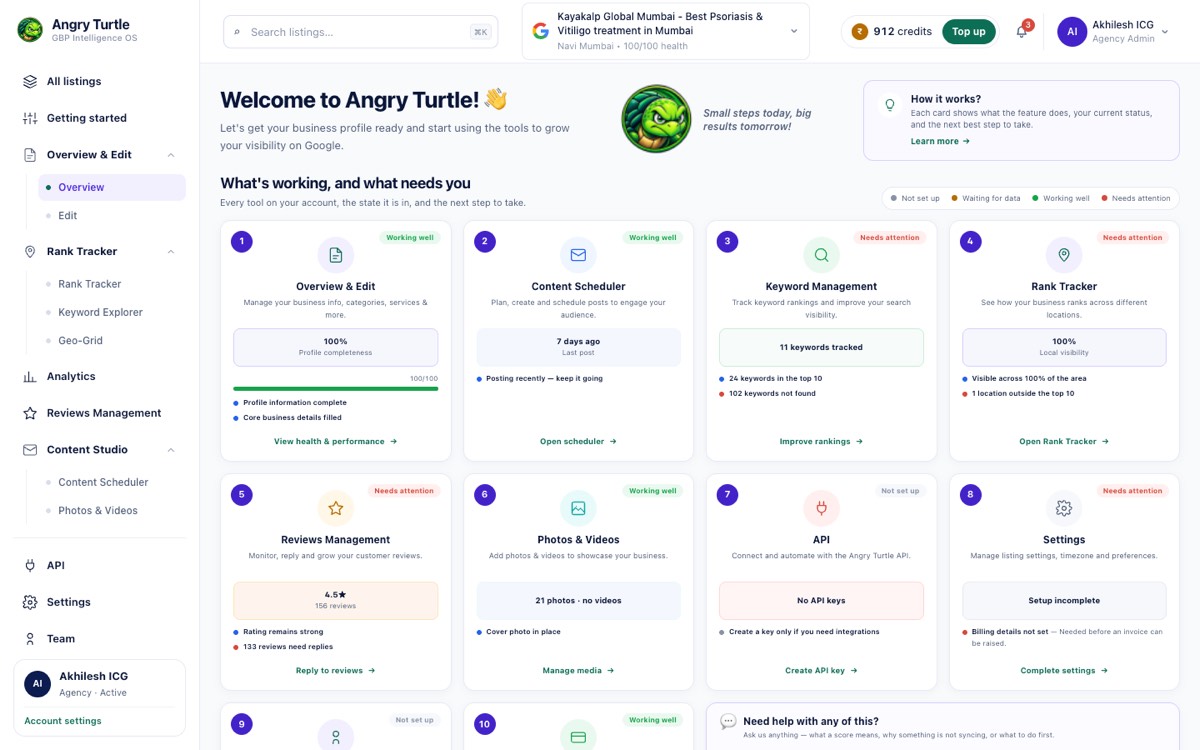

Related reading
Ready to have this run for you?
Book a free audit — we'll show you where you stand in 48 hours.