 Angryturtle
Eleven fields sit inside a Google Business Profile that most Indian businesses never touch after the day they verified. Not attributes — attributes get their own dedicated treatment in our guide to the attributes that actually convert. These are the fields underneath and around that layer: the description, the secondary categories, the service area setting, the short name, the products section, the opening date, and a handful of others that quietly do relevance and trust work every day they sit blank.
The business description most profiles waste
GBP gives 750 characters for a business description, and most Indian profiles either leave the default Google-generated text in place or fill it with a paragraph of generic praise — "we provide quality service to all our customers." Neither does any work.
A description that earns its space states what the business does, who it serves, and what specifically sets it apart, in plain sentences rather than adjectives. "Family-run orthopaedic clinic in Andheri West treating sports injuries and joint pain since 2014, with same-day X-ray on site" tells a searcher and Google's systems something concrete. Keyword stuffing here backfires the same way it does in the business name field — see GBP suspension reasons for what happens when promotional language crosses from description into policy violation.
Secondary categories left at zero
GBP allows one primary category and up to nine secondary categories, and a large share of Indian profiles use only the primary. A dermatology clinic that also runs a small aesthetics practice, for instance, is eligible for both "Dermatologist" and "Skin Care Clinic" as secondary categories, each opening up a different set of searches. Choosing the right GBP category covers how to pick the primary; the secondary slots are worth filling with the same care rather than left as an afterthought.
Service area defined for the wrong business type
A plumber, a wedding photographer, a home tutor — any business that goes to the customer rather than the other way round should be configured as a service-area business, with the physical address hidden and a defined service radius or list of areas served instead. Many of these businesses skip this setting entirely and leave a storefront-style address showing, which both misrepresents the business and, in some cases, is the exact virtual-office-style violation that leads to suspension. Setting up a service-area business covers the configuration in full.
The products section, ignored in favour of services
Services and products are two separate GBP sections, and most businesses that do the work on one skip the other entirely. Products and services structured correctly covers services in depth; products specifically matter for retail, and for any business with discrete, priced items — a bakery's cake range, a salon's product line, a clinic's diagnostic packages. Each product entry carries a name, price, description, and photo, and an empty products tab on a retail profile is a missed relevance signal every time someone searches for a specific item by name.
Opening date, left blank or wrong
The opening date field feeds into how Google's systems interpret business maturity and can affect eligibility for "new business" surfacing in some contexts. Franchise locations especially tend to leave this blank or, worse, carry over the parent brand's founding date rather than the specific branch's actual opening date — see franchise GBP management for the broader pattern of parent-brand fields bleeding into branch profiles incorrectly.
Short name and custom URL, unclaimed
GBP allows a short name — a custom handle like g.page/r/yourbusiness — and unclaimed short names default to a long, unmemorable auto-generated string. A claimed short name is easier to put on a physical sign, a receipt, or a WhatsApp message asking for a review, which connects directly to why WhatsApp review requests work better with a short, typeable link than a long one nobody bothers to click.
Booking and appointment links, missing where the business actually takes bookings
A business that takes appointments, reservations, or bookings through any online system — a clinic's patient portal, a restaurant's reservation platform, a salon's booking app — can attach that link directly to the GBP panel. Its absence means a customer has to leave the panel, find the website, hunt for a booking page, and start over, and a meaningful share simply don't bother. Adding a booking link to GBP covers the setup for the platforms Indian businesses actually use.
Special hours around Indian holidays, never updated
Regular hours are usually set correctly. Special hours for Diwali, Holi, Eid, and regional holidays are the field that goes stale, showing "open" on a day the business is actually closed, or the reverse — both of which cost a customer's trust the moment they show up to a locked door. This is exactly the kind of seasonal upkeep a monthly GBP management routine is meant to catch before it becomes a bad experience rather than a missed field.
The Q&A section, left to third parties
GBP's Q&A panel is public and anyone can post a question or answer one, and an unmoderated section frequently ends up with incorrect third-party answers sitting at the top. GBP Q&A management covers seeding it properly, though it's worth treating this one as legacy upkeep rather than a growth lever — GBP Q&A is being deprecated as a feature in some markets, so the return on heavy new investment here is limited even as basic monitoring stays worthwhile.
Why these fields go unfilled in the first place
Most of these aren't skipped out of neglect exactly — they're skipped because nobody flags them at setup. A business claims its profile, fills in name, address, hours, and category, and stops there, because that's what the verification flow itself asks for. Everything past that point is optional, unprompted, and easy to forget entirely once the profile shows up correctly on a map.
The businesses that do fill these fields tend to do it because someone specifically told them to, or because a managed service did the audit for them. Angryturtle's platform runs a completeness check against every eligible field, including these secondary ones, and its Rank OS score weights profile completeness inside its broader scoring model — not because any one field moves rank dramatically on its own, but because a profile with every field filled out consistently outperforms one that's technically live but half-finished.
Frequently asked questions
Do these secondary fields actually affect ranking, or just conversion? Both, in different amounts. Category, service area, and products carry direct relevance weight in Google's local ranking systems; description, short name, and booking links matter more for conversion and for making the profile easier to act on once a searcher finds it.
How often should these fields be reviewed once they're filled in? Quarterly for most of these — categories, service area, and products don't change often — but special hours need checking before every major Indian holiday, and the description is worth revisiting whenever the business itself changes meaningfully.
Is it worth filling in every one of these fields even for a very small, single-location business? Yes. None of these require a large team or a budget, only attention, and a single-location business with every field complete is competing against neighbours who mostly haven't bothered.
Stop guessing where you rank locally.
Rank OS scores your Google Business Profile the way Google's local algorithm does — relevance, review health, freshness, entity authority and AIO readiness — and shows you exactly what to fix.
Book a live demo →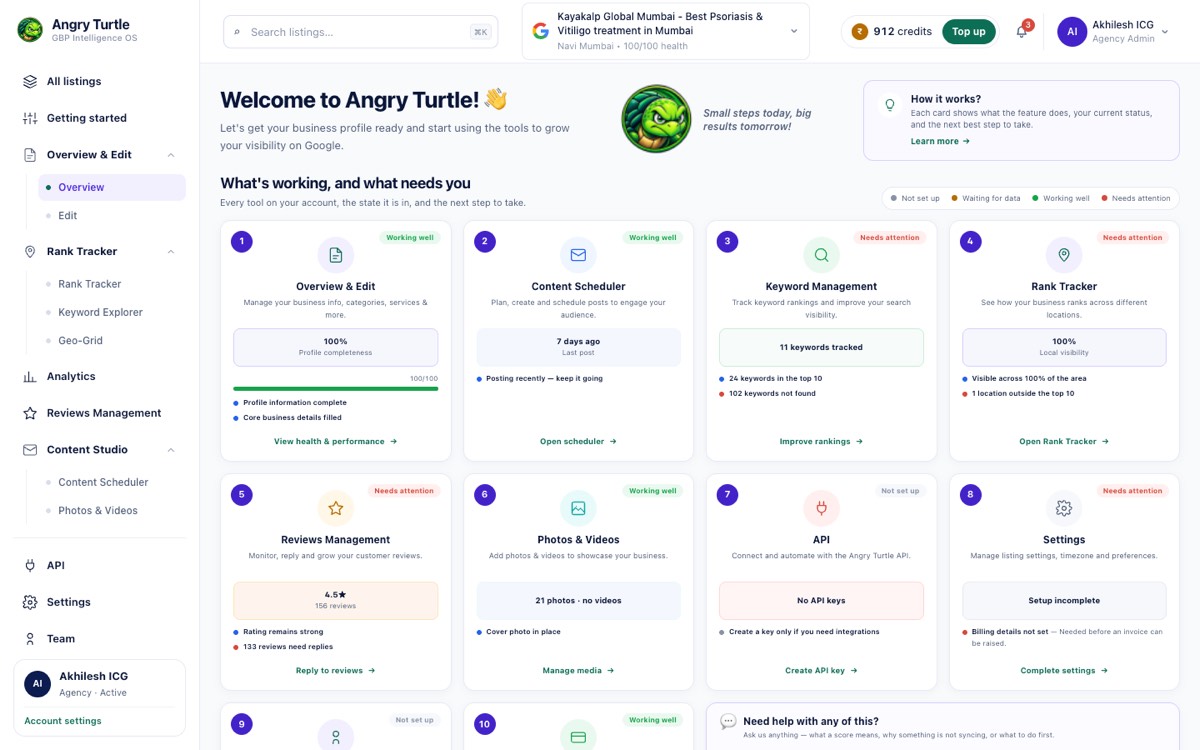

Related reading
Ready to have this run for you?
Book a free audit — we'll show you where you stand in 48 hours.