 Angryturtle
Three reasons account for most photo removals on Google Business Profile: a policy violation Google's automated moderation flagged, a copyright claim from whoever actually owns the image, or a manual "report photo" flag from a user, competitor, or unhappy former customer. Google rarely tells you which one applied, which is most of the frustration in this situation.
The removal itself is usually silent — no email, no dashboard notification in many cases, just a photo count that's lower than it was last week. Working out why matters less for getting it back than for making sure the next batch of photos doesn't get pulled the same way.
The most common reasons photos get pulled
Watermarks, logos, or promotional text overlaid on the photo are one of the most frequent triggers — Google's guidelines want photos of the actual business, not designed marketing graphics with your logo stamped in the corner. A genuinely good photo of your storefront with a small watermark added for branding purposes can still get flagged by the same automated system that catches actual stock-photo abuse.
Stock photos or images that don't depict your actual business are another common cause, especially for newer listings that used a generic "before we have real photos" placeholder and never swapped it out. Google's systems increasingly detect stock imagery even when it's been lightly edited.
Photos containing people who didn't consent to being photographed, or images that include personal information like license plates or faces in a way that raises privacy flags, can also get pulled, particularly in categories like healthcare where patient privacy is scrutinized more heavily. And straightforwardly, photos uploaded by someone who doesn't hold the rights to them — lifted from a competitor's page, pulled from a stock site without a license, or taken by a photographer who didn't transfer usage rights — are removable on copyright grounds regardless of your intent.
Was it Google, or was it a person?
If an entire batch of photos disappeared at once, that pattern usually points to an automated policy sweep rather than a single manual report, since individual user reports tend to remove one photo at a time rather than several simultaneously. A single specific photo vanishing — especially one that was doing well in terms of views — more often suggests someone flagged it directly, which could be a legitimate complaint or a competitor abusing the report tool.
There's no dashboard view that tells you definitively which one happened. What you can do is re-check the removed photo against Google's actual guidelines yourself before re-uploading anything, since re-uploading a genuine violation just repeats the cycle. It's also worth checking whether the removal happened alongside a verification hiccup — if the profile shows as needing re-verification, claiming and verifying your profile covers that separately, since photo edits sometimes surface a dormant verification issue rather than causing one.
What to do before re-uploading
Strip any overlay text, logos, or watermarks from photos going forward — plain, unedited photos of your actual space, products, team, and work are what Google's guidelines actually want, and they tend to perform better with searchers too. If the removed image was a stock photo, replace it with a genuine photo of your business rather than a different stock image; the second stock photo is just as removable as the first.
If you believe the removal was made in error — a genuine photo of your business pulled by mistake or a bad-faith competitor report — Google does allow an appeal through the photo's options menu in some cases, though resolution isn't guaranteed and the timeline varies. This sits in the same category as suspension appeals: the process exists, but the outcome is Google's call, not something a management tool can influence directly.
Building a photo strategy that doesn't keep tripping the same wire
Photos are one of the more direct freshness signals Google reads on a profile — a listing that hasn't added a new photo in months looks dormant regardless of how good the existing photos are. GBP photos best practices covers cadence and composition specifically; the short version is real, recent, unedited photos uploaded consistently rather than a large batch once a year. There's also a growing AI-search angle worth knowing about — do GBP photos help AI search visibility covers how photo completeness feeds into that separately from the ranking-freshness signal.
Category-appropriate photo types matter too — a restaurant needs food and interior shots, a clinic needs the waiting area and equipment, a hotel needs rooms and amenities. Complete profile optimisation covers how photos fit into the broader profile-completeness picture alongside attributes and the business description, which together drive most of what Google reads as an actively maintained listing. This is also part of what our GBP optimization checklist tracks across every field, not photos in isolation.
How Angryturtle handles this
Direct GBP editing includes photo and post publishing straight to your live Google profile rather than through a delayed upload queue, using the same Google Posts pipeline for scheduled content, which matters when you're trying to rebuild a photo count quickly after a removal. If the removal coincided with other flags on the account — a suspended listing, a suspicious edit pattern — GBP suspension reasons and fixing a suspended profile cover the broader account-level process, since photo removals sometimes arrive alongside those rather than in isolation.
GBP management services covers ongoing photo and content publishing as part of ongoing management if keeping a steady, compliant photo cadence isn't something your team has time to track manually every week.
Frequently asked questions
How long until Google restores a wrongly removed photo? There's no fixed timeline. Appeals that clearly show the photo complies with guidelines sometimes resolve within days; others take longer or don't get overturned at all.
Can a competitor really get my photos removed just by reporting them? A single report doesn't automatically remove a photo — Google reviews reports rather than acting on them instantly. But a genuinely borderline photo, like one with a watermark, is more likely to actually get pulled once flagged, whoever flagged it.
Should I remove watermarks from photos I've already uploaded? Yes, proactively. Re-uploading the same photo without the watermark, or replacing it with a clean version, reduces the odds of a future removal for the same reason.
Do removed photos count against my listing's overall standing? A single removal generally doesn't. A pattern of repeated removals for policy violations can contribute to a broader suspicious-activity read on the account, which is part of why fixing the underlying cause matters more than just re-uploading.
Is it worth hiring a professional photographer for GBP photos specifically? It's worth having genuinely good, real photos of your business, professionally taken or not. What matters for Google's guidelines is that they're authentic and unedited with marketing overlays, not the equipment used to take them.
Stop guessing where you rank locally.
Rank OS scores your Google Business Profile the way Google's local algorithm does — relevance, review health, freshness, entity authority and AIO readiness — and shows you exactly what to fix.
Book a live demo →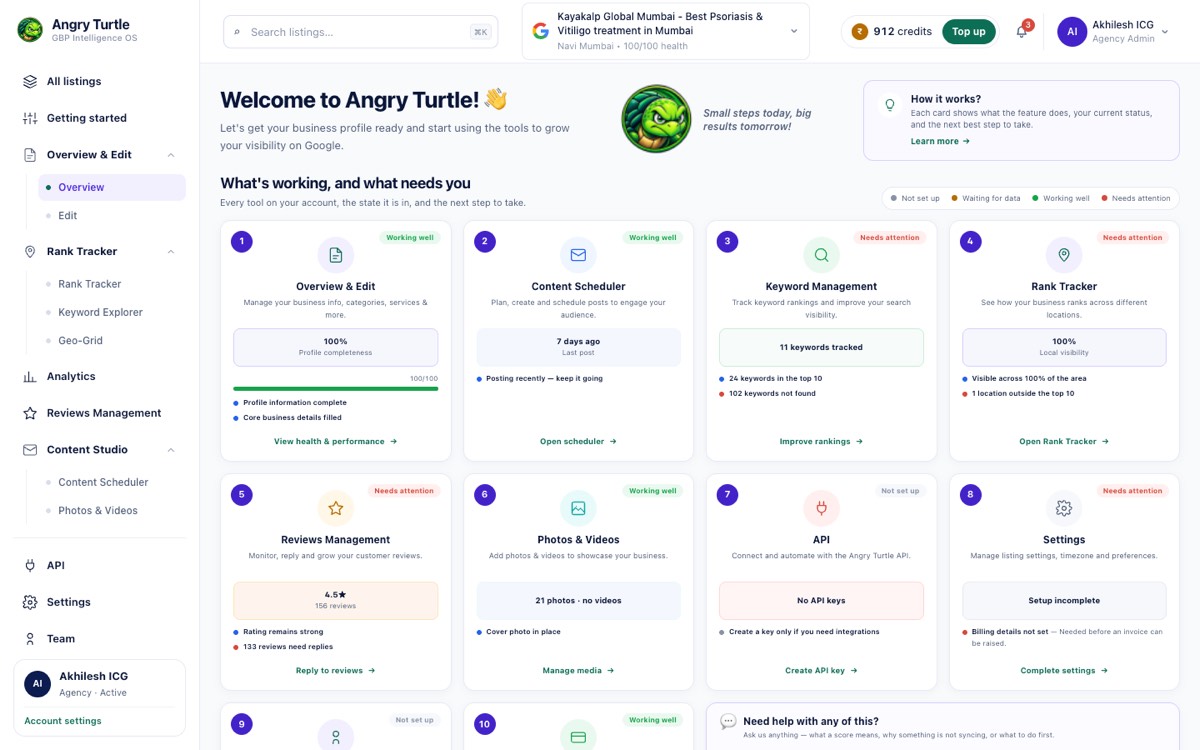

Related reading
Ready to have this run for you?
Book a free audit — we'll show you where you stand in 48 hours.