 Angryturtle
Does Geotagging Photos Help GBP Rankings? (No, and Here's Why)
·
No, geotagging your Google Business Profile photos does not help your rankings. Google strips EXIF metadata, including GPS coordinates, from images the moment they're uploaded, so any location data embedded in a photo file before upload is gone before Google's ranking systems ever see it. This is one of the longest-running myths in local SEO, repeated in enough blog posts and YouTube tutorials that a lot of genuinely careful business owners have spent real time geotagging photos that were never going to carry that signal anywhere.
Where the myth actually came from
The geotagging advice isn't a random invention. It's a leftover from an earlier era of general web SEO, where embedding location data in image files was pitched as a way to help search engines associate a page with a place, back when image metadata got more weight across search generally. Somewhere along the way that advice got copied into local SEO checklists without anyone re-checking whether it actually applied to Google Business Profile specifically, and it's been repeated ever since because it sounds plausible and it's hard to disprove without actually knowing how Google's upload pipeline works.
It also survives because it's a comfortable myth. Geotagging feels like a concrete, doable task — open a tool, add coordinates, upload — compared to the actual local ranking factors that move a profile's visibility, which are slower and less mechanical.
What Google does with a photo on upload
When a photo is uploaded to a Google Business Profile, Google's systems strip the EXIF data — the metadata block that can include GPS coordinates, camera model, and timestamp — as part of standard processing. Google already knows exactly where your business is located, because that's the address field on your profile, one of the local ranking factors that genuinely matters alongside proximity and prominence. It has no need for, and no use for, coordinates buried inside an uploaded JPEG.
This is also just how most platforms handle image uploads at scale for practical reasons that have nothing to do with SEO — stripping metadata reduces file processing overhead and avoids inadvertently publishing personal location data embedded in customer-submitted photos. Local relevance for a Google Business Profile comes from the address field, the category, the service area setting, and proximity to the searcher — not from anything written into an image file.
What photos genuinely contribute
None of this means photos don't matter. They do — just not through the mechanism most geotagging advice assumes.
Freshness is the clearest lever. Google's ranking systems read how recently a profile has been actively maintained, and photo uploads are one of the more visible content freshness signals available. A profile that hasn't had a new photo in over three weeks starts to look inactive on that dimension, regardless of how strong the rest of the listing is. Uploading photos on a regular cadence — new interior shots, product photos, team photos — is a genuine, mechanical contributor to staying fresh, in a way geotagging never was. GBP posts frequency covers the same freshness logic applied to posting cadence rather than photos specifically.
Engagement is the second lever. Photos with real content — a clear shot of a storefront, a dish, a treatment room — get more views and more clicks than generic stock imagery, and Google's systems do read user engagement with a profile as a signal of quality, visible in your own GBP Insights once you know what to look for. A photo customers actually look at is doing real work; a correctly geotagged but low-quality photo of a blank wall is not.
Multimodal understanding is the newer layer, and it's genuinely relevant to where local search is heading. As AI Overviews and other AI-driven search surfaces increasingly parse image content directly rather than relying purely on text and metadata — see multimodal search — what's actually depicted in a photo starts to matter for how well an AI system understands and can describe the business. This is a content question, not a metadata question: a photo that clearly shows what your business looks like and does contributes to that understanding regardless of any embedded coordinates, because the system is increasingly capable of reading the image itself.
What to actually do instead of geotagging
Upload real photos of your actual business, not stock imagery — interior and exterior shots, products or services in use, team photos, and anything that helps a searcher or an AI system understand what you actually offer. Upload consistently rather than in a single large batch and then nothing for months; a steady cadence feeds the freshness signal that a one-time upload doesn't. And prioritize image quality and clarity over any metadata manipulation — a sharp, well-lit photo of your storefront does more for both human clicks and AI-driven multimodal understanding than any coordinates ever embedded in the file.
GBP photos best practices covers the practical side of this in more depth — what to shoot, how often, and what customer-submitted photos versus owner-uploaded photos each contribute.
Photos and the freshness dimension in Rank OS
Freshness is one of the five weighted dimensions in Angryturtle's Rank OS scoring model, alongside relevance, review health, entity authority, and AI readiness — and photo and post recency is a direct input into that dimension, decaying after roughly three weeks of inactivity. This is worth understanding concretely rather than abstractly: it means a business that posts a fresh photo every week or two is measurably outperforming an identical business that uploaded fifty photos once and stopped, on this one dimension alone, regardless of anything either business ever did with EXIF data.
Angryturtle's Photos and Videos manager, part of the same Content Studio and GBP posting toolset, publishes directly to the live Google profile, which matters here specifically because freshness is measured by what's actually live on Google, not by what's sitting in a content calendar waiting to be uploaded.
The broader pattern: mechanical hacks versus real signals
Geotagging isn't the only local SEO myth built on a mechanical-sounding action that doesn't actually connect to anything Google measures. It's worth being skeptical generally of any local SEO tactic that sounds like a one-time trick rather than an ongoing practice — real local ranking signals are almost always about sustained behavior over time (consistent posting, accumulating genuine reviews, keeping information accurate) rather than a single clever setting to toggle once. GBP ranking factors is a fuller rundown of what actually moves a listing, for anyone who's spent time on geotagging and is now wondering what else on their checklist might not be doing what they think.
Frequently asked questions
Does adding location data to a photo's filename help, even if EXIF gets stripped? No meaningful evidence supports this either. Google's systems read the image content and the profile's own address field, not filenames. A descriptive filename doesn't hurt, but it isn't a ranking lever.
If geotagging doesn't help, why do so many local SEO guides still recommend it? Mostly inertia — it's an old piece of advice from general web SEO that got copied into local SEO checklists years ago and never re-verified against how Google actually processes Google Business Profile uploads specifically.
Do customer-uploaded photos carry the same freshness benefit as owner-uploaded ones? They contribute to overall profile activity, but owner-uploaded photos are the more direct and controllable freshness signal, since you decide exactly when they go up rather than depending on customers to upload something.
Does photo quality actually affect AI Overview or AI-search visibility specifically? As AI search surfaces increasingly parse image content directly, a photo that clearly and accurately represents your business plausibly helps an AI system describe you correctly. See GBP optimization for AI search and AI Overviews for local businesses in India for the broader picture of what feeds that kind of visibility.
See how Angryturtle keeps photo freshness and every other Rank OS dimension moving automatically.
Stop guessing where you rank locally.
Rank OS scores your Google Business Profile the way Google's local algorithm does — relevance, review health, freshness, entity authority and AIO readiness — and shows you exactly what to fix.
Book a live demo →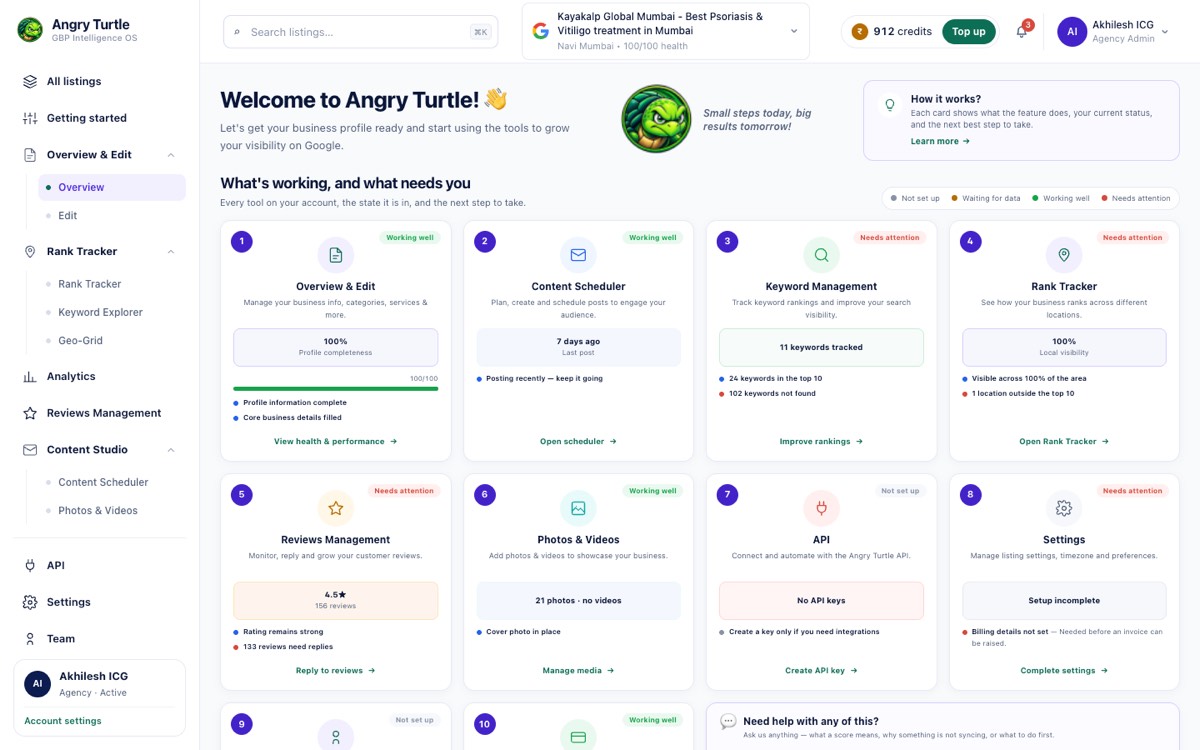

Related reading
Ready to have this run for you?
Book a free audit — we'll show you where you stand in 48 hours.