 Angryturtle
Google Business Profile Software Compared by Job
·
A dental clinic in Pune, a 12-branch NBFC, and an agency managing 80 client listings across three cities all end up typing some version of "Google Business Profile software" into a search bar. They mean three different things by it. The clinic wants one tool that tells it what to fix this week. The NBFC wants consistency across branches without forty separate logins. The agency wants a system it can run at scale without paying for scale it doesn't need yet. Same search term, three different buying decisions.
This guide breaks the category down by job rather than by feature list, because feature lists tend to look identical across vendors until you actually try to use them.
What "Google Business Profile software" covers
The category sits on top of Google's own Business Profile APIs — the same data and write access Google exposes to any developer, wrapped in a friendlier interface with added intelligence. That's true whether the vendor calls itself a "GMB tool," a "local SEO platform," or a "reputation management suite." The APIs are the same; what varies is how much of that access the vendor actually uses and how it's presented back to you.
Three real capability tiers exist inside the category, and it's worth knowing which one you're looking at. Tier one is read-only reporting: views, calls, clicks, maybe a star-rating trend. Tier two adds write access — editing the listing, posting updates, replying to reviews, all pushed live to Google. Tier three adds intelligence on top of both: a scored diagnosis of what's wrong and what fixing it is worth, plus growing coverage of whether the listing shows up as a citable answer in AI systems, not just the classic map pack.
Solo owners: one fix at a time
A solo operator with one or two locations doesn't need forty metrics. What moves the needle for this segment is a single ranked next action, applied and then checked again next week. Rank OS is built for exactly that shape of use — a 0-100 score across five weighted dimensions (relevance, review health, freshness, entity authority, and AI readiness) with a ranked list of the specific actions that would move the score most.
The trap for this segment is buying an enterprise-shaped tool because it has more checkboxes on the pricing page. Most of those checkboxes — bulk CSV export, role-based permissions, pooled credits across ten profiles — are dead weight for someone managing one listing. Free trials exist precisely so you can find out whether a tool's actual workflow suits one profile before committing.
Multi-location brands: consistency at scale
A retail chain with locations in Mumbai, Bengaluru, and Ahmedabad has a different problem entirely: keeping forty listings in sync rather than optimizing any one of them heavily. NAP consistency — identical name, address, and phone formatting everywhere the business is listed — becomes the load-bearing requirement, because inconsistent NAP data quietly erodes entity authority across every location at once, not just the one with the typo.
What this segment actually needs is bulk operations: editing a shared attribute across dozens of locations in one action, a portfolio dashboard filterable by health score or review frequency, and enough governance that a regional manager can't accidentally overwrite a corporate-approved description. Angryturtle's Agency OS architecture, while built agency-first, covers this same territory for in-house multi-location SEO teams — see the managing multiple locations guide for the operational detail Google's own dashboard doesn't surface.
Agencies: a defensible client story
An agency's requirement isn't really software features at all — it's a story it can tell a client every month that explains, in numbers the client trusts, why a listing got better or didn't. A raw metrics export doesn't do that job; a client reads "profile views up 12%" and has no idea whether that's good. A transparent, weighted score does the job, because the client can see which of the five dimensions moved and why.
The practical requirements underneath that story are white-label reporting, pooled credits so the agency isn't paying per-client for the same infrastructure, and role-based access so a project manager and a client see different views of the same data. White-label local SEO tooling exists specifically for this, and the difference between a tool built for agencies and a tool retrofitted for agencies shows up fastest in how painful bulk actions are across a real client book.
Enterprise: governance over everything
At true enterprise scale — hundreds of locations, multiple regional teams, SSO requirements from IT — the buying criteria shift again. Volume pricing and unlimited profiles matter, but so does something smaller-scale buyers rarely think about: audit trails and change history, so a compliance team can see exactly who edited what on a listing and when. Enterprise local SEO tooling typically bundles this governance layer with the same core scoring and editing capability everyone else gets, just wrapped in stricter access controls.
Where AI-answer readiness fits in
Every tier above still assumes the goal is ranking in Google's map pack. That's necessary but no longer sufficient. A separate and newer question is whether the listing shows up as a source when Google's AI Overviews, ChatGPT, or Gemini answer a question about a business in that category and city. Ask Maps and AIO readiness scores that specifically, seeding and checking a question bank per listing rather than assuming classic ranking signals carry over automatically. Most software built before 2024 doesn't touch this at all, which is worth checking for directly rather than assuming any "AI-ready" claim on a pricing page actually means this.
A short buying checklist
Confirm write-back actually reaches Google, not just the vendor's own database — ask for a live demo of a published change, not a screenshot. Confirm the scoring methodology is visible rather than a black box. Check whether citation coverage includes the Indian directory layer specifically — JustDial, Practo, Sulekha, IndiaMART — since a US-built tool's default citation list often misses these entirely; the NAP and citations basics guide covers why that gap matters more in India than in markets with fewer competing directories. And ask what happens to your data and workflows if you outgrow the plan you're starting on; migrating a hundred client listings between platforms later is far more expensive than choosing correctly now.
Frequently asked questions
What's the difference between GMB software and Google Business Profile software? None functionally. Google renamed the product from Google My Business to Google Business Profile in 2021; both terms describe the same category and are used interchangeably in search.
Does Google Business Profile software replace the need to verify a listing with Google? No. Google still owns verification and ownership of a listing. Software augments and manages a profile once it's claimed and verified — see claiming and verifying a profile for that separate step.
Is one tool enough, or do agencies typically stitch several together? It varies. A lot of agencies still stitch a rank tracker, a citation builder, and a review tool together because no single vendor covered all three well. That's exactly the gap a built-in citation engine, geo-grid, and review suite in one platform is meant to close.
How much does Google Business Profile software typically cost in India? Pricing spans a wide range, from free trials on solo plans up to custom enterprise pricing for unlimited locations. Confirm current tiers directly with a vendor rather than relying on an old pricing page, since these change.
Compare Angryturtle's approach to Google Business Profile management across all three segments.
If you are comparing products rather than learning the category, Angryturtle's GBP management software sets out what it does, what it does not, and what it costs. Teams managing profiles programmatically should read GBP API management.
Stop guessing where you rank locally.
Rank OS scores your Google Business Profile the way Google's local algorithm does — relevance, review health, freshness, entity authority and AIO readiness — and shows you exactly what to fix.
Book a live demo →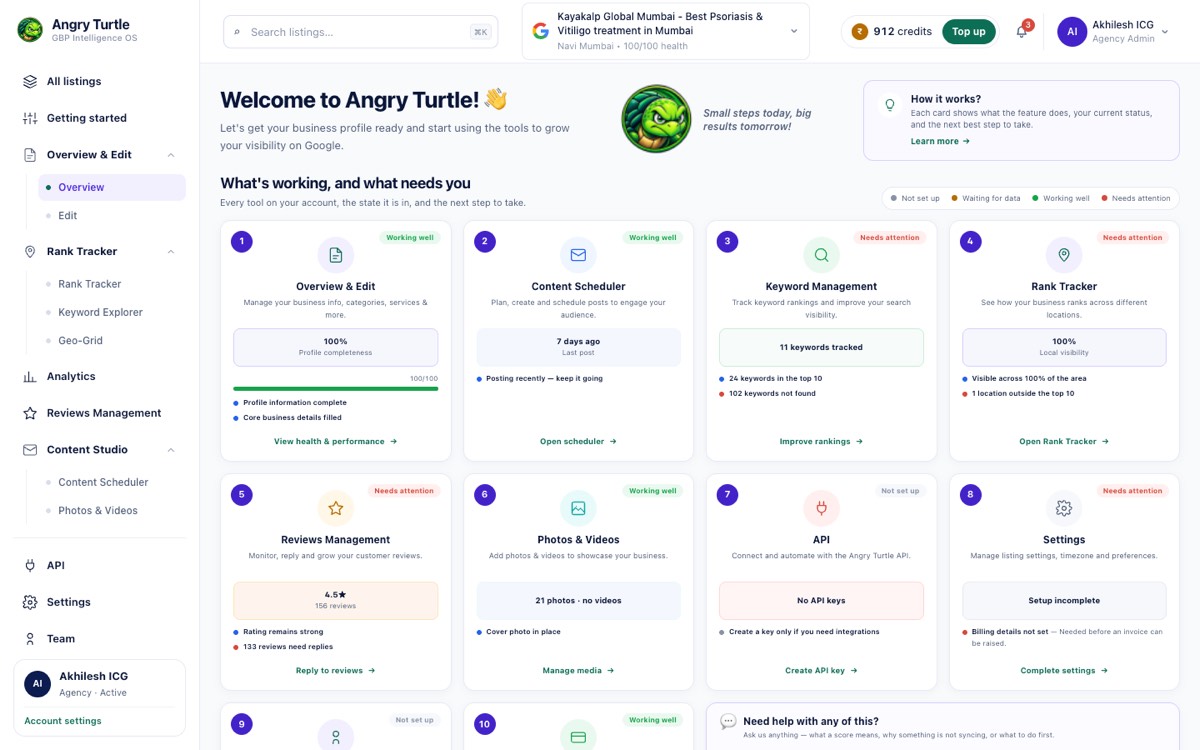

Related reading
Ready to have this run for you?
Book a free audit — we'll show you where you stand in 48 hours.