 Angryturtle
GBP management software, built for Indian businesses.
Score every profile, fix what is holding it back, and push the change live to Google — from one dashboard, priced in rupees.
·
In brief: Angryturtle is Google Business Profile management software — also called GMB management software by the many buyers who still use the product's old name — built for Indian businesses and the agencies that run listings on their behalf. It scores every profile on a 0-100 scale, tells you which fixes are worth the most, and lets you make those fixes — name, hours, categories, posts, photos, review replies — from inside the tool, with changes pushing live to Google. Pricing is in rupees, and the same platform runs both self-serve and as a managed service, including GMB management services and GBP management services for anyone who would rather hand the day-to-day off entirely.
Most people typing "gmb software" or "google business profile software" land on a review-aggregator page ranking ten tools with no real detail on any of them, or on a US-built platform priced in dollars with no idea where JustDial or Practo even fit in. Searching for the "best gmb software" usually turns up the same aggregator problem from a different angle. This page is the opposite: what the software actually does, what it costs in rupees, and where it is a poor fit.
GMB management software, GBP management software, and Google Business Profile management software — same product, different names
Google renamed "Google My Business" to "Google Business Profile" in November 2021, folding the old GMB app into an editing experience built directly into Search and Maps. The product did not disappear. The name did. Hours, categories, posts, photos and messaging that used to live inside a separate GMB app now live inside the profile itself, managed through Search, Maps, or a third-party tool like this one.
That is why search volume for "GMB software" and "GMB management software" has not dropped the way the rebrand suggests it should. A rename that happens inside Google's own product does not automatically travel to every business owner, agency, or vendor who learned the older term years ago. Agencies pitching new clients still lead with "GMB management" because that is the phrase the client already knows. Vendors, including this one, end up serving both vocabularies on the same page, because the underlying product — GMB management software, GBP management software, Google Business Profile management software — is exactly one thing regardless of which name gets typed into Google.
Angryturtle does not pick a side in that naming fight. The APIs it runs on are Google's current Business Profile APIs. The language on this page matches whichever term a reader is more likely to search.
What GBP management software actually does
Whether the search was for GMB software, GBP software, or Google Business Profile management software, the underlying job is identical. A Google Business Profile is not a static listing. It has categories, services, hours, posts, photos, questions, reviews and a stream of performance data — and each of those pieces decays or drifts if nobody is watching it. A profile that was perfectly optimised eighteen months ago and hasn't been touched since is usually worse off than one that was mediocre to begin with and gets a weekly nudge. GBP management software exists to do three things in one place: tell you the current state of a profile, tell you what to fix first, and let you fix it without opening five separate tools to do it.
Angryturtle does this through several connected pieces, working off the same underlying data rather than five disconnected dashboards bolted together after the fact. A profile gets scored once, and every recommendation the tool makes traces back to that same score — which matters, because the alternative is a pile of unranked suggestions and no way to tell which one is actually worth your Tuesday afternoon.
Rank OS — the score behind the recommendations
Rank OS is Angryturtle's own 0-100 score, built from five weighted dimensions: Relevance (25), Review Health (25), Freshness (20), Entity Authority (15) and AIO Readiness (15). These weights are Angryturtle's own tuning, not Google's — nobody outside Google publishes Google's actual ranking weights, and any vendor that claims to have reverse-engineered them exactly is guessing. What Rank OS gives you instead is a transparent, adjustable model: you can see exactly why a profile scored 61 instead of 80, which of the five dimensions is dragging it down, and which single action would move the score the most before you touch anything.
Relevance looks at categories, listed services, the description, and how well the profile's content cluster matches what nearby competitors cover. Review Health reads rating, volume, velocity and how consistently the business responds. Freshness tracks how recently posts, photos and content went up — and it decays measurably once a profile goes about three weeks without an update, which is the single most common reason a profile that "used to rank well" quietly slides. Entity Authority checks NAP consistency and citation coverage across directories. AIO Readiness, the newest dimension, checks whether the profile reads as a citable answer when an AI system — Google's own AI Overviews, or a chat assistant — is asked a question that should surface it; see the Ask Maps / AIO readiness product page for how that scoring actually works.
Each dimension's weight can be adjusted, which is the "config-tunable, not a black box" part: a franchise chain that lives or dies on review velocity might reasonably weight that dimension higher than a healthcare clinic where entity authority and citation accuracy matter more. Full breakdown of each dimension is on the Rank OS glossary page and the Rank OS product page.
Geo-grid rank tracking, not a single number
"gbp software india" searches usually come from someone who has already been burned by a rank checker that reports "you rank #3" without saying where from. A single rank position is close to meaningless for a local business, because local rank varies by location within the service area — sometimes dramatically over a few kilometres. Angryturtle's geo-grid shows rank as a heat map across the whole area a business actually serves, and a pin checker lets you drop a point at any specific lat/long or pincode and see the exact local-pack position from there. A clinic in Andheri West can rank #2 for patients three kilometres away and be invisible from Powai, and a single-point tool would never surface that gap — it would just report the one number closest to the business address and call it done.
A keyword explorer sits alongside the grid, with a list of suggested keywords the profile could realistically be tracked against based on its category and services, plus a one-click add to the active tracker rather than a manual keyword-research exercise every time. The geo-grid product page and the geo-grid glossary entry cover the mechanics in more depth, including how the grid density and radius get set per listing.
Reviews, AI-drafted replies, and the identity-image gap
Review management inside Angryturtle covers three separate jobs that most tools treat as one: reading the reviews, replying to them, and understanding what they actually say about the business as opposed to what the business says about itself. Replies can be AI-drafted with a personalised greeting and the business's own signature, then published to Google in one click rather than typed out individually — which matters most for a business getting a dozen or more reviews a week, where manual replies either fall behind or get generic.
Underneath the reply tooling sits something less common: a Brand Identity vs Brand Image comparison. Brand Identity is the canonical story the business tells about itself — its category, its positioning, what it claims to be good at. Brand Image is what the reviews, read in aggregate, say customers actually experienced. The gap between the two is frequently where the biggest and least obvious win sits: a restaurant that markets itself on ambience but whose reviews consistently praise speed of service instead is leaving its actual strongest selling point out of its own profile. That comparison feeds directly back into the Rank OS Review Health dimension rather than sitting off to one side as a report nobody reads. See the reviews & AI product page and the brand identity vs image page.
One honest limit worth stating here: Google Business Profile Q&A is on a deprecation path inside Google's own product, and Angryturtle treats it as legacy accordingly. Existing Q&A still shows where Google still shows it, but no serious feature work goes into a part of the product Google itself is winding down.
GBP posting software, on a schedule, timezone-aware
For the "gmb posting software" search specifically: Angryturtle's Content Studio schedules Google Posts to publish at the listing's own local time, not the account owner's — which sounds trivial until a business runs locations across more than one time zone, or an agency in Bengaluru is scheduling posts for a client chain with branches spread across states. Post ideas draw partly from demand clusters, the industry-aware keyword groupings that show what nearby searchers are actually asking for, and come out length-controlled and flagged for compliance-sensitive categories, but reviewed by a human before anything goes live, for the same reason any AI-drafted content pushed to a live public profile should be reviewed rather than auto-published blind. Photos and videos publish through the same calendar and the same timezone logic.
Editing the profile — and pushing the change to Google
This is the part most tools in this category cannot actually do, and it is the single strongest differentiator on this page. Angryturtle's edit-to-Google editor sits over a visual "how it looks on Google" preview and lets you change the name, description, phone, website, address, business hours, holiday hours, categories through the live Google category picker, and service areas — and the change pushes straight to the real profile on Google rather than sitting as a local draft you then have to go copy into Google's own interface by hand. Photos, posts, products, and review replies publish live the same way.
This write-back capability was confirmed working by the client team on 2026-08-02. It matters because a large share of tools in this category are read-only reporting layers, or write-capable only for a narrow subset of fields like posts and replies, leaving the core profile fields — name, address, hours, categories — to be edited manually inside Google's own dashboard anyway. Building reliable write access means handling Google's OAuth flow, update masks that avoid accidentally clearing fields you didn't intend to touch, resumable media upload for photos and videos, and correct timezone handling for anything scheduled — none of which is trivial, and all of which is invisible to a buyer until the day an edit silently fails to save.
Citations across India's directories
Citation discovery and NAP (name, address, phone) consistency checking run across 20+ platforms relevant to the Indian market, with a duplicate finder for the overlapping listings that accumulate when different staff create profiles over the years, a missing-citations list showing where the business should be listed but isn't, and a manual citations logger for the handful of directories that need a human to actually go submit a listing rather than an automated push. See the citations & NAP product page for the full mechanics, and the reinstatement service if a NAP mismatch has already triggered a suspension rather than just a slow ranking drag — the two problems look similar on the surface but need different handling.
Agencies and multi-location teams
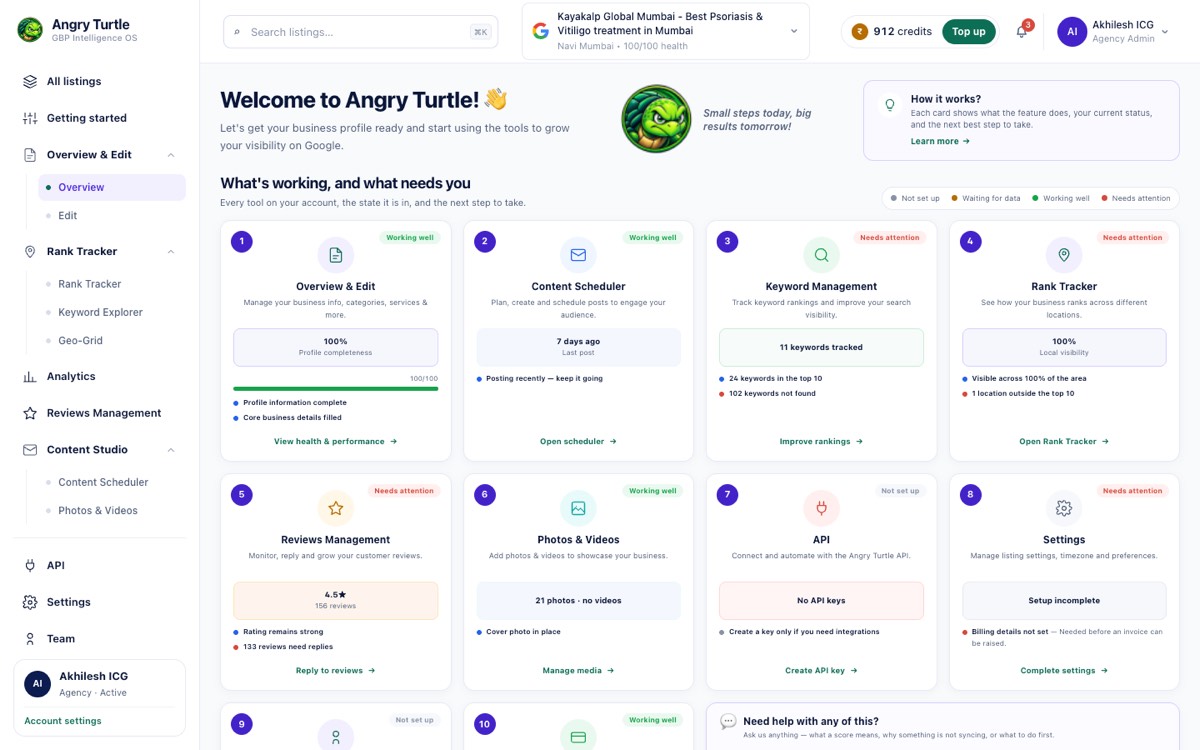
Agency OS is the multi-tenant layer underneath everything described so far. It carries roles — Agency Admin, SEO, Project Manager, Client — metered credits per listing with usage dashboards and low-credit alerts, and a portfolio view across every managed listing, filterable by health score, views trend, interaction type, review frequency, and account manager. Bulk actions and CSV export sit on top of that view for anyone managing more listings than a spreadsheet can reasonably handle. Angryturtle manages 319 GBPs across 8 industries on this exact layer today.
Agencies that describe this same layer to their own clients as "GMB management" rather than "GBP management" are describing the identical product; the vocabulary a client uses doesn't change what Agency OS does underneath it. See GMB management agency for how agencies typically position that service. Agencies planning to resell this under their own brand should look at white-label local SEO and agencies; brands running many branches under one roof, rather than an agency running many clients, should look at multi-location local SEO services, enterprise local SEO and location data management instead — the underlying scoring is the same, but the governance problem is different. The Agency OS product page has the full role and permission breakdown, and the Insights & Performance page covers the rollup reporting layer agencies present to clients.
How Angryturtle compares to other categories of GBP software
Comparing named tools by asserted feature or price invites disputes neither side can verify from outside, so the table below compares categories of tool rather than naming specific vendors' internals. See the competitors product page for how Angryturtle benchmarks against the five closest local rivals to a specific listing, which is a different comparison from the category table below. If you want a specific vendor's actual pricing or feature list, that vendor's own site is the only trustworthy source for it — including for Angryturtle.
| Criterion | Angryturtle | US-built enterprise platforms | DIY rank trackers | Review-only tools |
|---|---|---|---|---|
| India directory coverage | Built for JustDial, Practo, IndiaMART and 20+ India-relevant platforms | Usually optimised for US/UK directory networks first; India coverage varies by vendor | Not applicable — rank tracking only, no citation layer | Not applicable |
| Rupee pricing | Native ₹ pricing, no currency conversion | Usually priced in USD/GBP, converted at checkout | Varies by vendor | Varies by vendor |
| Write-back to Google | Confirmed — edits push live to the profile | Varies; several are reporting-only or partial-write; check the vendor's own product page | Read-only by design | Reply-only, no profile edit |
| Geo-grid vs single-point rank | Geo-grid heat map + pin checker at any lat/long or pincode | Some offer geo-grid at higher tiers; confirm with the vendor | Usually single-point or a simple fixed grid | Not applicable |
| AI-answer readiness | Scored as part of Rank OS (AIO Readiness dimension) | An emerging category-wide feature; check the vendor's own claims | Not covered | Not covered |
| API access | GBP Business Information, Performance, Reviews and Posts APIs, exposed in-platform | Varies by vendor and tier | Rarely exposed to the end user | Rarely exposed |
| Agency / white-label support | Multi-tenant Agency OS with roles and pooled credits | Common at enterprise pricing tiers | Rare | Sometimes, but review-focused only |
Pricing models across these categories also differ in shape, not just number: enterprise platforms often run annual contracts negotiated per location; DIY rank trackers are usually credit- or per-keyword-priced; review-only tools tend to charge per seat or per location per month. Angryturtle's own pricing structure is below.
Who this is not for
Angryturtle is not a website builder or an on-page SEO crawler — it checks a site's NAP against the GBP listing, but it does not audit page speed, on-page content, or site structure the way a dedicated SEO crawler does. It is not a backlink tool either: the citations it builds are NAP listings on directories, which is a different discipline from link-building, and the two shouldn't be conflated even though both sometimes get called "off-page SEO." It doesn't run a full social-media calendar — Google Posts publish through it, but Instagram, Facebook or LinkedIn scheduling is out of scope.
And it isn't real-time. GBP performance data carries roughly a one-month lag straight from Google's own Performance API, which is true of every tool built on that API, this one included — no vendor can report performance data faster than Google itself makes it available. A business that needs same-day web traffic numbers, or a general content and SEO platform for its actual website, should keep that separate tool running alongside this one rather than expecting Angryturtle to replace it.
Outsource GBP management or run the software yourself
Running GBP management software yourself works fine when someone on the team actually has the hour or two a week the profile needs — checking review replies, queuing a post, watching the Rank OS score after a change. That's the Solo-tier assumption: an owner-operator who wants the tool but not a second hire.
Outsource GBP management instead once one of a few things happens. The number of locations grows past what one person can watch weekly. The category is compliance-heavy enough that every post and reply needs a second set of eyes before it goes live. Or nobody on staff actually wants to own it, and it quietly stops getting touched. That last case is the expensive one — Freshness inside Rank OS decays after roughly three weeks without an update, so a profile "outsourced" to nobody ends up worse off than one that was never optimised carefully in the first place.
Angryturtle's managed tiers exist for exactly that handoff. Managed Essentials runs ₹1,499 a month plus a ₹5,000 setup fee for a single location. Managed Growth is ₹3,999 a month plus a ₹9,000 setup fee for a location that needs heavier posting and review-reply volume. Agency Partner pricing starts from ₹6,999 a month for agencies white-labelling the fulfilment under their own brand. The GMB management services and GBP management services described here and on the managed services page run on the same Rank OS score and the same write-back editor described above — the difference is who's driving it, not which product does the work.
Pricing
Self-serve plans run in rupees. Solo is ₹999/month (₹1,296.70 charged, including the platform fee and GST) for up to two profiles with 130 credits, aimed at an owner-operator running their own listing or two directly. Agency starts from ₹3,499/month for ten listings, scaling with unlimited seats and pooled credits as the client roster grows. Enterprise pricing is custom, built for unlimited profiles with SSO and volume terms.
The managed side — where Angryturtle's own team runs the profile for you rather than you running the software yourself — is priced per location: Managed Essentials at ₹1,499/month plus a ₹5,000 setup fee, Managed Growth at ₹3,999/month plus a ₹9,000 setup fee, and Agency Partner pricing from ₹6,999/month for agencies that want fulfilment handled behind their own brand. Full detail, including what's included at each tier, lives on the pricing page.
How to start
The 15-day trial runs on Solo or Agency and covers that plan's profiles and credits, which is enough to run a real Rank OS scan and see the geo-grid on your own listing before paying anything at all. Agencies evaluating the multi-tenant layer should book a demo instead of starting on the trial, since credits and roles behave differently once client portals and pooled credits are involved — a demo walks through that layer properly rather than leaving you to guess at it inside a solo-tier trial account. Either way, contact us if the right fit between your situation and a specific plan isn't obvious before you commit.
Frequently asked questions
Is this the same as Google's own Business Profile Manager? No. Google's own manager lets you edit a profile one field at a time, with no scoring, no rank tracking, and no bulk actions across multiple listings. Angryturtle sits on top of the same underlying Google APIs and adds the scoring model, the geo-grid, the citation engine and the write-back editor that Google's own interface doesn't offer.
Is GMB management software the same as GBP management software? Yes. GMB was Google's name for the product before its November 2021 rebrand to Google Business Profile. The two terms describe the same underlying platform and the same editing surface — GMB management software and GBP management software are the same category of tool, just named after the brand's old and current names.
Should I outsource GBP management or run the software yourself? Run it yourself if someone already has the weekly time to check reviews, post updates, and act on Rank OS recommendations. Outsource once locations multiply, the category needs compliance review before anything publishes, or the profile is realistically going untouched — a neglected profile loses more from Freshness decay than most owners expect. See the outsourcing section above for the specific pricing at each managed tier.
Does the software actually change my live Google listing, or just show recommendations? Both, depending on what you choose to do with a given recommendation. Rank OS shows the suggested fix and the expected point lift for making it; the editor then lets you make the change inside Angryturtle and push it straight to Google. Nothing changes on your live profile without you initiating that specific edit yourself.
How is the Rank OS score different from what Google actually uses to rank me? Nobody outside Google publishes Google's real ranking weights, so no vendor — including this one — can honestly claim to have reproduced them exactly. Rank OS is Angryturtle's own transparent, tunable model across relevance, review health, freshness, entity authority and AI-answer readiness, built as a proxy that correlates with what tends to move local rank rather than a leaked copy of Google's algorithm.
Can this software manage GBP for more than one location? Yes. The Agency and Enterprise tiers are built specifically for that, with bulk edits, a portfolio view across every listing filterable by health score and account manager, and role-based access so a brand's marketing team or an agency's client roster can be managed from one login instead of logging into each profile separately. See multi-location local SEO services for how that's typically scoped for a chain.
Is GBP posting software worth it if I only post once a month? Probably not on its own — the scheduling and timezone handling matter more once posting frequency or the number of locations goes up. At low posting volume, the bigger value tends to come from the scoring and the write-back editor rather than from the scheduler itself, so weigh the plan against what you'd actually use day to day.
What happens to the GBP Q&A features since Google is deprecating that part of the product? Angryturtle treats Q&A as legacy: it's still visible wherever Google itself still shows it, but no new feature work goes into a part of the underlying product Google is actively winding down. Anything you're relying on there should be treated as short-term, regardless of which management tool you use.
Why does performance data lag by about a month? Because Google's own Performance API reports with roughly a month's delay, and every tool built on that API — including this one — inherits the same lag. It isn't a limitation specific to Angryturtle; it's a limitation of the data source every vendor in this category is drawing from.
Do I need an agency to use this, or can a single-location owner run it themselves? Solo owner-operators are exactly the Solo tier's intended user, and the interface and recommendations are built to be actionable without an agency in between. The managed service exists alongside it for anyone who would rather hand the day-to-day execution to a team instead of doing it themselves.
Supporting reading: GBP management software for India, Google Business Profile software, GMB API tools, review management software, local rank tracking software, white-label local SEO software, and how GBP optimisation affects AI search. For a technical, API-first read of this same category, see GBP API management; for the India-specific angle on directories and rupee pricing, see local SEO software for India. If reviews are the priority, reviews and AI search visibility is worth reading alongside the reviews section above.
A score you can argue with, not a black box
Rank OS gives every profile a 0–100 score built from five weighted dimensions — Relevance, Review Health, Freshness, Entity Authority and AIO Readiness — and the weights are tunable. Underneath it sits a ranked list of the fixes that move the number, each with the point lift it unlocks.
Ready to have this run for you?
Book a free audit — we'll show you where you stand in 48 hours.