 Angryturtle
Healthcare SEO in Pune
How patients search, how Practo sits alongside Google, and how to structure multi-doctor and multi-branch profiles, for hospitals, clinics and diagnostic centres in Pune.
·
Two municipal corporations run Pune, and that split alone decides which registration papers a clinic near the PMC-PCMC boundary should be citing on its Google Business Profile. Pune Municipal Corporation covers the older core, Kothrud, and Aundh; Pimpri-Chinchwad Municipal Corporation covers the industrial belt and the approach roads into Hinjewadi. A diagnostic chain with centres in both jurisdictions that writes its address slightly differently for each — because the source documents used different civic references — ends up with citations across directories that quietly disagree with each other. That's not a minor formatting issue for a healthcare listing; it's the kind of inconsistency that erodes entity authority over months without ever throwing an obvious error. Healthcare SEO in Pune has to start here, in a way it doesn't in most other Indian cities, and a healthcare SEO agency that's never worked a Pune account is unlikely to know it matters at all.
This page covers healthcare SEO for hospitals, clinics, diagnostic centres, and individual practitioners in Pune specifically — what makes this market different from a generic national playbook, and what to check before hiring a healthcare SEO company in Pune or handing the work to a healthcare SEO agency that quotes a flat national rate without asking which corporation your clinic sits under.
Table of contents
- The PMC-PCMC split and what it does to a listing
- Hinjewadi and Kharadi versus the peth areas
- Practo alongside Google, not behind it
- Marathi in the query stream
- Multi-branch and multi-practitioner structure
- Reviews inside the compliance line
- Where this isn't worth a retainer
- What Angryturtle does for Pune healthcare accounts
- FAQ
The PMC-PCMC split and what it does to a listing
The practical fix here is boring, which is exactly why most clinics haven't done it: pick one canonical address format per location, verify it against the actual registration document rather than an old letterhead, and use that exact string identically across Google, Practo, and every directory the clinic is listed on. A location near the PMC-PCMC boundary is the highest-risk case, because the civic reference on paper can genuinely differ from what a patient assumes based on the neighbourhood name alone. This isn't unique to healthcare, but healthcare listings get flagged and reviewed more strictly than most other categories, so an inconsistency that would just look sloppy on a retail listing carries real suspension risk on a medical one.
Hinjewadi and Kharadi versus the peth areas
Hinjewadi and Kharadi are almost entirely corporate-driven for healthcare — physiotherapy, occupational health, same-day diagnostic walk-ins tied to the IT parks rather than a residential catchment, and a large share of that patient base checks whether a clinic is in-network with their corporate insurance before anything else. Baner and Aundh have grown alongside the same working population and skew toward multi-speciality clinics with extended evening hours built around office schedules. Koregaon Park and Kothrud carry the city's more established specialist practices, with longer accumulated reputations and a patient base that skews toward walk-in trust rather than insurance-network checking. The old-city peth areas run differently again — dense, long-settled neighbourhoods where a GP or dentist's Google listing mostly confirms what a neighbour already recommended, and where a large student population from outside Maharashtra adds a walk-in, price-sensitive layer that a Baner clinic rarely sees.
A Hinjewadi physiotherapy clinic writing its GBP description the way a Kothrud paediatric practice would — family-friendly language, weekend availability up front — is speaking to a patient who barely exists in that location, while missing the corporate employee booking a same-day slot on a lunch break who actually does. The fix is naming the real patient plainly: insurance networks accepted, evening hours, whether an appointment is required at all, stated in the description and attributes rather than left for a patient to guess.
Practo alongside Google, not behind it
Pune patients booking a specialist appointment, particularly in Baner, Koregaon Park, and Kothrud, check Practo for consultation fees and sub-specialty detail before or alongside a Google search, the same pattern that shows up across most large Indian cities. A Practo listing that's gone stale — a fee that's out of date, a doctor no longer practising there still shown as active — costs bookings a clean Google profile can't compensate for on its own. Scoping Practo cleanup as core work from the start of an engagement, not a later add-on, is one of the clearer signals that a Pune healthcare SEO agency actually understands this market rather than running a Google-only checklist.
Marathi in the query stream
"Dolyanche daktar" for an eye doctor, "dantavaidya" for a dentist — Marathi typed in Roman script, mixed into an otherwise English search, often alongside a locality name like Kothrud or Baner also written in Latin script. Pune's large out-of-state student population means the query mix at a single clinic can run Marathi, Hindi, and English side by side depending entirely on who's searching that day. None of this requires a bilingual rebuild of the profile. It requires the category and services list to be specific and complete, because those are the fields Google's matching system reads directly rather than infers from free text, regardless of the language or script a query arrives in.
Multi-branch and multi-practitioner structure
A physiotherapy or diagnostic chain with centres in Baner, Kothrud, and Hinjewadi runs into a structural question every multi-branch healthcare business in Pune eventually hits: a location gets its own profile only where a patient can physically walk in and be seen, and a practitioner consulting across more than one branch on a fixed schedule needs a profile referencing every facility rather than duplicating one branch's details across all of them. This breaks down most often on the Hinjewadi-to-Baner commute pattern specifically — a therapist covering both locations on alternating days, with a profile that only lists one address and leaves patients unsure where to actually book. For a hospital managing genuinely separate departments rather than branch locations, hospital SEO in India covers that particular structural decision in more depth.
Reviews inside the compliance line
Getting review volume moving in Pune doesn't require anything exotic — a QR card at the desk, a follow-up message sent a day or two after the visit, a front-desk request made once of a patient who's already said they were satisfied. An incentive of any kind, even a small discount, breaks Google's policy and isn't something Angryturtle will build into a client's workflow regardless of how the client frames the ask.
The reply constraint is where healthcare differs from every other vertical this platform works with, and it doesn't loosen for a smaller Pune clinic or a friendlier-seeming review. A reply can acknowledge a complaint and state the general standard of care the practice holds itself to. It can't confirm the reviewer was a patient, name a condition, or argue a clinical fact in public, no matter how wrong the review itself might be.
Where this isn't worth a retainer
A single-location practice with a full appointment book and no expansion plan doesn't need managed local SEO — get the category right, clean up the Practo listing once, ask happy patients for a review now and then, and stop there. If the real constraint is staffing capacity or a pricing mismatch with the insurance networks patients expect to see, more search visibility just surfaces that problem faster rather than solving it. This work changes whether a Pune practice gets found. It says nothing about the quality of care once a patient walks in, and no agency should pitch it as though it does.
What Angryturtle does for Pune healthcare accounts
A solo practitioner or a two-doctor Pune clinic can work through category correction, a Practo cleanup, and an address-consistency check across directories in an afternoon, without any platform involved. Where Angryturtle earns its keep is at the multi-branch scale, where nine correctly configured listings updated once and left alone drift out of date faster than nine listings each getting a monthly review. Rank OS scores every Pune location independently across relevance, review health, freshness, entity authority, and AIO readiness, and geo-grid tracking shows rank separately across Baner, Kothrud, and Hinjewadi rather than one averaged city figure that hides which branch is actually falling behind.
Managed GBP services cover category audits, Practo and citation cleanup, review workflows built around the compliance line above, and AI-drafted review replies that still require human sign-off before publishing. Direct write-back to Google keeps a schedule change affecting several therapists across branches from getting applied inconsistently, and if a listing has already been suspended, the GBP reinstatement service and the guide on writing a reinstatement appeal cover what the evidence needs to include.
The Pune healthcare cell goes deeper into the PMC-PCMC address mechanics and locality-by-locality detail, and the Pune hub covers the city's other sectors. The healthcare local SEO playbook and healthcare AI search readiness pages cover the platform's broader approach, and pricing covers what a managed or self-serve plan costs. Angryturtle manages 319 Google Business Profiles across eight industries, healthcare among them. Book a demo or get in touch to talk through a specific listing.
This is general guidance, not medical or legal advice, and nothing here guarantees a ranking outcome — Google's review and ranking process for healthcare listings sits outside any tool's or agency's control. Listing work changes discoverability, not clinical results, and any provider implying otherwise is overselling what this work actually does.
FAQ
Does the PMC-PCMC split actually matter for SEO, or is it administrative trivia? It matters wherever it creates address inconsistency across platforms. A chain with locations under both corporations needs one verified, canonical address format per location, or citation mismatches quietly erode entity authority over time without ever throwing an obvious error.
Should a Hinjewadi clinic's profile read differently from one in Kothrud? Yes. Hinjewadi's patient base is largely corporate and insurance-driven, while Kothrud runs closer to a family-practice, walk-in-trust model, and the description and attributes should say so plainly rather than using identical language for both.
Is Practo worth the same attention as Google for a Pune specialist practice? Yes, particularly in Baner, Koregaon Park, and Kothrud, where patients frequently check Practo's fee and sub-specialty detail before or alongside a Google search. A stale Practo listing costs bookings a strong Google profile can't make up for.
How should a multi-branch chain handle a therapist who works at two locations? Give that practitioner a profile referencing both facilities rather than duplicating either one's details, and keep the schedule current at each so patients aren't left guessing where to book.
Can a healthcare review reply in Pune ever confirm what a patient was treated for? No — never, regardless of how the review is worded or how factually wrong it might be. Acknowledge the complaint, state the practice's general standard of care, and take specifics to a named offline contact instead.
What's the fastest fix for a Pune clinic that's stalled in local search? Category accuracy and a complete services list, almost always, before review volume. A listing with a precise category and full services list frequently outranks one with more reviews but a generic category, on the locality-specific searches that actually convert.
Stop guessing where you rank locally.
Rank OS scores your Google Business Profile the way Google's local algorithm does — relevance, review health, freshness, entity authority and AIO readiness — and shows you exactly what to fix.
Book a live demo →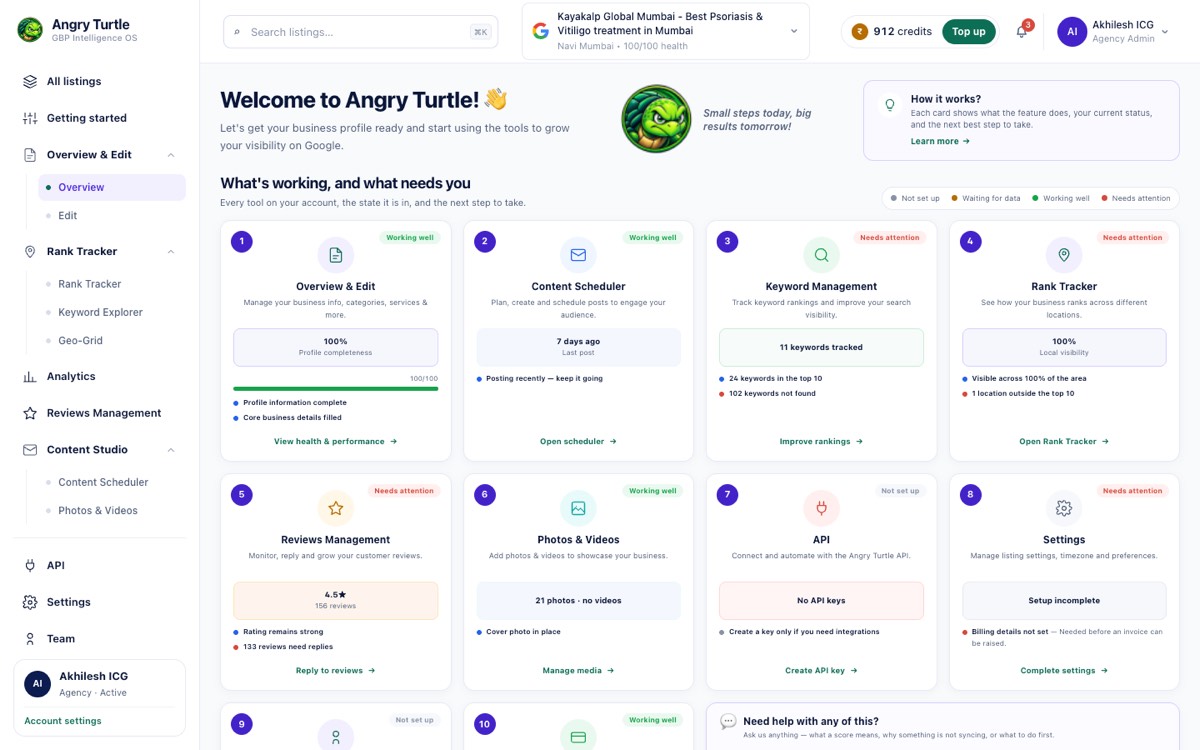

Related reading
Ready to have this run for you?
Book a free audit — we'll show you where you stand in 48 hours.