 Angryturtle
Benchmarking Local Performance Without Fake Industry Averages
·
Someone will eventually ask you: "is a 4.3 rating good for a clinic?" or "what's a normal review response rate?" and you'll want a number to hand them. This piece is going to disappoint that instinct on purpose. There is no credible, published industry benchmark for Indian local search performance — not by vertical, not by city, not for review counts, not for click-through rates. Anyone quoting one to you is quoting a made-up figure with a confident font.
That's not a hedge. It's the actual state of the data. Google doesn't publish vertical benchmarks. No independent research body has run a large enough, methodologically sound study across Indian GBP profiles by industry and city to produce one. Tool vendors sometimes publish numbers pulled from their own customer base, which is a biased, self-selected sample dressed up as an industry average. This piece exists to explain why that gap exists and what to measure instead.
- Why "industry average" doesn't work for local search
- What a fabricated benchmark actually costs you
- The honest alternative: your own baseline
- Comparing against real, named competitors instead
- What's actually measurable without inventing anything
- When someone hands you a number, ask this
- Frequently asked questions
Why "industry average" doesn't work for local search
A meaningful benchmark needs a representative sample, a consistent measurement window, and a definition of the metric that doesn't shift between businesses. Local search performance fails all three. A dermatology clinic in a Mumbai suburb and one in a tier-3 town aren't drawing from the same competitive density, the same search volume, or the same customer expectations around reviews — averaging them produces a number that describes neither.
Local ranking factors themselves are relative, not absolute. Proximity and prominence are measured against whoever else is competing in that specific area at that specific moment, which means "good" performance is a moving target that depends entirely on who your actual local competitors are — not a fixed threshold that holds across a whole industry. This is a big part of what makes local SEO KPIs genuinely different from e-commerce KPIs, where at least a shared cart and checkout flow gives everyone a common unit to compare.
What a fabricated benchmark actually costs you
Angryturtle removed eleven fabricated first-party claims from its own live pages — statements like "our data across 100+ managed profiles shows X" with a specific number attached, none of which had a real dataset behind them. The cost wasn't just a correction. It was every reader who'd made a decision based on a number that didn't exist, and every future claim on the site that now needs independent verification because one turned out to be invented.
The same risk applies to review-count thresholds specifically. There is no published review-count gate for appearing in AI Overviews or getting cited by ChatGPT or Perplexity — see how many reviews affect AI Overview citations for the honest version of that question, and the review-velocity-and-citation-threshold research for what's actually been studied so far. Review signal is a gradient, not a threshold — more recent, higher-quality reviews generally help, but there's no confirmed number where a business "unlocks" AI citation eligibility. Any guide that gives you a specific number here — "you need 50 reviews to show up in AI Overviews" — is guessing, and presenting the guess as settled fact.
The honest alternative: your own baseline
The only benchmark that's actually trustworthy is the one you build from your own history. Pull twelve months of your own GBP performance data — profile views, calls, direction requests, review velocity — and use that trailing window as your comparison point going forward. A 15% month-on-month improvement against your own baseline is a real, defensible number. A claim that you're "above the industry average" is not, because the industry average you're comparing against doesn't exist as a verified figure.
This is slower and less flattering than quoting a benchmark, and it's the correct tradeoff. Angryturtle's Insights & Performance module supports exactly this kind of self-comparison with custom date ranges and month-on-month export, which is what makes a trailing-baseline approach practical rather than a manual spreadsheet chore every quarter. A broader framework for this kind of measurement sits in local SEO measurement.
Comparing against real, named competitors instead
If you want external comparison rather than just your own trend line, compare against specific, named, real competitors in your actual local market — not an averaged category. Angryturtle's competitor module standardizes the top-5 local rivals for a given listing on rating, review volume, and citation coverage, and that comparison is honest in a way an industry average never can be, because every number in it traces back to a specific, checkable profile. This is the same principle behind benchmarking against competitors in AI search — named comparison, not an invented average.
The Brand Identity vs Brand Image gap works the same way — it compares your own canonical story against what your own reviews actually say, not against an outside benchmark. Both approaches share the same underlying discipline: compare against something real and specific, never against an aggregate nobody can trace back to a source.
What's actually measurable without inventing anything
Trend against your own history is measurable and real. Position against named competitors in your specific market is measurable and real. Rank OS scores your own profile on a transparent 0-100 scale across five weighted dimensions — Relevance, Review Health, Freshness, Entity Authority, AIO Readiness — and that score is a self-contained, internally consistent measure of your own listing, not a claim about where you sit relative to an industry that was never actually surveyed.
What's not measurable, honestly, right now: a verified "average" rating, review count, or response rate for any Indian vertical; a confirmed threshold for AI citation eligibility; a published conversion rate from direction request to walk-in across any industry. If someone hands you one of these numbers, the responsible move is to ask where it came from — see the next section.
When someone hands you a number, ask this
Before repeating a benchmark someone else quotes you, ask a simple question: is this traceable to a named, public source with a methodology you could check, or is it a number that "everyone in the industry knows"? The second category is where fabricated benchmarks live, because a number nobody can source is a number nobody has to defend. This applies equally to vendor claims, agency pitch decks, and — this is the uncomfortable part — anything a content piece like this one might have been tempted to include if a specific stat had been needed and wasn't available. None was invented here, and that's the standard worth holding every source to.
Frequently asked questions
Is there really no published benchmark for local SEO performance in India? Correct, not one with a sound sample and methodology covering vertical and city-level performance. Anything presented as one should be treated as an unverified claim until a source is named.
What should I compare my GBP performance against, then? Your own trailing history first, and named real competitors in your specific local market second. Both are traceable and specific. An industry average is neither.
Is a 4.5-star rating "good"? Good relative to what? Against your own rating six months ago, or against the three actual competitors ranking near you, it's a meaningful comparison. As a standalone number against an unnamed industry average, it tells you very little.
Does Rank OS give me an industry benchmark score? No. Rank OS scores your own listing on its own five weighted dimensions with transparent, tunable weights. It's a measure of your profile against the criteria that drive local ranking, not a comparison against an unverified industry average.
Stop guessing where you rank locally.
Rank OS scores your Google Business Profile the way Google's local algorithm does — relevance, review health, freshness, entity authority and AIO readiness — and shows you exactly what to fix.
Book a live demo →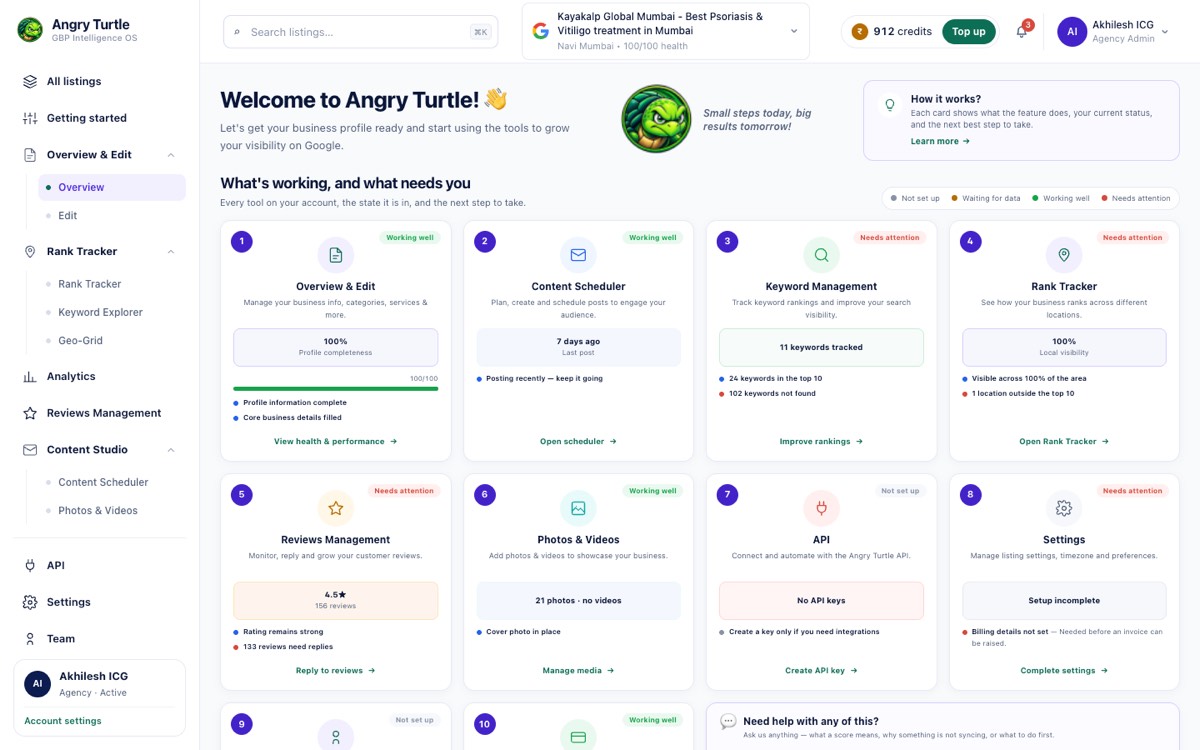

Ready to have this run for you?
Book a free audit — we'll show you where you stand in 48 hours.