 Angryturtle
Real Estate SEO in Bangalore
RERA versus marketing names, the sales-office lifecycle, and how the property portals interact with the Google listing, for developers, brokers and channel partners in Bangalore.
·
Bangalore generates more duplicate real estate listings per project than most Indian cities for a specific, traceable reason: its layout-block-cross-main addressing system gives a developer, a channel partner and a broker three different plausible ways to write the same address, and each one tends to set up their own listing rather than share one. A project on Sarjapur Road can end up with a Google profile, a 99acres listing and a Housing.com entry that all describe the same site office in three address formats that don't obviously match. That's the mechanical root of most real estate SEO problems in Bangalore, and it's what this page covers, whether the search that brought you here was real estate SEO in Bangalore, a real estate SEO agency in Bangalore, real estate SEO services in Bangalore, or a real estate SEO company in Bangalore. Bengaluru is the same market under its formal name; this page uses Bangalore throughout because that's how the search demand actually reads.
Contents
- Why the addressing system produces duplicate listings
- Broker, developer, or channel partner: who's supposed to own it
- RERA name versus marketing name for a research-heavy buyer base
- The sales-office lifecycle in Whitefield and Sarjapur Road
- Portal listings, Google, and NAP across four platforms
- Abandoned listings from closed offices in North Bangalore
- What to ask before signing with an agency
- Where this isn't worth doing
- FAQ
Why the addressing system produces duplicate listings
"2nd Cross, 5th Main, HSR Layout, Sector 2" is unambiguous to a local buyer and nearly meaningless to an automated geocoder, because the cross-and-main pattern repeats across sectors and layouts with no citywide uniqueness guarantee. When three different parties, developer marketing, a channel partner, and a broker handling resale, each enter that address independently into their own directory listing, small formatting differences (which cross number comes first, whether "Sector 2" gets included at all) are enough for Google and the portals to treat what should be one project as several. The fix isn't creative, it's mechanical: agree on one exact address string, drop the pin manually against a landmark rather than trusting auto-placement, and hold that string identical across every platform tied to the project.
Broker, developer, or channel partner: who's supposed to own it
Whitefield and Sarjapur Road both sell heavily through channel partners, and a partner setting up a project's Google profile under their own agency credentials rather than the developer's is routine here. It's a reasonable shortcut while the launch is active. The problem shows up later, when the partnership ends or the project sells out and the partner has moved to the next site, and the developer discovers they have no access to a listing still representing their project to buyers. A broker moving resale units in the same tower has no legitimate claim on that listing at all, their own visibility should come from a separate profile that references the project by name. None of this resolves on its own; someone has to decide, in writing, which party holds primary access before any listing cleanup can actually stick.
RERA name versus marketing name for a research-heavy buyer base
Bangalore's buyer base includes an unusually high share of first-time, tech-sector buyers who check RERA registration before they check almost anything else, more consistently than buyers in some other cities do. That makes a mismatch between a project's RERA-registered name and its marketing name a bigger liability here than elsewhere; a buyer who finds a name on the RERA portal that doesn't obviously match what they searched can read it as a red flag even when nothing is actually wrong. RERA registration is a fact worth stating plainly in a profile description. It's not a claim about build quality or investment outcome, and treating it as one is a compliance risk, not a selling point. Keeping the RERA name canonical on the Google Business Profile, with the marketing name clearly labelled as a secondary reference, closes that gap; the Bangalore real estate cell page goes deeper on how this plays out locality by locality.
The sales-office lifecycle in Whitefield and Sarjapur Road
A project on Sarjapur Road or in the outer stretches of North Bangalore opens a booking office months or years before construction finishes, sells out, and closes it, and the Google listing that pointed there rarely closes with it. Whitefield and Electronic City behave slightly differently, both established enough that a closed sales office there is more likely to be absorbed back into a developer's other active listings nearby rather than left completely orphaned, but the underlying discipline is the same either way: mark it closed or merge it into the corporate profile the day the office actually shuts, not months later when someone happens to notice.
Portal listings, Google, and NAP across four platforms
Bangalore's tech-sector buyer base does more cross-platform research before making contact than most cities' buyers do, comfortable spending an evening checking 99acres, MagicBricks, Housing.com and NoBroker against each other before calling anyone. That means a stale phone number or price note on even one of the four gets noticed, by exactly the buyer segment most likely to notice it. NoBroker specifically has strong penetration in the rental segment around the tech corridors, where tenant turnover is high and owner-direct listings proliferate alongside broker listings for the same unit. Citation and NAP tracking is built for reconciling this across four platforms at once, since doing it manually per project doesn't hold up once a developer or brokerage is running more than a handful of active listings.
Abandoned listings from closed offices in North Bangalore
North Bangalore's growth has been fast enough, on the back of the airport-road connectivity story, that the corridor now carries a real backlog of closed pre-launch and early-construction sales offices from projects that have since completed and handed over. Each one is a listing still technically live, still showing an address a buyer could drive to and find nothing at, and each one dilutes whichever developer or channel partner's other active listings sit nearby, because Google's local systems don't distinguish a dead listing from a competing one when scoring proximity and relevance.
What to ask before signing with an agency
- Can they name which layout-block-cross-main format they'll standardise on for your project addresses, and why?
- Do they know whether your channel partner or your own team currently holds admin access to each project's Google profile?
- What's their process for identifying and closing out abandoned listings from your completed North Bangalore projects?
- Have they pulled an actual NAP audit across Google, 99acres, MagicBricks and NoBroker for one live listing, not described the process in the abstract?
Where this isn't worth doing
A single agent working referrals in one Bangalore layout, fully booked, with no plan to expand, doesn't need a managed engagement here. Claim the profile, get the locality and configuration terms into the description honestly, ask closed clients for a review, stop. And a developer whose real constraint is unsold inventory in a price band the market has already rejected won't fix that with better listing hygiene, no amount of profile cleanup manufactures buyer demand that isn't there.
FAQ
Why does Bangalore produce more duplicate real estate listings than other cities? Its layout-block-cross-main addressing system gives multiple parties, developer, channel partner, broker, plausible but slightly different ways to write the same address, and each often sets up a separate listing rather than sharing one.
Should a channel partner or the developer own a Bangalore project's Google Business Profile? The developer's corporate entity should hold primary ownership, with the channel partner given manager-level access rather than full control, so the listing doesn't become inaccessible when the partnership ends.
Does RERA registration prove a Bangalore project is a good investment? No. It's a regulatory registration fact that can be named in a listing. It says nothing about build quality, pricing, or expected returns, and no agency should present it that way.
Is Bengaluru treated differently from Bangalore for search purposes? No, they're the same market. Search demand and this page both use Bangalore as the primary spelling, since that's the term buyers actually type more often.
What happens to a sales-office listing once a North Bangalore project completes and hands over? It should be marked closed or merged into the developer's corporate profile. Left live, it keeps surfacing in "near me" searches with a dead address, diluting whichever active listings sit nearby.
What should a developer ask before hiring a real estate SEO agency in Bangalore? Whether they understand the layout-block-cross-main addressing problem specifically, who currently holds admin access to each project listing, and whether they've actually pulled a NAP audit across Google and the major portals rather than just describing the process.
The Bangalore real estate cell page covers locality-by-locality search behaviour and a worked Kanakapura Road case in more depth, and sits alongside healthcare and retail on the Bengaluru local SEO hub. The national guide to local SEO for real estate agents covers GBP setup and citation stacks that apply everywhere, and method-level detail lives on the real estate local SEO playbook and AI-search playbook for real estate, alongside common real estate local SEO mistakes in India and a developer-focused local SEO guide. See also duplicate listings, service-area business setup, and NAP consistency at scale. Multi-project developers can look at multi-location local SEO; pricing and a demo are there for anyone ready to check a listing directly.
Stop guessing where you rank locally.
Rank OS scores your Google Business Profile the way Google's local algorithm does — relevance, review health, freshness, entity authority and AIO readiness — and shows you exactly what to fix.
Book a live demo →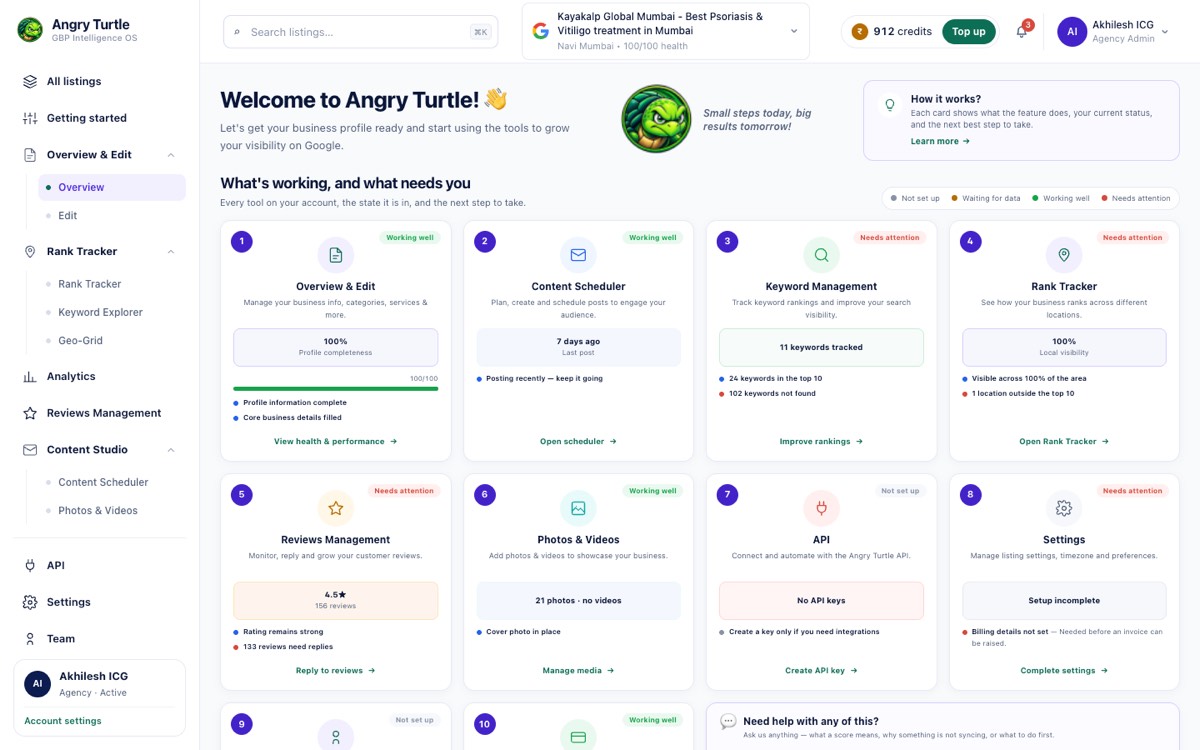

Related reading
Ready to have this run for you?
Book a free audit — we'll show you where you stand in 48 hours.