 Angryturtle
9 Ways Indian Developers Get Projects Found on Google Maps
From a site office with no signage to a sold-out tower, the visibility problem changes at every stage of a project.
A project's local search needs change shape from land acquisition to possession, and most developer teams keep running the same GBP and listing playbook across all of it. Here are nine moves mapped to where a project actually is in that lifecycle, and what specifically goes wrong at each stage when the move gets skipped.
Strengthen the developer's own entity before the project exists
Pre-launch, before any physical sales presence exists, the visibility problem is almost entirely about the developer's own entity, not the unbuilt project. This is the stage to strengthen the developer's main GBP profile, corporate directory listings, and past-project track record — because a buyer's first move when a new project is announced is usually to search the developer's name, not the project name, especially for a first launch in a new city. A developer that skips this and waits until the project itself is searchable arrives at launch with a thin, unverified entity behind it, which is exactly the profile a cautious buyer is trained to be wary of in a market with real track records of delayed or stalled projects. Feeding entity authority early, through consistent listings and a clean citation footprint with correct NAP, is what a buyer's own due-diligence search actually finds.
List the sales office the week it opens, not the month after
Once a site sales office opens, a fixed-address GBP listing for that specific office becomes the priority, with accurate hours, a phone number staffed during those hours, and photos of the actual office rather than renderings. This listing should launch the same week the sales office opens — a two-month gap between opening the office and getting it listed is two months of buyers who couldn't find it on Maps, driving past instead, or assuming the project doesn't have an active sales presence yet and deferring their visit indefinitely. Every week that gap stays open is a week of foot traffic and phone calls the listing should have been converting. A sales office that opens without ever getting listed, or that gets flagged and suspended in the process, should move straight to GBP reinstatement rather than letting the gap sit unresolved.
Lead with legitimacy signals during the booking phase
During the pre-launch booking phase, the listing's job is answering "is this legitimate and how do I book a site visit," so the description should carry the RERA registration status plainly, alongside a way to schedule a visit. Buyers verifying legitimacy before paying booking money are searching for exactly this reassurance, and a listing that doesn't offer it pushes them toward a phone call the sales team then has to spend time on manually just to answer a question the listing itself should have already settled. This is the same RERA-name-matching discipline covered in more depth in our real estate mistakes guide.
Post dated construction photos on a steady cadence
Through active construction, the highest-value habit is a steady cadence of dated, real progress photos posted to GBP and the microsite alike. This does double duty: it satisfies buyers checking on delivery timelines, and it's the kind of specific, checkable content Google's freshness signal and answer engines both respond to, unlike a static gallery that never changes. A developer that goes quiet for months during construction — even for entirely ordinary reasons, like a slow monsoon season — reads to a watching buyer as a delay they haven't been told about, whether or not that's actually true.
Shift from brand terms to locality terms as units sell down
As units sell down toward the later phases of a project, locality-based search terms — the area name, nearby landmarks, connectivity references — should carry more weight in the listing description and posts than the project's own brand name, because by this stage most remaining serious buyers are comparing this project against others in the same locality, not searching by name from cold awareness. A listing still optimised purely around brand recall at this stage is answering a question fewer and fewer remaining buyers are actually asking, in exactly the demand cluster shift that shows up in city after city, from Kolkata to Gurgaon to Ahmedabad.
Ask for the review right at possession, every time
At possession, the review-request opportunity is the single best moment in the entire project lifecycle and the one developers most consistently skip. A buyer who has just received keys, after months of anticipation, is in the best possible mindset to leave a positive, specific review about the handover experience — asking at this exact point, rather than waiting for reviews to accumulate on their own, changes the review profile's overall tone measurably, because reviews that arrive unprompted skew toward the most frustrated buyers rather than the median experience.
Change the listing's status honestly once the project sells out
Once the project is fully sold out, the sales-office listing needs an explicit status change rather than abandonment: hours updated to reflect the office is closing or has closed, posts stopped, and the description shifted to a factual "sold out, possession completed" statement. Leaving a sold-out sales office listed as actively open, with stale posts still running, misleads exactly the resale buyers and reference-checking future customers who still look the listing up, and it leaves an active-looking profile with zero real activity behind it — a mismatch that tends to surface in a bad review the moment someone actually calls.
Keep each project's identity separate from the developer's corporate listing
For a developer running multiple simultaneous projects across a city, keeping each project's listing distinct from the developer's own corporate listing — cross-linked, not merged — prevents the dilution that happens when five projects' worth of hours, addresses, and photos get forced into one profile. This becomes the harder problem the more active projects a developer is running at once, and it's exactly the kind of portfolio-wide coordination that an Agency OS style portfolio view is built to manage across every listing at once rather than one at a time.
Assign one owner to the listing across every milestone, not just at launch
Across the whole lifecycle, one habit underlies all the others: whoever owns the developer's digital presence needs a simple recurring checklist tied to project milestones — sales office opens, phase completes, possession starts, project sells out — rather than a one-time GBP setup treated as finished work. Projects that get this right tend to be the ones with a single named person accountable for the listing at each stage, not a marketing agency briefed once at launch and never revisited, because a briefed-once approach reliably falls apart exactly at the milestones — sellout, closure, handover — that matter most and happen least often.
A single-project boutique developer can run through these nine stages in order without much complexity. A developer running several projects concurrently across cities such as Mumbai, Bengaluru, Pune, and Hyderabad needs to track all nine simultaneously across a whole portfolio, which is where most of the actual coordination difficulty lives — the same coordination problem covered from the doctor and clinic side in our local SEO tactics for individual doctors.
FAQ
When should a project's sales-office GBP listing go live? The same week the physical sales office opens — delaying this creates a gap where buyers driving to the location can't confirm it exists or find its hours in advance.
What should happen to a sold-out project's listing? It should be explicitly updated to reflect that sales have ended, not deleted — resale buyers and reference checks still rely on it, but it needs a factual status rather than an active sales pitch.
Why does possession matter so much for review requests specifically? It's the moment a buyer's full experience — from booking through construction to handover — is freshest and most likely to be positive if the project delivered reasonably on schedule, which makes it the highest-yield point to ask.
Should a developer with five active projects use one GBP profile or five? Five — each project with its own sales office needs its own listing with accurate, project-specific hours, address, and photos, cross-linked from the developer's main profile rather than combined into it.
Does posting construction-progress photos actually help search visibility, or is it just buyer reassurance? Both — regular, dated, real content feeds the freshness component of how a listing is scored, and it happens to be exactly the reassurance a buyer checking on delivery timelines is looking for.
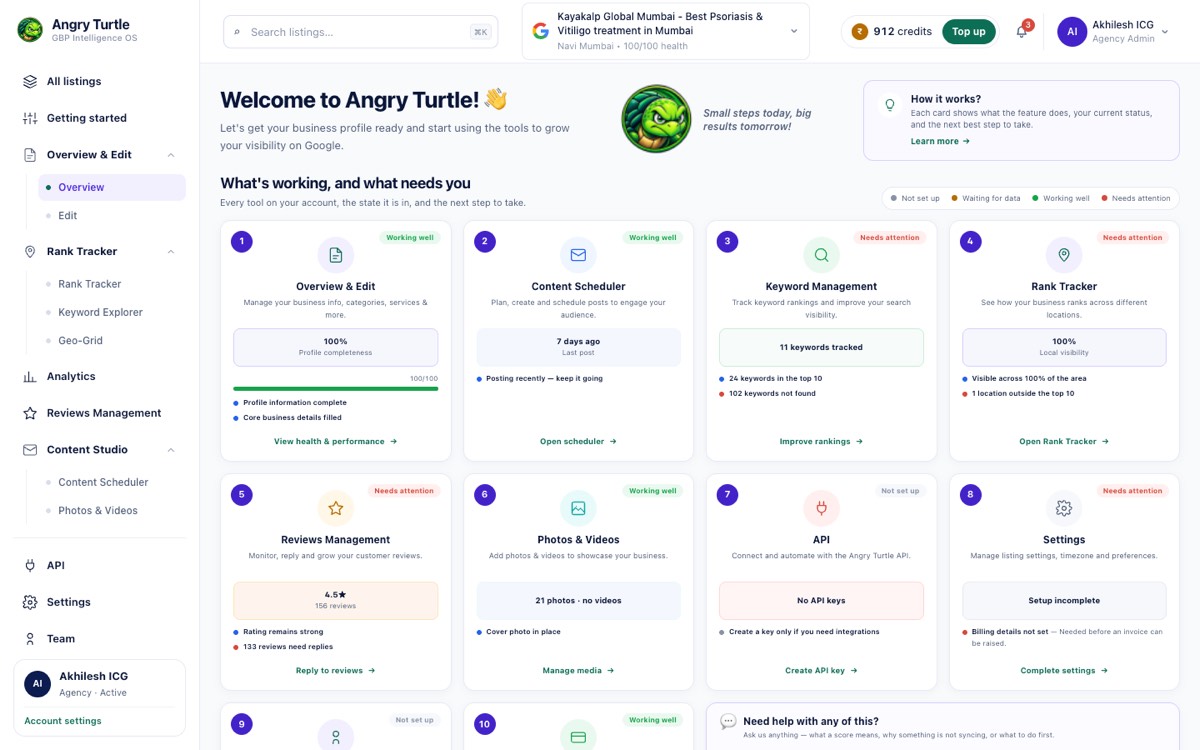
Angryturtle's Content Studio and Rank OS freshness tracking are built for exactly this kind of milestone-driven posting cadence across a developer's active project portfolio, with entity authority and citation checks running underneath to catch drift before a buyer does. See the full list of listing mistakes to avoid in our real estate mistakes guide, see how it maps to real estate specifically on the real estate industry page and real estate local SEO page, check pricing for a portfolio plan, or book a free audit.
More listicles and rankings
A score you can argue with, not a black box
Rank OS gives every profile a 0–100 score built from five weighted dimensions — Relevance, Review Health, Freshness, Entity Authority and AIO Readiness — and the weights are tunable. Underneath it sits a ranked list of the fixes that move the number, each with the point lift it unlocks.
Ready to have this run for you?
Book a free audit — we'll show you where you stand in 48 hours.