 Angryturtle
10 Local SEO Mistakes Indian Real Estate Businesses Keep Making
Project names that do not match RERA records, sales offices that vanish, and the listing habits that quietly cost developers visibility.
Indian real estate developers and brokerages lose local search visibility mostly through listing mistakes, not content mistakes. A project's Google presence and directory footprint change shape at every stage — pre-launch, under construction, possession, sold-out — and most of these ten mistakes come from treating the listing as a one-time setup instead of something that needs to move with the project.
Using the marketing name instead of the RERA-registered name
A project marketed as "Skyline Heights" might be registered with RERA under a different legal or phase-specific name. When the GBP listing, the website, and RERA disclosures don't match, buyers doing the entirely reasonable step of verifying RERA registration before paying booking money hit a wall — they search the marketing name, find the RERA site listing a different name, and can't confirm the two are the same project. That gap doesn't just cost a lead; it actively raises suspicion in a market where buyers have specific, well-known reasons to be cautious about unverifiable project names. Keep the marketing name for buyer-facing search and clearly state the RERA registration number and registered name together, on the listing description and on the site, so the two can be matched without a buyer having to call and ask. This is also a NAP consistency problem in disguise — the same entity showing up under two different names across GBP and RERA weakens entity authority the same way an inconsistent phone number would.
Letting the sales office GBP outlive the actual sales office
Site sales offices are temporary by design — they open when a project launches and close once inventory sells out or once the developer moves to a permanent booking office elsewhere. Developers routinely forget to update or close the GBP listing when that happens. A buyer who drives to a listed address and finds an empty plot, or a locked cabin, doesn't just lose that lead — they leave a one-star review describing exactly that experience, which then sits on the profile indefinitely and gets read by every subsequent buyer researching that developer's other projects, not just this one. The fix costs almost nothing: updating hours and the description the same week the office actually closes, which is a discipline problem far more than a technical one.
Treating an under-construction site with no physical presence as if it needs a full address listing
In the pre-launch and early construction phase, there may be nothing at the plotted address except boundary fencing and a signboard. Some developers still try to force a full GBP listing at that address, which Google's guidelines don't really support for a location without an operating presence, and which confuses buyers who show up expecting a functioning sales office. Listings created this way are also disproportionately likely to get flagged and suspended, which then means a real sales office launching a few months later inherits a suspension history it didn't earn — see GBP reinstatement for what that recovery actually involves. The better move during this phase is a service-area business listing tied to the developer's actual registered office, with the project itself promoted through the developer's main profile and posts rather than a premature standalone listing.
Ignoring locality-led search behaviour
Buyers in India search by locality first — "2BHK Whitefield" or "flats near Hinjewadi" — far more than they search by project name, especially before they've heard of a specific project. Developers who optimise everything around the project's brand name and skip the locality terms in the description, posts, and photo captions miss the exact stage of the buyer journey where most search volume actually sits, which means the project never enters the consideration set for buyers who are still comparing areas rather than developers. This gap shows up clearly in demand cluster data — locality-plus-configuration terms consistently carry more search volume than brand-plus-configuration terms in the early stage of a purchase decision, in city after city, from Mumbai to Pune to Ahmedabad.
No distinction between the developer's brand profile and the project's own profile
A developer running five active projects across a city sometimes tries to funnel everything through one corporate GBP listing. That listing can't carry per-project hours, per-project address, or per-project photos coherently, and it dilutes the specificity a buyer is searching for — a buyer looking for "Project B site visit timing" gets a listing built around Project A's launch, or a generic corporate description that answers nothing about the specific project they care about. Each active project with its own sales office deserves its own listing, cross-linked from the developer's main profile rather than merged into it, and that separation is what lets each project's own freshness signals and reviews accumulate correctly instead of getting averaged into a single undifferentiated score.
Photos that show the rendering, never the actual site
Architectural renderings are useful marketing material, but a GBP photo gallery made up entirely of renderings, with zero actual site photos, reads as evasive to a buyer who has learned — often the hard way, in a market with real delayed-possession stories — to distrust a project that won't show its real progress. Uploading dated, timestamped construction-progress photos regularly builds exactly the kind of trust a rendering-only gallery erodes, and it does a second job at the same time: it's exactly the kind of specific, checkable content that keeps a listing's freshness signal active instead of decaying after weeks of no updates.
No category accuracy between "real estate developer," "real estate agency," and the specific project type
A developer selling apartments should be categorised differently from a brokerage reselling multiple developers' inventory, and a commercial project should carry different categories than a residential one. Using the same generic "Real Estate Agency" category across every listing a company owns loses the specificity that helps a buyer land on the right listing for what they're actually shopping for — a commercial-space buyer searching for office space filtered by category never sees a residential-only listing miscategorised as generic real estate, and vice versa. This is a five-minute fix with a disproportionate payoff, because category accuracy feeds directly into which searches a listing is even eligible to appear in.
Reviews left entirely to chance
Real estate has a natural, obvious review-request moment that many developers skip: possession handover. That's the point at which a buyer's overall satisfaction with the whole process — from booking to construction updates to final handover — is freshest and most likely to be positive if things went reasonably well. Waiting for reviews to arrive organically means the loudest voices are usually the most frustrated ones, since dissatisfied buyers are more motivated to write unprompted, which skews the entire visible review profile toward complaints even when most buyers were actually satisfied. There's no published review count that changes this dynamic — the fix is a consistent review request habit tied to the handover milestone, not a one-time push to hit a target number.
NAP inconsistency across the developer's own project microsites
Larger developers often spin up a separate microsite for each project, each with its own footer contact details, sometimes maintained by a different marketing vendor per project. Phone numbers drift, office addresses get typo'd, and nobody notices until a buyer calls a disconnected number pulled from an old microsite that Google still indexes. A periodic sweep across every project microsite the company runs catches this before it costs a lead — this is precisely the kind of drift that a citation audit across a developer's full portfolio is built to catch systematically rather than relying on someone noticing by accident.
No plan for what happens to the listing after sellout
A sold-out project's GBP listing doesn't need to disappear — resale buyers, buyers checking on possession status, and buyers researching the developer's track record for a future project all still look it up. But it does need updating: hours should reflect that active sales have ended, posts should stop promoting units that don't exist, and the description should shift toward a factual project-status statement rather than a sales pitch that's no longer true. A listing that keeps running "book your dream home now" posts for a project that sold out eighteen months ago doesn't just look neglected — it actively misleads a resale buyer who assumes, reasonably, that an actively posting profile means active inventory.
A single project launch with one sales office is a manageable listing problem — get the RERA name pairing and the locality terms right and most of the risk is handled. A developer running a multi-project pipeline across cities such as Bengaluru, Gurgaon, and Kolkata needs the fuller list, especially the brand-versus-project separation and the microsite NAP sweep, because that's where the mistakes compound fastest at scale.
FAQ
Should a developer list every project under one GBP profile or separate ones? Separate profiles for each active project with its own sales office or site presence — a single combined profile can't represent distinct addresses, hours, and photo sets clearly enough for a buyer comparing specific projects.
What happens to a sales-office GBP listing after the project sells out? It should be updated to reflect that active sales have ended rather than deleted outright — resale buyers and possession-status searches still rely on it existing and being accurate.
Does the RERA registration number need to appear on the GBP listing itself? GBP fields are limited, but the registered project name and RERA number should appear together somewhere a buyer can find quickly from the listing — typically the description or a linked page — so the two names can be matched without doubt.
Why do locality-based search terms matter more than project-name terms early on? Because most buyers start searching by area before they've heard of a specific project by name — locality-led queries capture that earlier, larger stage of the buyer journey.
Is it a problem if a project's photo gallery is mostly renderings during early construction? A few renderings are fine, but a gallery with zero dated, real progress photos reads as evasive to buyers who have learned to be wary of delayed-possession patterns in the market.
Angryturtle's entity authority and NAP consistency checks catch exactly this kind of drift across a developer's project microsites and directory listings, and Rank OS turns the gaps into a ranked action plan across an entire multi-project portfolio via the Agency OS portfolio view. See how it applies to real estate specifically on the real estate industry page or the broader real estate hub, read the companion piece on nine moves developers make across a project lifecycle, or book a free audit.
More listicles and rankings
A score you can argue with, not a black box
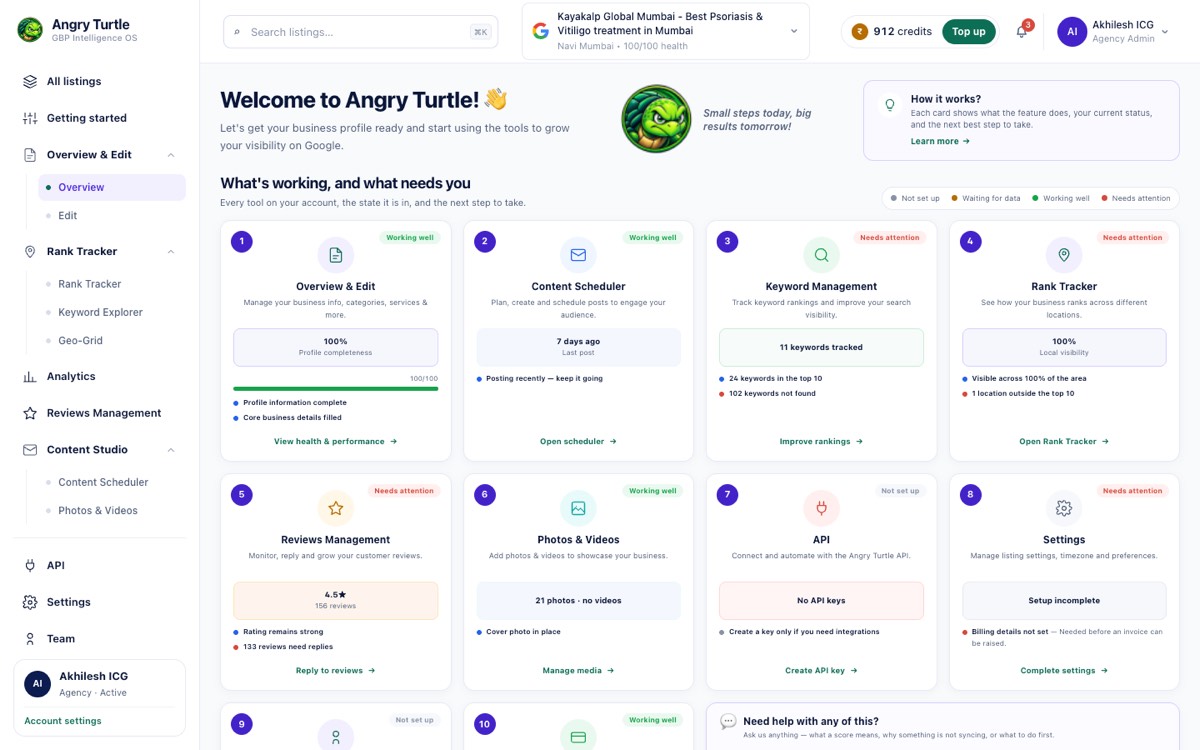
Rank OS gives every profile a 0–100 score built from five weighted dimensions — Relevance, Review Health, Freshness, Entity Authority and AIO Readiness — and the weights are tunable. Underneath it sits a ranked list of the fixes that move the number, each with the point lift it unlocks.
Ready to have this run for you?
Book a free audit — we'll show you where you stand in 48 hours.