 Angryturtle
Restaurant SEO in Mumbai
The delivery-platform layer versus the Google listing, menu and hours accuracy, and review response, for restaurants, cafes and cloud kitchens in Mumbai.
·
Two restaurants can share a Lower Parel mill-compound tower, the same pin radius, and almost none of the same search visibility, because one of them has a Zomato menu that hasn't matched its Google Business Profile since a price revision eight months ago. Restaurant SEO in Mumbai isn't a smaller version of hospitality SEO in Mumbai. It's a narrower, messier problem: three discovery layers (Google, Zomato, Swiggy) that each think they own the customer relationship, a cloud-kitchen model that puts four brands behind one shutter, and a diner who decides in under a minute whether tonight's order comes from you or the place two doors down. This is what restaurant SEO services in Mumbai actually need to cover, and what separates a restaurant SEO agency in Mumbai that understands the vertical from one running a generic hospitality template with the word "restaurant" swapped in.
How Mumbai actually searches for a place to eat
A Bandra diner at 8pm typing "biryani near me" is not doing the same search as someone typing "biryani Bandra" at 3pm planning ahead, and Google treats the two differently in terms of which businesses it surfaces and how it weighs proximity against relevance. Suburban rail geography compounds this in a way flatter cities don't deal with: someone searching from Bandra station is anchored to a walking radius around the station exit, not a neighbourhood boundary, and a restaurant three minutes from the wrong exit might as well be in a different suburb for that search. Andheri splits the same way between its east and west sides, separated by the railway line itself, where a restaurant on the wrong side rarely shows up for a search anchored on the other.
Lower Parel's search pattern skews toward the after-work and corporate-lunch crowd, fast, specific, price-aware. Bandra's skews toward evening leisure dining, where "rooftop," "live music," and cuisine-specific terms dominate over generic ones. A restaurant running the same GBP description and the same keyword approach across outlets in both areas is optimising for a customer that doesn't exist in either place.
The Zomato and Swiggy layer, and where it fights the Google listing
Most Mumbai diners discover a new restaurant on Zomato or Swiggy before they ever open Google Maps, particularly for delivery-oriented categories, and both platforms carry their own review pool, their own menu, and their own operating hours that Google never sees. Google still does its own job in that chain: it's where a diner checks a place is real and still open, and where they go back to remember it before a repeat visit that skips the delivery app entirely.
The friction shows up as name-address-phone mismatches nobody notices until it costs a booking. "Sharma's Kitchen" on Zomato, "Sharma Kitchen Bandra" on Google, and a phone number on Swiggy that still rings a number disconnected since a lease change, all under one physical restaurant. A customer who orders through Swiggy, has a bad experience, and goes to leave a Google review finds a business name that doesn't quite match what showed up on their delivery app, which reads as a small credibility gap even when nothing else is wrong. NAP consistency across the citation layer needs to hold across all three platforms, checked on a schedule, not fixed only after a complaint surfaces it.
Cloud kitchens: one address, several listings, and where that breaks
Mumbai's cloud kitchen density, especially around Andheri, Powai and parts of Lower Parel, creates a structural problem no dine-in restaurant faces: four or five delivery-only brands operating out of one commercial kitchen, each wanting its own Google Business Profile at the exact same address. Google's own systems are built to flag multiple businesses sharing a single location as a possible spam signal, because that pattern is also how fake listings and address-stuffing schemes work. A legitimate cloud kitchen operator doing this correctly still has to fight through the same suspicion a bad actor would trigger.
The fix is documentation, not persuasion. Each brand needs its own FSSAI registration reflected in the listing, its own phone number that actually routes to that brand's order line rather than a shared kitchen number, and photos specific to that brand's food and packaging rather than a generic kitchen shot reused across all four profiles. Duplicate listing cleanup matters here in a slightly different sense than usual: the goal isn't removing a duplicate, it's proving to Google that four listings at one address are four distinct, legitimate businesses rather than one business gaming the map for extra visibility. Skip this and the likeliest outcome isn't a ranking penalty, it's an outright suspension review that takes weeks to resolve while the kitchen keeps cooking with no listing live at all.
Menu accuracy and the attribute fields that actually get checked
A GBP menu that still lists a dish discontinued two menu revisions ago does more damage in Mumbai's fast-turnover food scene than in almost any other local business category, because the customer ordering off that menu finds out they're wrong at the worst possible moment, mid-order or mid-table. Price accuracy matters the same way; Mumbai diners comparing a handful of nearby options before ordering notice a price that doesn't match what actually shows up on the bill, and that's a review magnet.
Attribute fields carry more weight for a restaurant than for most categories Google supports: outdoor seating (relevant for the handful of Mumbai venues that can actually offer it), dine-in versus takeaway versus delivery-only, alcohol service, and vegetarian-specific flags that matter more here than in most Indian metros given how much of Mumbai's dining search filters specifically for pure-veg options. A cloud kitchen that leaves "dine-in" checked because nobody unchecked it after the concept shifted delivery-only is actively misleading the exact search filter a customer used to find it.
Photos, and what a Mumbai diner actually clicks through for
Dish photos convert here the way they do everywhere, but Mumbai's building-name addressing adds a second job for photography that most cities don't need: an exterior or entrance shot that helps a diner standing outside three towers on the same Lower Parel road match what's on their phone to what's actually in front of them. A restaurant description that names the building, "Trade View, 2nd floor," alongside a photo of that actual entrance solves a wayfinding problem the address field alone can't.
New dish photos should go up whenever the menu changes, not on a fixed monthly schedule disconnected from what's actually different. A restaurant that revises its menu every festival season and updates its photos on the same cadence keeps both accurate at once instead of letting one lag the other.
Hours that hold up on a Friday night and after midnight
Mumbai's late-night trade runs into real limits that don't apply everywhere: licensing windows that cap how late alcohol service can run, and a kitchen that may keep cooking after the bar stops pouring. A GBP profile showing one blanket closing time for every night of the week misrepresents a restaurant that closes its kitchen at 11:30 on weeknights but keeps a late menu going past midnight on Friday and Saturday specifically. Get this wrong and the failure is physical, not just a ranking problem: someone travels to Bandra for a place listed as open, finds the shutter down, and the resulting review has nothing to do with the food.
Monsoon season adds a second, Mumbai-specific wrinkle. Waterlogging shuts some Lower Parel basement restaurants early without warning most years, and a profile that still shows standard hours through a flooded week is actively misleading anyone checking it from their phone before heading out in the rain.
Review response, and why cadence matters more than tone
A negative review sitting unanswered for two weeks reads worse to the next searcher than the complaint itself did, and Mumbai's review volume, especially for anything near a dense dining strip like Bandra or Lower Parel, makes daily response an operational habit rather than a monthly project. The complaint also splits by channel in a way that matters: a Swiggy delivery complaint about a cold order and a dine-in complaint about slow service need genuinely different responses, and answering both with the same templated apology reads as inattentive to anyone comparing the two. Response templates by scenario cover the general pattern; a Mumbai restaurant running both dine-in and delivery needs at least two distinct response scripts, not one.
Where this isn't the right fit
A single Bandra restaurant that's full every night with no plan to open a second outlet doesn't need a restaurant SEO company in Mumbai on retainer. Claim the listing, keep hours honest across weekday and weekend, ask regulars for a review, and that covers most of the available upside at that scale. If tables are full but revenue still lags, the constraint is almost always pricing, staffing, or the menu itself, not search visibility, and no amount of listing work reaches that far downstream. None of this fixes food quality either, and no restaurant SEO agency in Mumbai that claims otherwise is being straight with you.
What Angryturtle does for Mumbai restaurants
Rank OS scores relevance, review health, freshness, entity authority and AIO readiness against nearby competitors, cuisine by cuisine, rather than one flat city-wide number. Geo-grid tracking shows rank separately across Bandra, Lower Parel and Andheri instead of averaging them into a single misleading figure. For groups running more than one outlet, or a cloud kitchen operating several brands from one address, write-back to Google and managed GBP services keep menu changes, monsoon-hours updates, and category corrections consistent across every listing at once instead of relying on whichever manager remembers first.
Mumbai's other sectors sit on the Mumbai hub, and the hospitality-wide method, including the property-versus-restaurant listing decision for hotels with their own restaurant, is covered in the Mumbai hospitality page and the hospitality local SEO playbook. The national restaurant local SEO playbook covers the category-and-review fundamentals that apply everywhere, worth reading alongside this page rather than instead of it, and cloud kitchen local SEO goes deeper on the delivery-only model specifically. Pricing and a demo are the fastest ways to see what a Rank OS score looks like against two or three nearby competitors, or get in touch with specifics about a listing.
FAQ
What does restaurant SEO in Mumbai actually involve beyond a general GBP setup? Mostly the things generic hospitality SEO skips: reconciling NAP across Google, Zomato and Swiggy, structuring cloud kitchen listings so multiple brands at one address don't trigger a spam flag, and keeping hours accurate across licensing limits and monsoon disruptions rather than one static schedule.
Should I look for a restaurant SEO agency in Mumbai or a general local SEO company? Depends on scope. A restaurant SEO agency in Mumbai that can speak specifically to cloud kitchen documentation, delivery-platform NAP conflicts and locality-specific dining search patterns will catch things a generalist misses, but if the restaurant is one part of a broader multi-category business, a general local SEO company handling everything under one roof may be simpler to manage.
How many Google Business Profiles can a cloud kitchen have at one address? As many as there are genuinely distinct, separately registered brands, but each one needs its own FSSAI documentation, its own routing phone number, and brand-specific photography. Sharing a kitchen number or reusing photos across listings is what triggers Google's spam review.
Does a restaurant need a different GBP category for dine-in versus delivery-only? The underlying cuisine category usually stays the same, but the attribute fields, dine-in, takeaway, delivery, need to reflect the actual current operating model. A former dine-in space that shifted to delivery-only and left "dine-in" checked is misleading the exact filter a customer used to find it.
How fast can a new Mumbai restaurant expect to rank for its neighbourhood? It depends heavily on how competitive the specific street or building cluster is rather than the neighbourhood as a whole, since Mumbai's density means two addresses on the same road can face very different competitive sets. The metro comparison guide covers general timeline ranges, though nothing here can promise a specific number.
Does Angryturtle manage Zomato or Swiggy listings directly? No. Work covers the Google Business Profile and the citation ecosystem around it, including keeping NAP consistent with what's live on Zomato and Swiggy, not the platform listings or their internal ranking systems themselves.
Stop guessing where you rank locally.
Rank OS scores your Google Business Profile the way Google's local algorithm does — relevance, review health, freshness, entity authority and AIO readiness — and shows you exactly what to fix.
Book a live demo →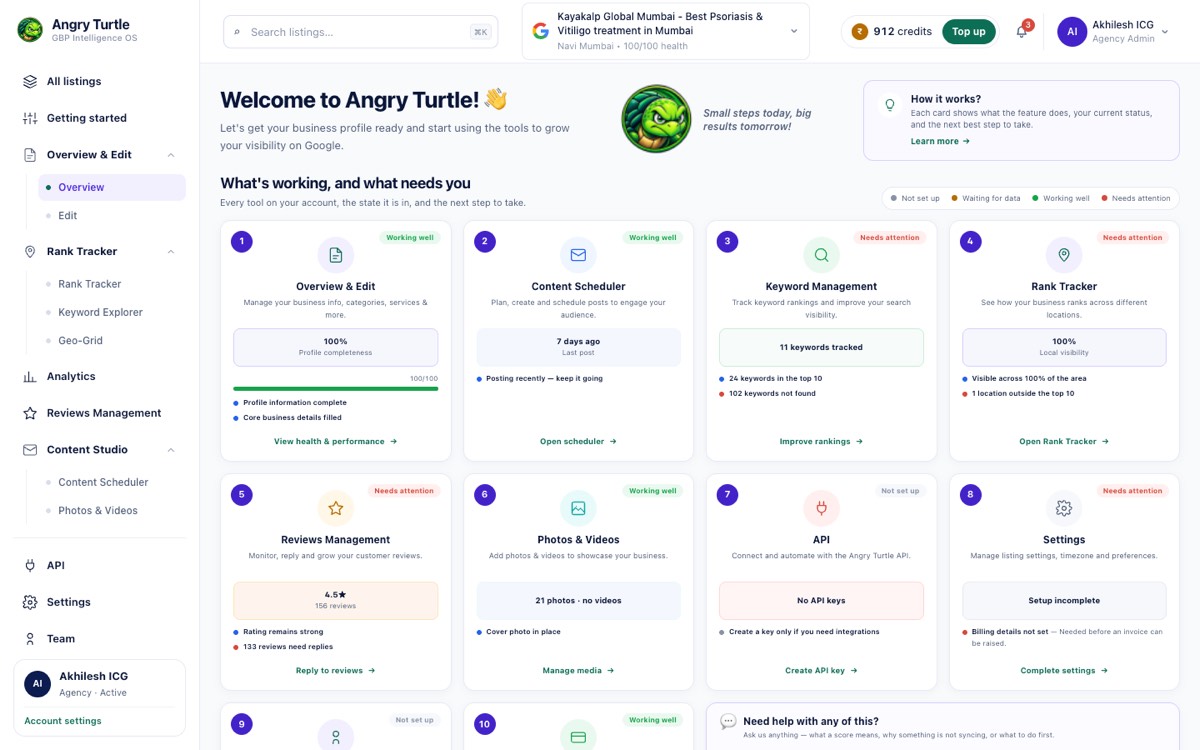

Related reading
Ready to have this run for you?
Book a free audit — we'll show you where you stand in 48 hours.