 Angryturtle
Review Response Patterns That Don't Sound Templated
·
"Thank you for your feedback. We strive to provide the best service to all our customers. Please contact us at your convenience so we can resolve this." Anyone who's browsed Google reviews on Maps has read a version of that reply fifty times, on fifty different businesses, attached to reviews about fifty completely different problems. It reads as a template because it is one, and customers can tell the difference between a business that read their review and a business that pasted a paragraph.
This isn't an argument against having a consistent approach to responses — consistency is good, and a business replying to every review needs some structure to do it at scale. The argument is against a structure so rigid that the specific words of the customer's review never actually make it into the reply. That's the whole difference between a response that sounds templated and one that doesn't, and it has almost nothing to do with length.
Why the generic reply fails
A generic reply signals one thing clearly to the next reader: nobody on the other end actually read this. It doesn't matter how sincere the business owner was when writing it, or how many times it's been copied — the review sitting above it named a specific dish, a specific staff member, a specific wait time, and the reply below it responded to none of that. The mismatch is what reads as fake, not the politeness.
It also wastes the single best opportunity a negative review creates. A prospective customer reading a 2-star review with a specific complaint, followed by a specific and human response addressing that exact complaint, often trusts the business more after reading both than they would have trusted a page of unbroken 5-star reviews with no friction anywhere. A generic reply throws that opportunity away, and it flattens the kind of review sentiment signal a business could otherwise be reading and acting on.
What an actual response needs
Three things separate a response that reads as real from one that doesn't: it names something specific from the actual review, it doesn't over-apologize past what the situation calls for, and it doesn't try to litigate the complaint in public.
Naming something specific means quoting or referencing an actual detail — the dish, the appointment time, the staff member by name if the review named them, the specific delay. "We're sorry the paneer tikka came out cold" reads as a real response. "We're sorry your experience didn't meet expectations" could be pasted onto any review from any restaurant in the country.
Not over-apologizing matters more than it sounds like it should. A five-sentence apology for a ten-minute wait reads as either desperate or insincere. Match the weight of the response to the weight of the complaint — a short, direct acknowledgment for a minor gripe, a longer and more detailed one for something that actually went wrong.
Not litigating in public means resisting the urge to argue with a reviewer's account of events in the reply itself, even when the business genuinely believes the reviewer is wrong or exaggerating. "That's not accurate, our records show..." reads badly to everyone reading it except the business owner who wrote it. Move disagreements to a phone call or private message; keep the public reply focused on acknowledgment and what happens next, following the same approach laid out in responding to reviews.
Building a fast workflow without sounding templated
The businesses that respond well at volume aren't writing every reply from a blank page — they're working from a short mental checklist rather than a fixed script. Read what was actually said. Pull out the one or two specific details worth naming. Match the tone to the severity. Close with something concrete, not vague — an invitation to call, a note about a fix already made, a specific improvement rather than "we'll do better."
That checklist produces different-sounding replies every time, because the input, the actual review, is different every time, even though the underlying process is repeatable. A rigid word-for-word template can't do that by definition, because it's optimized to be reused unchanged.
For high-volume businesses, this is where AI drafting genuinely earns its place, done correctly. Angryturtle's AI-drafted review replies read the specific review content and generate a personalised draft with the business's own brand signature, rather than filling in blanks in a fixed paragraph, and every draft is meant to be reviewed before it publishes live, not sent blind. That review step matters — the goal is a reply that sounds like it was actually read, and a human glance before publishing is what keeps it that way at scale. This same review data feeds the review health dimension inside Rank OS, so a business can see whether its response habits are actually improving over time, not just guess.
Different situations need different shapes
A one-line five-star review ("Great service, will come back") doesn't need a long reply — a short, warm acknowledgment naming the business or the visit is enough, and a paragraph here would look strange, not thorough. A detailed one-star review describing a specific failure needs the opposite: enough length to actually address what went wrong, without turning into a defensive essay. Handling fake and negative reviews covers the harder edge cases where a review looks more like abuse than genuine feedback.
A review in Hindi, Tamil, or another regional language deserves a reply in the same language, or at minimum acknowledging it, rather than a generic English template pasted underneath — this shows up more than owners expect in Indian metros, and ignoring the language a customer chose to write in reads as its own kind of dismissiveness.
A review naming a specific staff member by name, positive or negative, is worth addressing that name directly rather than generically referencing "our team." Clinics and hospitals in particular run into this often, and it's part of the broader reputation management work healthcare businesses tend to underinvest in compared to hospitality.
Getting the basics right first
None of this replaces responding at all, or responding on time. A brilliant, specific reply written six weeks after the review was posted has lost most of its value to the customer who wrote it, though it still helps future readers. Review response management covers the operational side of turnaround time and assigning ownership across a team, which matters as much as what the reply actually says, and our step-by-step guide to responding to negative reviews walks through the mechanics for anyone doing this manually.
And responses work best sitting inside a review process that isn't gated in the first place — see why review gating is banned — since a business filtering which reviews it even receives has a smaller, skewed set to respond to in the first place.
Frequently asked questions
Should every single review get a response? Ideally yes, though prioritise negative and detailed reviews first if volume makes responding to everything impractical. A short one-line five-star review with no response is a much smaller loss than an unanswered detailed complaint.
Is it okay to use AI to draft replies? Yes, provided a human reviews the draft before it publishes and the draft is genuinely responding to the specific review content rather than producing another generic template. AI-drafted replies work well specifically because they read the actual review text, not because they remove the human step entirely.
How fast should a response go up? Within a few days is reasonable for most businesses; within 24 to 48 hours for anything negative or urgent. Speed matters less than specificity, but a response that takes a month reads as an afterthought regardless of how well it's written.
Should I ever delete or hide a response? You can edit or remove your own response at any time if you notice a mistake, but avoid deleting a reasonable response just because the reviewer pushed back — that usually escalates rather than resolves things.
What about reviews that are clearly fake or abusive? Those follow a different path entirely, covered in what Google will and won't remove from reviews — a normal response template doesn't apply to a review that shouldn't be there at all.
Stop guessing where you rank locally.
Rank OS scores your Google Business Profile the way Google's local algorithm does — relevance, review health, freshness, entity authority and AIO readiness — and shows you exactly what to fix.
Book a live demo →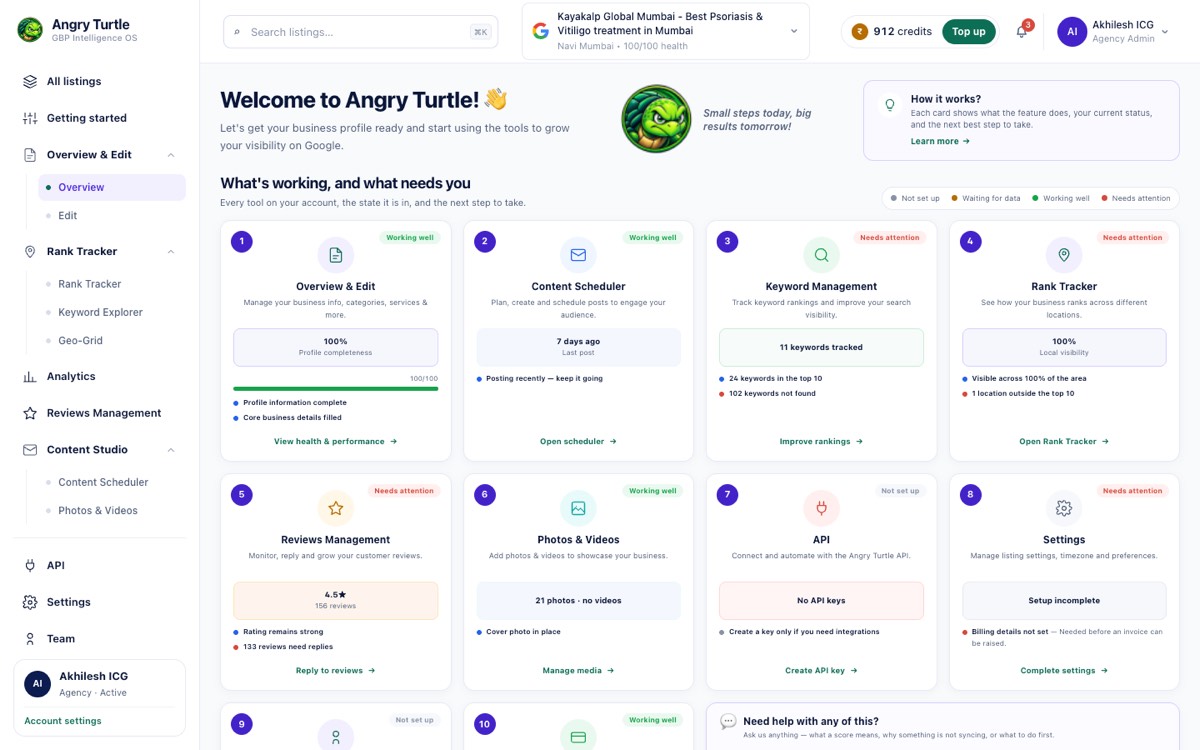

Related reading
Ready to have this run for you?
Book a free audit — we'll show you where you stand in 48 hours.