 Angryturtle
Building a Review Response SLA
How to create a scalable review response system for Indian businesses. SLA framework, escalation protocols, response template library, and team structure.
·
Building a Review Response System: Reputation Management for Multi-Location Businesses
For a single-location business, review response is a straightforward task: read the review, craft a response, publish. For a multi-location business receiving reviews across every branch every week, response management needs a system — with defined timing expectations, an escalation path, and a library of starting-point templates that don't sound canned. This is one piece of the broader reputation management discipline.
One structural note worth stating plainly: on Angryturtle, review replies you write in the platform publish live to Google — this isn't a drafting tool that leaves you to copy responses over manually. That matters for everything below, because a response system is only as good as its slowest step, and here the slowest step (publishing) isn't a bottleneck.
Why response timing matters
A business that responds to reviews consistently reads, to Google and to prospective customers, as actively managed rather than abandoned. Customers who leave reviews, especially negative ones, generally expect some acknowledgement — a review that sits unanswered for a week signals that nobody's watching, while a same-day or next-day response signals the opposite.
There's also a reputational exposure window to consider. A negative review that goes unanswered is read by every prospective customer who views the profile during that window, with no counterpoint from the business anywhere nearby. The faster a thoughtful response goes up, the shorter that exposure window is — not because the negative review disappears, but because it stops being the last word. Angryturtle's guide to responding to negative reviews and the companion how-to walkthrough cover the specific wording that works for the hardest cases.
A workable SLA structure, not a universal one
There's no published, universal number for how fast a review response "should" be. What follows is a structure many multi-location brands find workable, adapted to fit the business rather than copied as gospel: treat 5-star and clearly positive reviews as the lowest urgency, since there's little downside to a slightly slower response; treat mixed 3–4 star reviews as moderate urgency, worth a same-day or next-day response; and treat 1–2 star reviews, especially ones naming a specific complaint, as the highest urgency, worth flagging to a manager quickly rather than sitting in a general queue.
The logic behind prioritising negative reviews for speed isn't about the review itself — it's about the reader. Prospective customers read negative reviews more carefully than positive ones, weighing them against everything else on the profile. A pointed 1-star review about a specific failure that gets a prompt, professional response within hours does far less lasting damage than the same review sitting untouched for five days.
Building a response template library that doesn't read as templated
A library of starting points for common review scenarios is the operational backbone of response management at scale, but the word "template" undersells what makes it work. Organise it by scenario rather than by star rating alone — general positive appreciation, positive reviews mentioning a specific staff member, positive reviews mentioning a specific service, mixed reviews with a minor concern attached, and several negative categories split by theme: wait time, pricing or billing, staff conduct, product or service quality, process and administration, and a separate category for reviews that look like they might be fake or competitor-sourced. Angryturtle's guide to removing fake Google reviews and the step-by-step version cover that last category specifically — flagging and reporting is a different action from responding.
Each entry in the library should be a base — maybe 60 to 80 percent of the eventual response — with room left for one or two sentences specific to that review. That personalisation isn't optional polish. Two responses that are word-for-word identical across different reviews read as obviously automated to anyone comparing them, and Google's own systems can flag patterns like that too. The base text saves time; the personalised sentence is what makes the response actually land.
Staffing the response function as volume grows
A handful of locations can usually be handled by one dedicated person, full time or shared, monitoring and responding across all of them. As the count climbs into the dozens, that usually becomes a small team — someone coordinating, someone drafting responses, and someone doing periodic quality review of a sample of what's gone out, since consistency tends to drift without a check. At real scale, past a hundred or more locations, many brands introduce AI-assisted drafting trained on their response library and brand voice, with a human reviewing and approving before anything publishes. The AI drafts; a person still signs off. That's a meaningfully different model from full automation, and it's the one worth building toward rather than either extreme. Angryturtle's learning centre guide to responding to reviews covers the underlying skill this staffing model is built to scale.
Escalation: not every review fits a template
Some reviews need to skip the standard queue entirely. A 1-star review alleging a safety incident, a review alleging something legally serious like fraud or negligence, a sudden cluster of 1-star reviews that looks coordinated, or a review naming a specific staff member in a serious complaint — all of these warrant immediate escalation to a senior manager, not a template response drafted by whoever's on shift.
A second tier deserves faster-than-normal but not emergency attention: a review that's visibly gaining traction, being shared or upvoted; a review from someone with an unusually large following or industry profile; or a review pointing at a problem that's come up before and hasn't actually been fixed. Everything else is standard, template-based response — which, for most businesses on most days, is the overwhelming majority of what comes in.
Monitoring without checking fifty dashboards a day
Enabling GBP's own new-review notifications is the baseline — one email per new review to whoever's responsible. For anything beyond a handful of locations, a single dashboard that pulls reviews from every location's GBP into one filterable feed (by location, date, rating) is the difference between a manageable job and an impossible one. Angryturtle's GBP performance insights guide covers the reporting layer this usually plugs into, and a monthly view of review volume, response rate, and response time by location — shared as part of the team's regular performance review — closes the loop on whether the whole system is actually working.
How this connects to generation, sentiment, and schema
Response management is one leg of a larger review system. The requests that bring reviews in are covered in Angryturtle's review generation strategy guide and, for the India-specific channel that drives most of that volume, the WhatsApp review request guide. What the responses and the underlying reviews reveal about operations — recurring complaints, location-level patterns — is covered in the review sentiment analysis guide. And if reviews are displayed on the business's own website, marking them up correctly for rich snippets is covered in the review schema guide. A business that's excellent at one of these four and ignores the rest is still leaving most of the value on the table.
Common mistakes in review response at scale
Copy-pasting the exact same response across many reviews is the single most visible sign of an unmanaged programme — customers notice, and so does anyone comparing reviews side by side. Responding to positive reviews promptly while letting negative ones sit is the opposite of the right priority order. And treating every negative review as an emergency, rather than reserving true escalation for the handful that actually warrant it, burns out whoever's on response duty within a few months.
FAQ
Do review replies actually reach Google, or do they just sit inside a management tool? On Angryturtle, replies published through the platform post live to Google — the same as replying directly inside your GBP dashboard. There's no separate manual step required to make a response visible to the public.
How fast does a negative review really need a response? Faster than a positive one, as a rule — within hours rather than days where possible, because prospective customers weigh negative reviews more heavily and an unanswered one sits as the last word on the topic for longer.
Is it ever appropriate to leave a review unanswered? Rarely, and mostly for a review that's clearly spam or entirely unrelated to the business. Even a brief, calm response to a harsh but genuine complaint is usually better than silence.
Stop guessing where you rank locally.
Rank OS scores your Google Business Profile the way Google's local algorithm does — relevance, review health, freshness, entity authority and AIO readiness — and shows you exactly what to fix.
Book a live demo →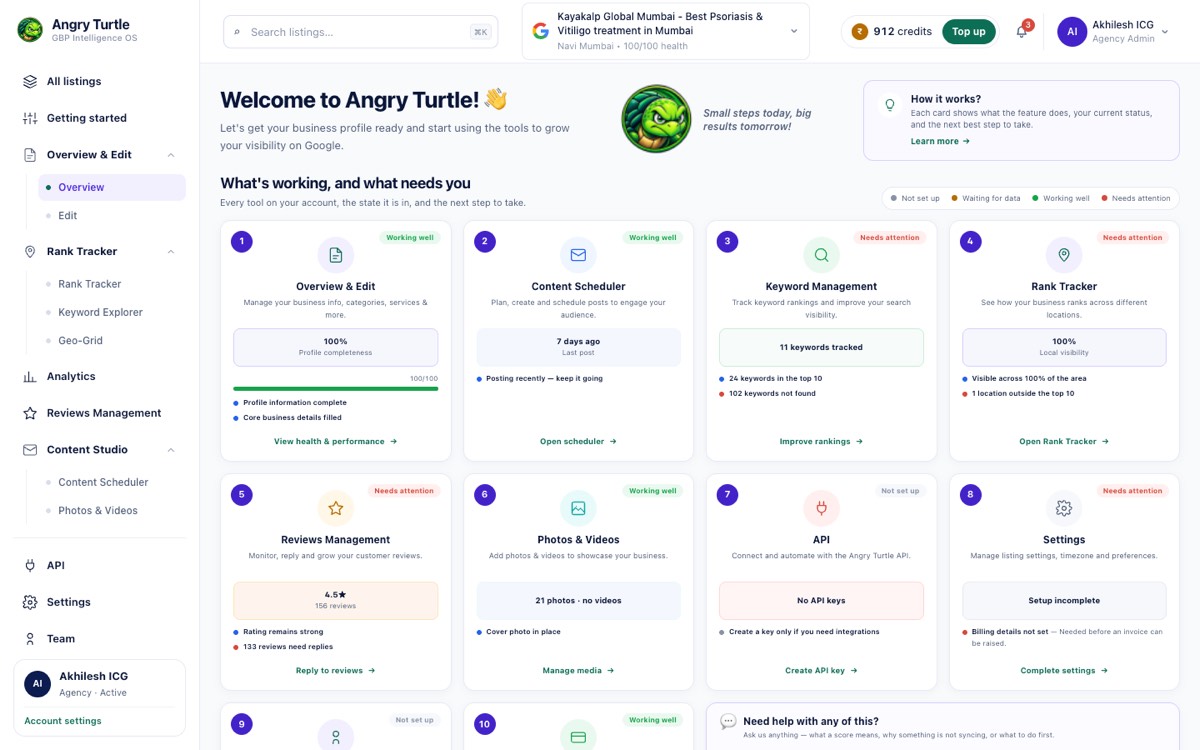

Related reading
Ready to have this run for you?
Book a free audit — we'll show you where you stand in 48 hours.