 Angryturtle
Most local SEO guides are written for someone managing several branches, or for an agency juggling a portfolio of clients. Read enough of them and a single-location business owner starts to feel like an afterthought — half the advice is about cannibalization between branches, duplicate-listing cleanup across a chain, or bulk operations that assume you have ten profiles, not one. If you run one clinic, one restaurant, one shop, that advice doesn't map cleanly onto your situation, and some of it is actively irrelevant.
Running exactly one location is, in some ways, the simpler problem. There's no cannibalization to manage, no portfolio to keep consistent, no franchise-level governance question. But it's also higher stakes in a specific way: you don't have a second listing to fall back on if this one is misconfigured, and every hour spent on local SEO has to justify itself against a business that's usually being run by the same person doing the marketing, the operations, and often the actual service delivery.
Why single-location businesses should prioritize the local pack first
For almost any single-location business, nearly every relevant search carries local intent — "dentist," "electrician," "bakery" typed near your business almost always triggers a map pack rather than a purely organic result. That means the highest-leverage place to put your limited time is your Google Business Profile, not a blog or a content strategy, at least at first. Local pack vs organic results goes into why the two surfaces behave so differently and why the pack usually matters more for exactly this kind of business.
This isn't an argument against having a website at all — it's an argument about sequencing. A single-location business with a perfect website and a neglected, wrong-category GBP profile is leaving the higher-value opportunity on the table.
Setting up the profile once, correctly
Because there's only one listing, there's no excuse for it being anything less than complete. Claiming and verifying your GBP is the starting point if this hasn't happened yet, and complete profile optimisation covers every field worth filling — hours, services, attributes, description — that a busy owner is tempted to skip past.
Category choice matters as much here as anywhere else, arguably more, since a single listing has no sibling profile to compensate if this one is set wrong. GBP categories covers how to pick the most specific match rather than a broad, safe-sounding one, and it's worth revisiting even if you set the category years ago — Google's category list changes, and a more precise option may exist now that didn't before.
If you're a service-area business rather than a storefront — a mobile groomer, a home tutor, a plumber who travels to the customer — get your service radius configured accurately from the start. Service area business walks through the setup, and getting this wrong either shows you outside your real coverage area or, worse, suppresses your visibility inside it.
What actually moves rank for a single-location business
Reviews carry outsized weight for a single-location business because there's no aggregate portfolio-level reputation to lean on — this one profile's rating and review count are the entire signal. Review generation covers realistic ways to build this steadily, and responding to reviews, including the negative ones, factors into ranking on its own, separate from the star rating itself.
Consistency in NAP data across your website, your GBP, and any directories you're listed on matters just as much with one location as with fifty — arguably it's easier to get right with one, since there's nothing to keep synchronized across branches, but that also means there's no excuse for a mismatch surviving unnoticed. NAP consistency covers the mechanics.
Freshness — posting occasionally, updating photos, keeping hours current including festival and holiday hours — signals an actively-run business, and for a single owner-operated location this is often the easiest dimension to neglect simply because there's no marketing team keeping a content calendar. A modest, sustainable cadence beats an ambitious one that stops after two months. GBP posting and content cadence covers what a realistic schedule looks like.
Where a single location can actually beat a chain
A single, well-run profile with genuine local roots often outcompetes a chain location on prominence and relevance signals a franchise struggles to replicate at scale — a chain has to manage this consistency across every branch, while a single-location owner only has to get it right once and keep it that way. The tradeoff is resources: a chain can absorb the cost of dedicated local SEO management across its portfolio, while a single-location business is usually doing this alongside everything else the business needs.
This is also where the case for either doing it yourself carefully or handing it to a managed service becomes a real decision rather than a hypothetical one. Done-for-you vs. DIY local SEO covers that tradeoff directly, and Angryturtle's Solo tier exists specifically for the owner-operator running one or two profiles who wants the same scoring and action-plan model an agency uses, without agency-scale overhead.
Measuring progress without a dashboard team
A single-location business doesn't need a portfolio-level reporting stack — it needs to know, simply, whether the profile is getting stronger and whether that's translating into calls and visits. Reading GBP performance data covers the core metrics Google exposes natively: views, website clicks, calls, direction requests.
A geo-grid check, which samples rank from several points across your actual service area rather than relying on a single personalized search from your own phone, is worth running periodically even for one location, since it shows the honest pattern of where you're winning nearby searches and where a competitor is beating you. Geo-grid rank tracking explains how this is typically set up.
Frequently asked questions
Do I need to worry about cannibalization if I only have one location? No. Cannibalization, where two of a chain's own listings compete against each other, only applies to businesses with multiple GBP profiles. A single location has no sibling listing to compete with.
Should a single-location business bother with content marketing at all? It depends on the category. Categories with a genuine research phase — legal, higher-ticket healthcare, real estate — benefit from some content even with one location. Immediate-need categories like a locksmith or a pharmacy get comparatively less return from content and more from GBP-side work.
How much time should a single-location owner realistically spend on this per week? There's no fixed number, but a sustainable, small weekly habit — checking for new reviews and responding, posting once every week or two, updating a photo occasionally — beats an intensive one-time push followed by months of neglect, given how much freshness now factors into ranking.
Is it worth hiring a managed service for just one location? It depends on the owner's time and the category's competitiveness. In a crowded category in a dense city, the time cost of doing this well yourself can exceed what a modest managed plan costs; in a less competitive category, a careful DIY approach following the fundamentals above is often enough.
Stop guessing where you rank locally.
Rank OS scores your Google Business Profile the way Google's local algorithm does — relevance, review health, freshness, entity authority and AIO readiness — and shows you exactly what to fix.
Book a live demo →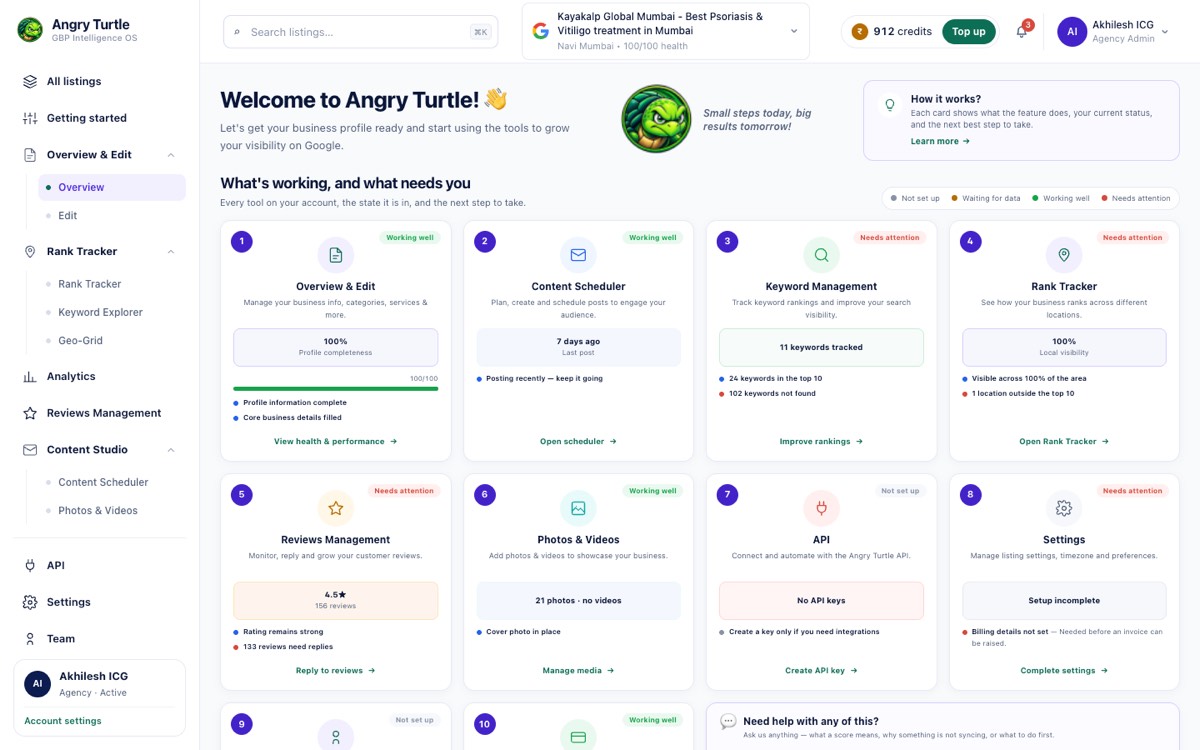

Related reading
Ready to have this run for you?
Book a free audit — we'll show you where you stand in 48 hours.