 Angryturtle
Business Location Data Management: The Operating Model
·
A location data management program fails quietly, long before anyone notices the wrong phone number on Google. It fails the day nobody in the company can say who is allowed to change a listing, and it fails again the day a franchisee edits their own hours without telling head office. Angryturtle's location data management page covers what the discipline is and what it fixes. This post is about the part that rarely gets written down: who owns the data, who approves a change, and how you audit whether any of it held.
Why governance, not tooling, is the actual gap
Most chains that call us already have some kind of listings tool. What they don't have is an answer to "who decided this address format" or "why does the Bengaluru branch still say a manager who left in March." Software syncs data. It doesn't decide who's allowed to touch it, and it doesn't catch a franchisee who bypasses the sync because head office's dashboard is slower than just editing the profile directly.
That's the gap this piece is about. A location data management platform gives you the pipe. Governance is what runs through the pipe — the rules, the roles, and the record of who did what, when.
Who should own location truth
Somebody has to be the single source of truth for what a location's name, address, hours, and services actually are — not the somebody who happens to notice a wrong number first. In practice this role sits in one of three places depending on company size, and our guide to managing multiple locations covers the operational side of this split in more detail.
At a 5 to 15 location business, it's usually one marketing or ops person who also does everything else. That's fine as long as they're explicitly named as the owner, not just the person who happens to have GBP login access.
At 20 to 100 locations, this becomes a real role — a data steward, sometimes titled "listings manager" or folded into a digital marketing lead's job. Their job isn't to write every listing update themselves. It's to define what a correct listing looks like, hold the source-of-record file (usually a spreadsheet or a location database feeding whatever tool sits on top), and reject or route changes that don't match it.
Past 100 locations, especially franchised networks, ownership splits. Corporate owns brand-level fields — name format, category, brand description language. Each location or franchisee owns operational fields — hours, phone, local promotions. The steward's job becomes defining exactly where that line sits and enforcing it, which is the part most franchise agreements leave vague.
The change-approval workflow, in practice
Say a franchisee in Pune wants to change their listed hours because they've started closing an hour earlier on Sundays. Who approves that, and how fast?
The honest answer for most businesses right now is: nobody approves it, they just do it, and head office finds out three weeks later from a customer complaint. A working approval workflow has three parts that have to exist regardless of company size.
First, a defined list of fields a location can change without approval — hours, temporary closures, phone number if it's a direct line — versus fields that need sign-off, like business name, category, or address. Second, a route for the second category: a form, a ticket, an email to the steward, something with a timestamp, not a verbal request that evaporates. Third, a turnaround commitment. If a franchisee waits nine days for hours approval, they'll stop asking and just edit it themselves, which puts you back where you started.
Angryturtle's Agency OS role structure — Agency Admin, SEO, Project Manager, Client — maps onto exactly this kind of split when a managed-service provider sits between the steward and dozens of locations, because someone still needs defined write permission before a change reaches Google.
Audit cadence: how often to check, and for what
An approval workflow without an audit is a policy nobody's checking. Two cadences matter here, and they check different things.
A monthly spot-check on a sample of locations — not all of them, that's not sustainable past 30 or so — looking for NAP consistency drift between what's live on the profile and what the source-of-record file says. This catches the slow leaks: a category that got changed during a Google-side re-verification, a phone number ported to a new line without anyone updating the master file.
A quarterly full audit across every location, checking not just NAP but category accuracy, description freshness, and whether secondary categories still match what the location actually offers. This is heavier, and it's the pass that catches the franchisee edits nobody flagged in the monthly spot-check because they weren't in the sample.
Neither cadence works without a written record of what was checked and what was found. "We looked and it seemed fine" isn't an audit. A dated log — even a plain spreadsheet — that says which locations were checked, what was wrong, and when it got fixed is the difference between governance and a vague sense that someone's keeping an eye on things.
What a location-data RACI actually looks like
RACI — responsible, accountable, consulted, informed — sounds like a consulting-deck word, but for multi-location data it maps onto something concrete enough to write on one page.
For a brand-level field, like the primary category: the data steward is responsible for defining it; a marketing or ops lead is accountable for the final call if there's a dispute; legal or franchise relations is consulted if a category choice touches franchise agreement language; every location owner is informed once it's set.
For an operational field, like holiday hours: the location manager is responsible for entering it; the steward is accountable for confirming it matches the approved format; nobody needs consulting for something this routine; the regional ops lead is informed via the monthly report.
Write this out once, put it somewhere every location manager can actually find it, and most of the "who approved this" arguments stop happening, because there's a document to point to instead of a memory of a conversation.
Where the write-back capability actually matters here
None of this governance work is worth much if the fix still has to be typed into Google's own interface by hand, location by location, after it's approved. Angryturtle's GBP editing pushes changes for name, description, phone, address, hours, categories, and service areas straight to Google rather than staging them for someone to re-enter manually. That's the difference between a governance policy that exists on paper and one that a steward can actually enforce at 60 locations without burning a week doing it by hand. See edit-to-Google for what the write path covers.
It matters more once volume climbs. A steward reviewing and approving 40 change requests a month can still push each one to Google individually. At 400 requests a month across a franchise network, the bottleneck isn't the approval decision, it's the manual re-entry after approval — which is exactly where bulk operations against the GBP API change what's realistic to enforce.
Onboarding a new location into the governance model
A new location is where governance gets tested first, because it's the one moment a listing gets created rather than edited, and every field starts from a blank slate.
The steward's checklist at onboarding should cover category selection against the brand's approved list, name format matching every other location exactly, address formatting consistent with how the rest of the network lists theirs, and — the one that gets skipped most often — a note in the source-of-record file the day the profile goes live, not three months later when someone remembers. Our onboarding new business locations piece walks through the mechanics of getting a fresh profile right; the governance layer here is making sure that new profile lands inside the same approval and audit structure as the other 60, rather than existing off to the side until someone notices.
When the model breaks down
Governance models fail in two predictable ways. The first is over-centralizing: every field, even the trivial ones, needs corporate sign-off, so locations stop bothering and edit directly, and the steward loses visibility entirely. The second is under-defining: the RACI exists on paper but nobody enforces the routing, so it collapses back into "whoever notices first fixes it," which is where most businesses started.
The fix for both is the same instinct — keep the rules few enough that people actually follow them, and check compliance often enough that drift gets caught before it becomes a pattern across dozens of locations. A multi-location local SEO strategy built on inconsistent underlying data doesn't compound. It just makes the inconsistency visible to more searchers, faster. The same discipline scales into full enterprise-grade multi-location governance once a network moves past a few hundred locations.
Frequently asked questions
Who should be the location data steward if we don't have a dedicated role yet? Whoever already owns the source-of-record file, even informally — usually a marketing ops or digital lead. Naming them explicitly, even without a title change, fixes most of the "who approved this" confusion on its own.
Does a location-data RACI need legal sign-off? Only the fields where a franchise agreement or brand contract already specifies who controls what. Operational fields like hours rarely need it. Brand-level fields like business name format sometimes do, especially in franchised networks.
How is this different from just buying a listings management tool? A tool syncs data across platforms once someone tells it what's correct. Governance is the part that decides what's correct, who's allowed to change it, and how often that gets checked. See what is a location data management platform and location data management vs listings management for the fuller distinction.
What's a realistic audit cadence for a 200-location franchise network? Monthly spot-checks on a rotating sample, quarterly full audits across every location. Anything less frequent than quarterly on the full set tends to let category and description drift accumulate past the point of a quick fix.
Stop guessing where you rank locally.
Rank OS scores your Google Business Profile the way Google's local algorithm does — relevance, review health, freshness, entity authority and AIO readiness — and shows you exactly what to fix.
Book a live demo →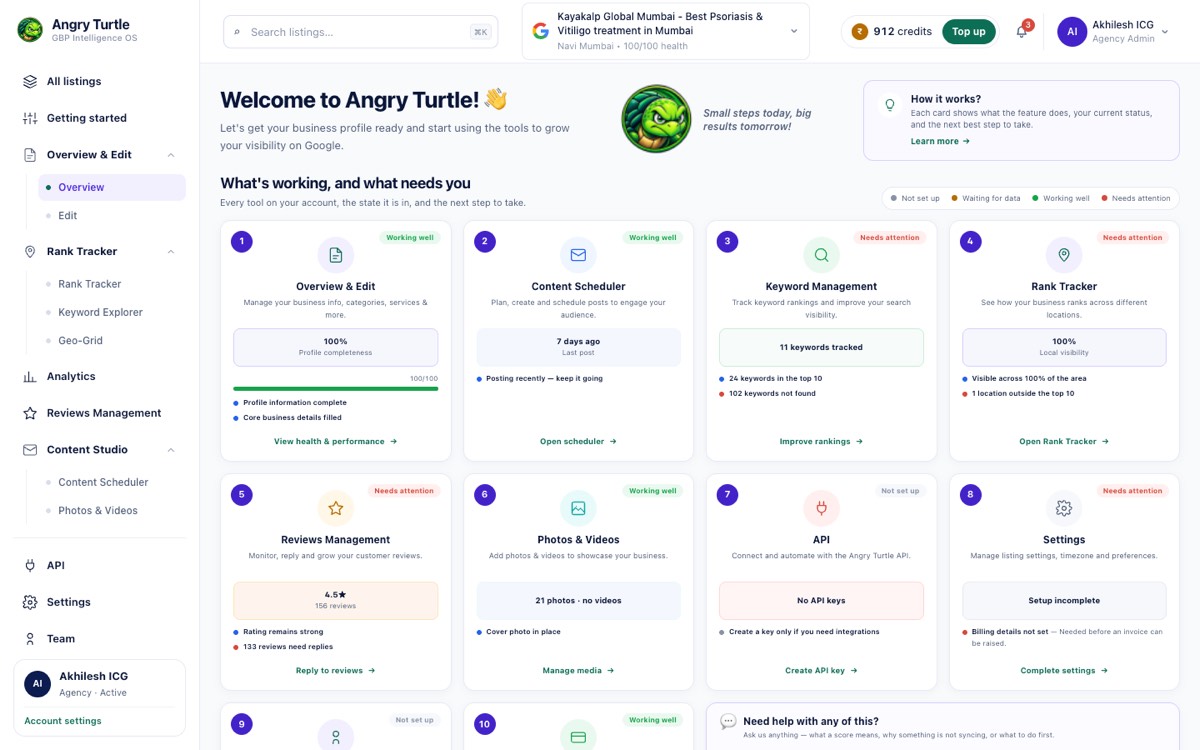

Related reading
Ready to have this run for you?
Book a free audit — we'll show you where you stand in 48 hours.