 Angryturtle
An answer engine is a system whose primary output is a direct answer rather than a ranked list of links. That's the whole definition, but it's worth sitting with, because the shift from "list" to "answer" changes almost everything about how a business gets found.
Traditional search engines are link engines. Type a query into classic Google, and you get ten ranked results and decide for yourself which one to click. The engine's job ends at ranking; the user does the reading and deciding. An answer engine skips that handoff — it reads across sources itself and hands the user a synthesised answer, often with a name or two already picked out.
Why the distinction changes what "optimisation" even means
Link engines get optimised through rank factors — backlinks, on-page keyword relevance, page speed, the traditional SEO toolkit. Answer engines get optimised through a different set of levers: entity clarity (does the system know clearly and unambiguously what this business is and where it's located), content structure (is the answer sitting in an extractable format near the top of the page), and authority signals that make a business citable rather than just rankable — reviews, schema, consistent citations across platforms.
This is why a business that's spent years doing classic SEO well — strong backlink profile, solid keyword targeting — can still be nearly invisible in answer engines if its entity data is scattered and its GBP is thin. The two skill sets overlap but aren't the same one. Keyword density and link building have limited pull on an answer engine's citation decision; entity clarity and structured authority have a lot.
The mechanics of how an answer gets built
An answer engine doesn't index the whole web the way a link engine does and then rank it. It retrieves a smaller set of relevant sources at the moment of the query — sometimes live, sometimes from a cached index — and generates a response by synthesising across them, usually attributing specific claims back to specific sources. That retrieval step is where entity clarity does its work: a system trying to decide which sources are actually about the business being asked about needs unambiguous signals to make that match confidently. A business named slightly differently across its website, GBP, and directory listings makes that matching harder, and a harder match means a lower chance of being pulled into the answer at all.
A mistake that follows from misunderstanding this
Businesses sometimes respond to AEO advice by doing more of what already worked for classic SEO — publishing more blog content, building more backlinks — without touching the entity-clarity and structure side at all. That effort isn't wasted, but it's aimed at the wrong lever for answer-engine visibility specifically. A business with ten strong backlinks and a fully consistent, schema-complete entity profile will usually out-cite one with a hundred backlinks and a messy, inconsistent one.
India's answer engine landscape
India's most-used answer engines, in roughly descending order of adoption as of 2025–26: Google AI Overviews, which reach the widest audience simply because they sit inside standard Google search; Gemini, both as a standalone product and as the model underneath AI Overviews and AI Mode; ChatGPT, with browsing enabled; Perplexity, whose adoption is growing fastest among tech-sector and research-oriented users; and Microsoft Copilot, present but with lower everyday consumer usage in India than the others. A business trying to prioritise where to build AEO effort first should generally weight toward Google's AI surfaces given that reach, then layer in Perplexity and ChatGPT presence as secondary but growing channels.
Example: A user asks Perplexity "which IVF clinic in Mumbai has the best success rates?" Perplexity browses live sources — clinic websites, Practo listings, news coverage — and generates a direct answer with citations attached. No ranked list appears; the user gets a name, or two, with reasoning attached. That's an answer engine functioning exactly as designed, and it's the moment where entity clarity either wins or loses the citation.
Related terms: AEO → · GEO → · LLM → · AI Overview → · RAG → · Entity SEO →
Related glossary terms
A score you can argue with, not a black box
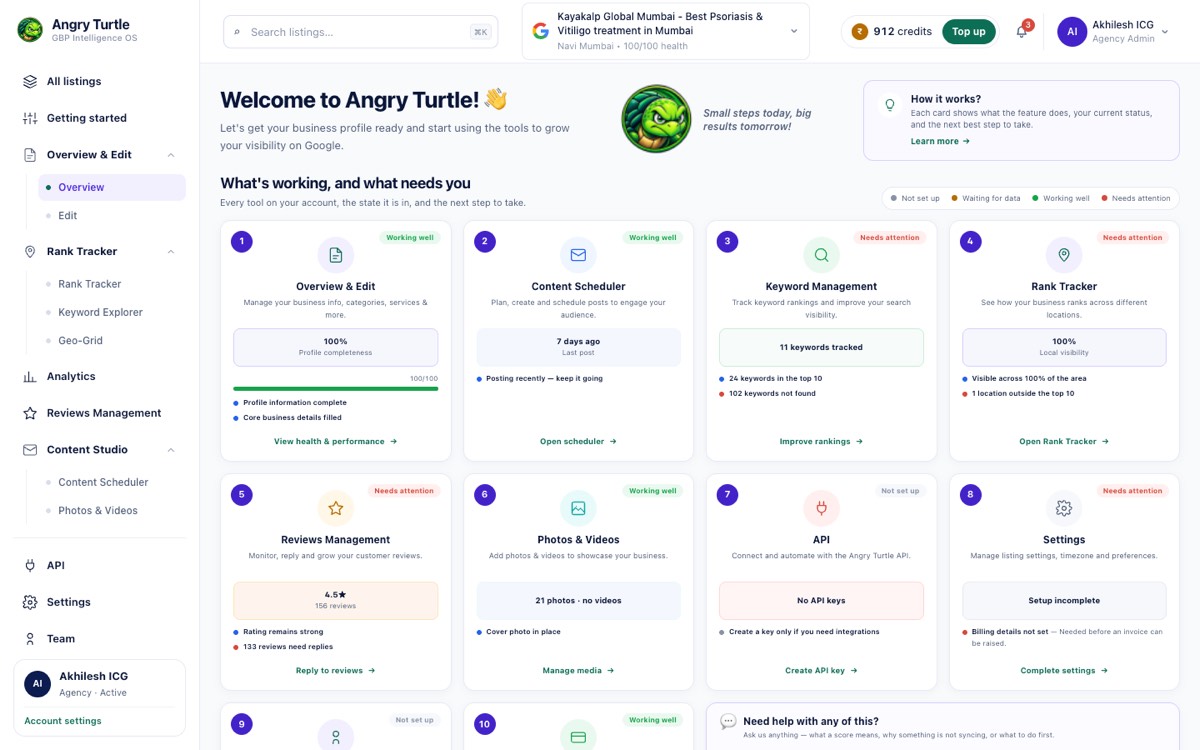
Rank OS gives every profile a 0–100 score built from five weighted dimensions — Relevance, Review Health, Freshness, Entity Authority and AIO Readiness — and the weights are tunable. Underneath it sits a ranked list of the fixes that move the number, each with the point lift it unlocks.
Ready to have this run for you?
Book a free audit — we'll show you where you stand in 48 hours.