 Angryturtle
Location Data Management
What it is, why it breaks at scale, and the tools and process that keep multi-location data accurate.
What is location data management?
Location data management is the discipline of keeping a business's core location facts — name, address, phone number, hours, categories, attributes, and geographic coordinates — accurate, consistent, and complete across every digital channel where that information appears: the GBP, directories, the company website, social platforms, navigation apps, and data aggregators. The word "management" is doing real work in that definition. This isn't a one-time cleanup; it's an ongoing system, because location facts change (a branch relocates, a phone line gets ported, hours shift for a festival) faster than most businesses notice and correct them everywhere they've been published.
For a single-location business, this is close to trivial. One set of facts, a handful of platforms, easy to keep in sync by hand whenever something changes. A solo dentist or a single-outlet café can manage this with a spreadsheet and twenty minutes a quarter.
Business location data management: the practice at scale
For a multi-location business — a bank with 400 branches, a retail chain with 150 stores, a hospital network with 25 facilities — location data management stops being a task and becomes an operational discipline with its own processes, ownership, and audit cadence. This is what "business location data management" actually refers to: not the concept in the abstract, but the specific practice a company with many locations has to build so that one relocated branch, one changed phone number, or one new store opening doesn't silently go stale on thirty different platforms while head office assumes it's handled.
The practice has three moving parts that a single-location business never has to think about. First, there's a source of truth — a master record that every platform gets checked against, rather than each location's manager updating things independently and inconsistently. Second, there's propagation — a defined way changes flow out from that source to every platform, on a timeline, rather than depending on whoever remembers to log into Sulekha that week. Third, there's ownership — a named person or team accountable for the whole thing, because "everyone's responsibility" reliably becomes nobody's.
Franchise networks face a particular version of this problem: each franchisee often manages their own local listings, with no consistent process across the network, so data quality varies branch to branch depending entirely on how organized any given franchisee happens to be.
Location data management vs. listings management
The two terms get used loosely and interchangeably, but they're not quite the same thing. Listings management is the narrower activity of getting a business listed correctly on individual directories and platforms — claiming a JustDial profile, fixing a Practo listing, updating a GBP. Location data management is the broader system that listings management sits inside: the master data, the change process, the audit cycle, and the governance that decides what "correct" even means before any individual listing gets touched.
A business can do listings management without location data management — going directory by directory, fixing whatever looks wrong at the time — and that's exactly how most multi-location businesses operate today. It works until the tenth branch opens, or the third rebrand happens, or head office loses track of which of forty vendors last touched which listing. Location data management is what prevents that collapse. Listings management on its own can't, because it has no system underneath it, just a series of individual fixes with no shared source of truth.
The mechanism: why inconsistent data actually costs rank
Google's local ranking systems use NAP consistency — how uniformly a business's name, address, and phone number appear across the web — as a trust signal that feeds into its assessment of a listing's legitimacy and prominence. The mechanism isn't mysterious: if the same business shows three different phone numbers across the directories Google's systems crawl and cross-reference, that's a weaker, less confident signal than a business whose facts match everywhere. Google isn't penalizing the inconsistency as a rule violation; it's simply less certain which version of the facts is real, and less certainty translates into less prominence in ambiguous cases.
The same mechanism now extends to AI systems. Large language models and AI Overviews draw on the same directory and citation data when they answer a "best X near me" query, and they're arguably less forgiving of contradictory data than Google's local pack algorithm, because an AI system generating a direct answer has to pick one version of the facts to state, and inconsistent source data makes that harder to do with confidence. See LLM citation → for how that mechanism works in more detail.
What's evidenced vs. widely repeated
It's worth separating what's actually confirmed from what gets asserted as fact across the local SEO industry. Google has stated, in its own guidance, that consistent business information helps it show accurate results and that inconsistent information can create confusion. What Google has not published is any specific weighting — no number that says NAP consistency is worth X% of ranking, no threshold for how many inconsistent listings triggers a penalty. Any article that gives you a precise percentage for how much NAP consistency "counts" is repeating an industry estimate, not a Google-published figure. The honest version: consistency is directionally confirmed as a factor, and the exact size of that factor isn't public.
Location data management infrastructure
A working system has four pieces, and skipping any one of them tends to reintroduce the exact problem the other three were built to prevent.
Master location file: a single source-of-truth spreadsheet or database holding canonical NAP data for every location — the one reference every platform gets validated against, not "whatever the GBP currently says" or "whatever's on the website."
Change management process: when any location's data changes — a new phone number, a relocated address, revised hours — a defined process propagates that change to every platform within a set SLA, rather than relying on whoever happens to remember.
Regular audit cycle: a monthly or quarterly automated check comparing every platform's live data against the master file, flagging discrepancies for correction before a customer or a competitor notices them first.
Platform-specific workflows: GBP updates go through the API for speed and scale. JustDial and Sulekha typically require direct claim-and-edit. IndiaMART and 99acres, relevant for B2B and real estate respectively, need their own platform-specific submission processes that don't generalize to a single workflow.
Location data management platforms: the tooling category
This is the third distinct thing people mean when they search "location data management" — not the concept, not the internal business practice, but the software category itself: a platform built to hold the master record, push changes out to directories, and flag discrepancies automatically instead of a team doing it by hand in spreadsheets and browser tabs.
Enterprise-grade platforms in this category, in Western markets, include Yext and Uberall, both built around syndication to a fixed set of mostly US and European directories. That's a real limitation for an India-based business: neither platform has native, deep coverage of JustDial, Sulekha, Practo, IndiaMART, or 99acres, because those directories aren't part of the syndication network either platform was originally built around.
That gap is exactly why Angryturtle manages the Indian location data stack through direct API integrations with the directories Indian businesses actually rely on, rather than routing everything through a syndication layer designed for a different market's directory landscape. This page stays on the concept; the commercial specifics of that service live at Location Data Management → rather than here, if that's what a reader is actually looking for.
A platform is not a replacement for the three-part practice described above — source of truth, propagation, ownership — it's the tool that makes that practice sustainable past the point where a spreadsheet and a quarterly manual check can keep up.
How to measure location data accuracy
The simplest working measurement is a consistency audit: for every location, check the same four fields — name, address, phone, hours — across every platform the business is listed on, and count how many platforms match the master record versus how many don't. Express it as a percentage per location, then average across the network. A business scoring 95%+ consistency across its top 15-20 directories is in reasonably good shape; a business scoring below 70% has a real, measurable problem, not a cosmetic one.
A bad reading looks specific, not vague: three branches showing a phone number that was disconnected eight months ago, five branches missing entirely from a directory the rest of the network is listed on, or a business name that reads "ABC Pvt Ltd" on the GBP and just "ABC" on JustDial. Any of those, found during an audit, is an actionable fix, not a footnote. The audit itself needs to run on a fixed cadence — monthly for anything past 50 locations, quarterly below that — because data drifts continuously; a one-time audit is a snapshot, not a system.
The location data problem at scale
At 50-plus locations, location data degradation is not a risk to plan for — it's the default state without an active system fighting it. The failure modes repeat with almost mechanical predictability: branches relocate, but the old address survives in thirty out of fifty directories for years afterward. Phone numbers change, and only the GBP gets the update, while every third-party directory keeps ringing the old line. New branches open and simply aren't added to most directories, invisible to anyone searching near them. Business name formats drift across platforms — abbreviations, punctuation, "Pvt Ltd" on one, dropped on another. Hours change seasonally, but the update reaches some platforms and not others. And GBP accepts suggested edits from third parties, some of which are wrong, and nobody at the business notices until a customer complains.
Common mistakes
Treating the GBP as the single source of truth is the most common one. The GBP is a destination for location data, not the master record — if it's treated as the source, every other directory ends up chasing whatever the GBP happens to say at any given moment, and the GBP itself is exactly as editable by anonymous third parties as any other listing.
Auditing once and calling it done is the second. A single cleanup project fixes the current state; it does nothing about the branch that relocates next quarter or the phone line that gets ported six months from now. Without a recurring cadence, every audit just resets the clock on the next round of drift.
The third is assuming a syndication tool covers India because it covers "the world." Checking the actual directory list a platform syndicates to — not its marketing copy — before assuming JustDial, Sulekha, or Practo are included, saves a business from discovering the gap only after the audit shows those directories were never touched.
Who actually needs this
Below roughly ten locations, a disciplined spreadsheet and a quarterly manual check is usually enough — the volume doesn't justify heavier tooling yet. Past that point, and certainly past fifty, manual tracking breaks down because the number of location-times-platform combinations to check grows faster than any team's capacity to check them by hand. Franchise networks, multi-branch banks and NBFCs, hospital and clinic chains, and retail chains with regional expansion plans are the categories where this stops being optional.
What breaks without it
Without active location data management, a multi-location business slowly accumulates a gap between what its systems say and what's actually true in the world. That gap shows up first in local search rank, then in AI citations — which draw on the same directory data and are, per the mechanism above, even less forgiving of inconsistency — and eventually in direct customer complaints about wrong addresses or dead phone numbers. By the time it's visible in complaints, it's usually been costing rank for months already.
FAQ
Is location data management the same thing as citation management? No. Citation management, getting a business listed correctly on individual directories, is one function inside location data management. The broader practice also audits what's actually live against the master record and hunts down the duplicate or orphaned listings a directory generates over time, rather than publishing the record once and moving on.
Is this the same as a location data management platform? Not quite. The platform is the software category, the tool that holds the master record and pushes it out automatically. Location data management is the underlying practice, the source of truth, the change process, the ownership, that the platform exists to make sustainable at scale. A business can run the practice on a spreadsheet without the tooling; it's just harder to keep up past a handful of locations.
Adjacent concepts
NAP consistency → is the specific data-accuracy outcome location data management is built to produce. Multi-location SEO → is the broader discipline it sits inside, covering GBP management, reviews, and citations at scale alongside the data layer. Local schema → is the on-website structured-data counterpart — the same facts, declared in a format machines can read directly. Citation aggregators (India) → covers the specific vendors that feed Indian directory data. Duplicate listings → is one of the most common byproducts of poor location data management, where a relocated or renamed branch spawns a second, orphaned profile instead of updating the original.
Example: A pan-India NBFC with 220 branches relocated eighteen branches during a single financial year as leases expired. Six months later, an internal audit found eleven of those eighteen still showing the old address on at least one major directory, and three still showing it on the GBP itself — despite the internal CRM having the correct address the entire time. The gap wasn't a data problem. The correct data existed. It was a location data management problem: no process existed to push a confirmed change out to every platform that needed it.
Related terms: NAP consistency → · Multi-location SEO → · Local schema → · Citation aggregators (India) → · LLM citation → · GBP API → · Duplicate listings → · GBP verification →
More on this: Stop branches competing in local search → · Enterprise Local SEO → · Multi-Location Local SEO Services → · GBP Management Services → · Location Data Management (service) → · Managing multiple locations (learning centre) →
Related glossary terms
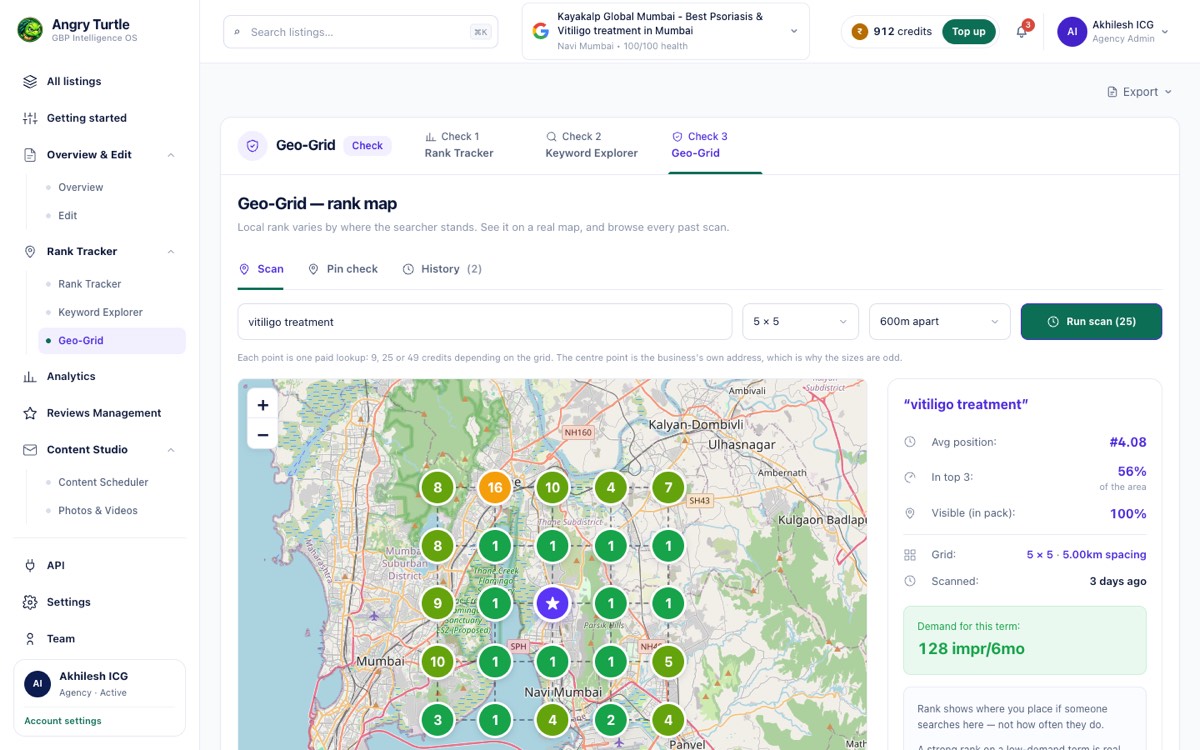
Rank at every point, not one number
A single "you rank #4" figure hides the truth. The geo-grid runs the search from a grid of points across the service area and shows where you actually win, where you fade, and where you are not in the pack at all.
Ready to have this run for you?
Book a free audit — we'll show you where you stand in 48 hours.