 Angryturtle
How to Rank in the Google Local Pack
The three factors behind local pack ranking, the levers you actually control, and an honest answer on why no one can guarantee a spot.
The short version
You rank in the local pack by being relevant to the search, close enough to the searcher, and prominent enough that Google trusts you over the other options nearby. There's no shortcut and no guarantee, but the levers are known: a complete verified profile, the right primary category, reviews that clear the local bar, clean citations, regular activity, and a website that backs up what the profile claims. Do those well and you compete for one of three spots. Nobody can promise you'll land in them, and anyone who says otherwise is selling something.
What the local pack actually is
The local pack, sometimes called the map pack or the local 3-pack, is the block of three business listings with a map that Google shows above the regular organic results for searches like "dentist near me" or "plumber in Gurgaon." Full definition and history are in the local pack glossary entry if you want the background. For this playbook, what matters is simpler: it's three slots, ranked, and most searchers never scroll past them.
Why it's the real estate worth fighting for
Local pack clicks convert at a different rate than organic listings below them. A searcher typing "electrician near me" is close to calling someone, not researching. Three businesses get seen before the fold on mobile; everyone else is one scroll down, competing with reviews and directory sites for attention they may never get. That's the whole case for caring about this specific box instead of just "ranking well" in general.
How eligibility and ranking actually work
Google has said its local ranking runs on three factors, and it's worth taking them one at a time instead of blending them into a single vague "algorithm."
Relevance is whether your profile matches what was searched. A profile categorized as "general contractor" competing for "emergency plumber" starts behind, no matter how many reviews it has.
Distance is how close your business is to the location implied in the search, whether that's a typed city name or the searcher's actual GPS position. You can't fake this and you can't buy your way past it — you can only make sure Google has an accurate address and service area to work from.
Prominence is everything else: review count and rating, citation consistency, how well-known the business is offline, and increasingly how complete and active the Google profile itself looks. This is the factor with the most room to work in, and it's where most of the levers below live.
The levers that actually move a listing
Verified, fully complete profile. An unverified or half-filled profile is competing with one hand tied. Every field Google exposes — hours, attributes, services, photos, description — should be filled in accurately, not just claimed and left blank.
Primary category match. This is worth its own line because it's the single most common reason a business is invisible for a search it should win. The primary category has to match the core service, not a broader or adjacent one. Secondary categories help, but the primary category carries the weight.
Reviews above the local threshold. There's no universal number — the "threshold" is relative to what competitors in that specific search have, not a fixed count anywhere. A business with 40 reviews can outrank one with 200 if the 40 are more recent, higher-rated, and answered. Volume matters, but recency and response rate matter close to as much.
NAP and citation consistency. Name, address, and phone number have to match, word for word, everywhere the business is listed. A mismatched suite number or an old phone number sitting on a directory page is a small thing that quietly caps prominence.
Engagement and freshness. Profiles that post, upload photos, and get clicked on look active to Google. A profile that hasn't been touched in eight months reads as dormant even if the business behind it is thriving.
On-page support. The website behind the profile should say the same things the profile says — same services, same location, same name. A local landing page for the specific city or neighborhood being targeted gives Google (and the searcher) a second data point that confirms the profile isn't just claimed but real.
Measuring it: the geo-grid, not a single rank check
A single "am I #1" check from one location tells you almost nothing, because local rank shifts by literal meters. Search from three blocks away and the pack can look completely different. That's what a geo-grid solves — it checks rank across a grid of points around a service area so you can see where you actually show up versus where you don't, and how that shifts over weeks. Angryturtle's geo-grid tool runs this automatically instead of asking someone to search from a dozen phones by hand.
The honest limit
Only three slots exist per search, per location, per moment. Every competitor doing the same work you are is chasing the same three slots, and Google's own local ranking systems change without notice. Nobody, including Angryturtle, can guarantee a spot in the local pack for any keyword. What can be done is measurable and repeatable: close the gaps above, track the movement, and keep doing it, because the businesses that show up consistently are the ones treating this as ongoing work rather than a one-time fix.
How Angryturtle helps with this, self-serve or managed
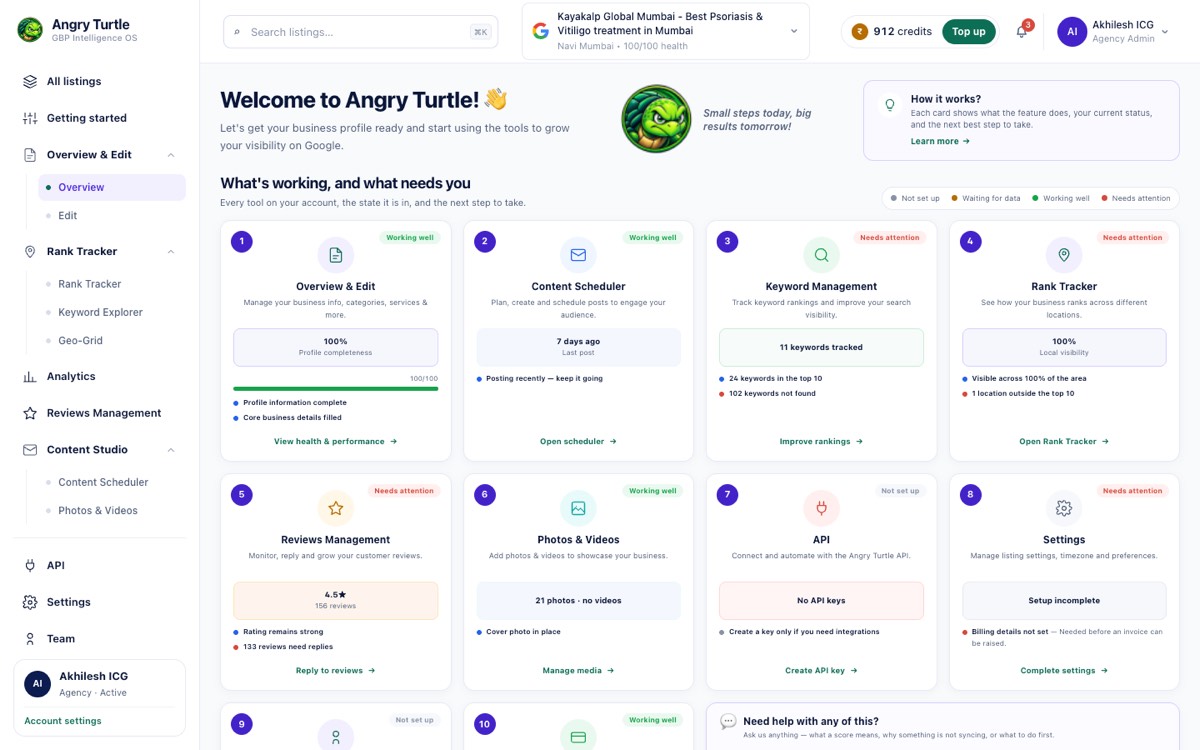
Angryturtle's Rank OS scores a profile across five weighted dimensions, including relevance and freshness, and tells you which of the levers above is worth fixing first for that specific listing rather than handing you a generic checklist. The geo-grid shows where rank actually sits across a service area, not just from one point. The competitor tool surfaces exactly which citations your top local rivals have that you don't, so the citation work above is targeted instead of guessed at. And the platform edits and pushes changes straight to the live Google profile — categories, hours, description — instead of just flagging what's wrong and leaving the fix to someone else.
Some businesses run this themselves inside the Solo plan. Agencies managing a book of local clients use the same scoring and geo-grid tools across a portfolio, white-labeled. Either way, it's the same underlying system: diagnose, prioritize, fix, measure again.
For a related read, see how to rank higher on Google Maps, which covers the broader Maps ranking picture beyond just the 3-pack.
FAQ
Can Angryturtle guarantee my business will show up in the local pack? No. No tool can guarantee a spot in three slots that every local competitor is also chasing, and Google's local ranking changes without notice. What Angryturtle does is show you the specific gaps holding a listing back and track movement over time.
How many reviews do I need to get into the 3-pack? There's no fixed number. It depends on what the businesses already in the pack for that search have. A newer business with fewer but recent, well-answered reviews can beat an older one with a stale review history.
Does my website need to rank well for my Google profile to show in the local pack? Not directly, but a website that backs up the profile's claims (matching name, address, services) supports prominence. A local landing page for the exact city or service being targeted helps more than a single generic homepage.
Is the local pack the same as the map pack? Yes, "local pack," "map pack," and "local 3-pack" all refer to the same three-listing block with a map that appears above organic results for local searches.
How often should I check my local pack ranking? Weekly is reasonable for an active listing, since rank shifts with review activity, freshness, and competitor changes. Checking from a single point is less useful than a geo-grid sweep, since rank varies by location within the same service area.
More how-to playbooks
A score you can argue with, not a black box
Rank OS gives every profile a 0–100 score built from five weighted dimensions — Relevance, Review Health, Freshness, Entity Authority and AIO Readiness — and the weights are tunable. Underneath it sits a ranked list of the fixes that move the number, each with the point lift it unlocks.
Ready to have this run for you?
Book a free audit — we'll show you where you stand in 48 hours.