 Angryturtle
Can You Rank on Google Maps Without a Physical Address?
Service-area businesses can hide their street address and still show up on Google Maps, though proximity to your registered location still shapes the reach.
Yes. If you run a service-area business, a plumber, electrician, home inspector, or consultant, you can hide your street address on Google Business Profile, set the areas you serve instead, and still rank on Google Maps in those areas. The catch: Google still favors proximity, so you'll rank strongest near wherever your business is actually registered, not evenly across every zip code you list.
Service-area business vs. storefront
A storefront listing shows an address because customers walk in. A service-area business, or SAB, goes to the customer instead: a mobile plumber, a home cleaner, a landscaper, a consultant who meets clients on-site. Google built a specific listing type for exactly this, defined at service-area-business. You still register a base location for verification, but you can hide it from public view and mark the profile as service-area only. Nobody searching sees your street. What they see is the areas you cover and, ideally, your listing on the map when they search a job inside one of those areas.
How to set it up
In the Business Profile, go to the business information section and toggle "I deliver goods and services to my customers" instead of listing a storefront. Then hide the address, and enter your service areas as cities, postal codes, or regions, whatever Google's system recognizes for your location. This part matters: Google won't accept a place it can't match to a real, mapped area. Type in a neighborhood name Google doesn't recognize and it just won't save. Most owners set this once and forget it, then wonder why leads dry up in a market they added six months ago.
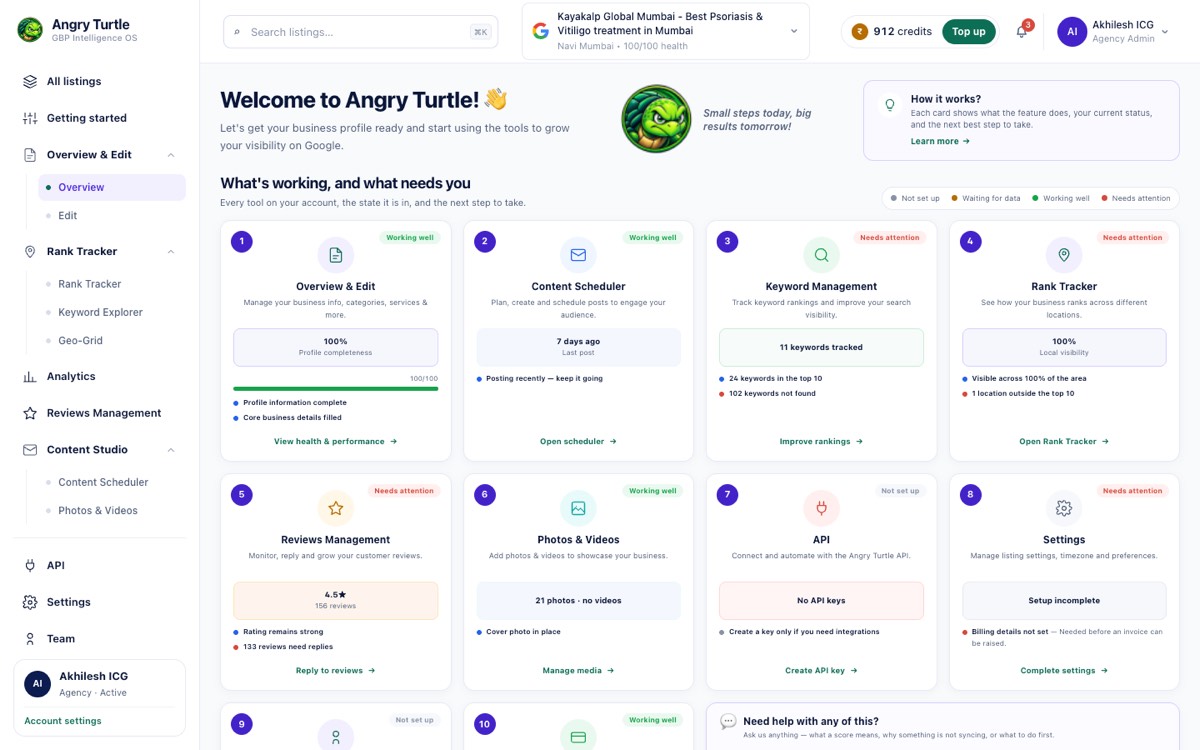
Angryturtle's edit-to-google tool handles this directly. You set or adjust service areas in the platform, and the change pushes straight to your live Google profile rather than sitting in a queue. If you manage several listings, that difference adds up fast, and it's covered further under multi-location local SEO once you're past a single profile.
The catch: proximity still rules
Google doesn't treat a 40-mile service radius as 40 miles of equal ranking strength. Rank tends to fade the farther a search sits from your registered base location, even inside a service area you've legitimately claimed. A plumber based in one suburb who lists an entire metro area will usually rank well near home base and weakly at the edges. You can't blanket a whole state and expect to show up first for every town in it. Distance decay is real, explained more fully at proximity, and it's one of the most common things owners misjudge about SABs.
This is where geo-grid checking earns its keep. Instead of guessing how far your visibility actually reaches, a geo-grid pulls rank position across a spread of points on the map, so you can see the real shape of your coverage rather than assuming it matches your listed service area.
What actually drives rank for an SAB
Hiding your address doesn't hide you from the ranking factors that matter. Category selection, review volume and recency, citation consistency across directories, and overall prominence, how well-known and well-linked the business is, all count the same as they would for a storefront. An SAB with a handful of reviews and a vague primary category isn't going to outrank a storefront with a strong review base just because it hid its address. Rank OS scores a listing across these dimensions and flags which one is actually holding a profile back, so the fix isn't guesswork.
The mistake that gets listings suspended
Some owners, frustrated by the proximity problem, list a fake or rented address just to look closer to a market they want to rank in. Google treats this as a policy violation, and it can get the whole profile suspended, which is worse than ranking modestly in a real service area. The gbp-suspension path is far more painful than accepting a smaller-than-hoped-for footprint. There's no shortcut here worth the risk, and no tool, Angryturtle included, can guarantee a specific ranking position. What a good setup does is remove the mistakes that keep a listing from competing fairly.
Angryturtle works either way here: self-serve, where you manage the service-area setup and geo-grid checks yourself, or managed through Angryturtle's GBP management service, where the team handles the profile end to end.
FAQ
Can I add cities far from my base and still rank there? You can list them, but expect weaker visibility the farther they sit from your registered location. Distance decay is normal for SABs.
Do I need a storefront to use Google Maps at all? No. Service-area businesses without a public storefront are fully supported. You just set up the profile as service-area only and hide the address field.
Is it against Google's rules to hide my address? No, it's an intended setting for exactly this business type. What's against the rules is entering a fake or unused address to appear closer to a market.
More questions answered
A score you can argue with, not a black box
Rank OS gives every profile a 0–100 score built from five weighted dimensions — Relevance, Review Health, Freshness, Entity Authority and AIO Readiness — and the weights are tunable. Underneath it sits a ranked list of the fixes that move the number, each with the point lift it unlocks.
Ready to have this run for you?
Book a free audit — we'll show you where you stand in 48 hours.