 Angryturtle
Location Data Management vs Listings Management
Two related but distinct disciplines, and why multi-location brands need the broader one.
Listings management is the narrower job: getting your business name, address, phone, and hours distributed and synced across directories like Google, JustDial, and Sulekha. Location data management is the bigger discipline it sits inside, keeping one accurate source of truth for every attribute of a location, across every channel that shows it, with someone actually responsible for catching drift when it happens. The full definition is at location-data-management; for what a platform built around this actually does, see what-is-location-data-management-platform.
Where the two overlap
Both deal with NAP data. Both care about consistency, covered in depth at nap-consistency. If a directory listing is wrong, both practices would flag it. That overlap is why the terms get used interchangeably in most vendor pitches, and why it's easy to buy a "listings" tool and assume it covers the whole problem. It doesn't.
Where they actually differ
Listings management is about distribution. You have one canonical version of your business info, and a tool pushes it out to a set of directories, then checks that each one still matches. That's the whole job. It's useful and necessary, but bounded, it stops at the directory layer.
Location data management is broader. It includes the directories, but also your website's own NAP block, your Google Maps pin, your schema markup, aggregator feeds like data brokers use, and increasingly your presence in AI answer engines. It asks a different question, not just "is this listing correct" but "is every place this location's data lives, correct, right now, and who's accountable if it drifts." That accountability piece, governance and an audit trail rather than just a sync job, is the part listings tools usually don't touch.
A useful way to think about it: listings management is a task. Location data management is a system that includes that task.
Why this matters more for multi-location Indian brands
A single-location business can often treat this as a listings problem and get away with it. A chain with fifteen branches across Mumbai, Bengaluru, and Pune can't. Each branch has its own hours, its own manager updating things ad hoc, its own mix of directories, JustDial in one city, Sulekha in another, Practo if it's a clinic, IndiaMART if there's a B2B angle. See citation-aggregators-india for how fragmented this gets in practice. Without a governance layer sitting above the individual listings, inconsistencies compound branch by branch, and nobody notices until a customer shows up to a location that's listed as permanently closed. Multi-location local SEO is where this gets solved at scale.
This is also where AI answer readiness starts to matter. If a location's data is inconsistent across sources, an AI system pulling from multiple feeds has conflicting signals to work with, making the business a worse candidate to be cited as a confident answer, a topic covered at ai-search-visibility and the ai-citations-chatgpt-perplexity-gemini pillar.
How Angryturtle handles both
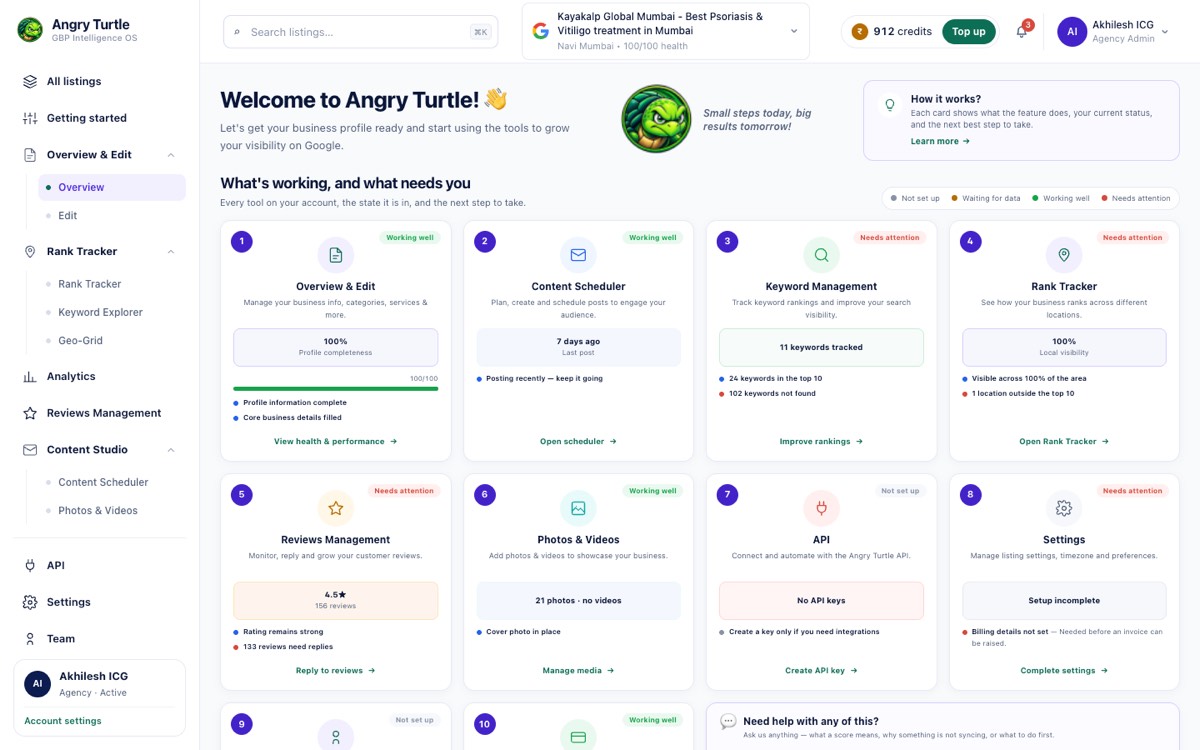
Angryturtle covers listings management as a base layer, automated citation discovery, NAP consistency checks, and a duplicate finder that catches the JustDial or IndiaMART entry nobody remembers creating, all under citations-nap. On top of that sits the location data management layer: a scored view of every profile element inside Rank OS, a current-vs-proposed audit that flags exactly what's wrong and why it's risky, and a direct write-back to Google so an approved fix actually pushes live instead of sitting in a report.
Whether that runs self-serve by an in-house team or as a managed service through gbp-management-services, the mechanism is the same: score the gap, fix it, push it, log it. Reports alone don't close the gap. Acting on them does.
FAQ
Is listings management the same as citation building? No. Citations are directory listings of your NAP data, not backlinks, they don't carry the same SEO weight as a link from another site, though consistent citations do support how confidently search engines and AI systems treat your location data.
Can I manage location data myself, or do I need a managed service? Either works. Angryturtle supports self-serve for teams who want to run the audits and pushes themselves, and a managed option for teams who'd rather hand the ongoing governance to someone else. Neither path guarantees a ranking outcome, the work is about accuracy and readiness, not a promised position.
What happens if my listings are consistent but my website NAP isn't? That's exactly the gap location data management is built to catch. A clean set of directory listings sitting next to a stale website footer is still a governance failure, just one that listings-only tools won't see.
More questions answered
A score you can argue with, not a black box
Rank OS gives every profile a 0–100 score built from five weighted dimensions — Relevance, Review Health, Freshness, Entity Authority and AIO Readiness — and the weights are tunable. Underneath it sits a ranked list of the fixes that move the number, each with the point lift it unlocks.
Ready to have this run for you?
Book a free audit — we'll show you where you stand in 48 hours.