 Angryturtle
Your Map Pack Ranking Dropped: What to Check First
·
Check three things before you panic: a recent edit to your profile, a review pattern change, and whether your competitors moved instead of you sitting still. Most map pack drops trace back to one of those, and the fix is usually faster than the anxiety around it suggests.
A ranking drop feels sudden but rarely is. Google's local algorithm re-scores constantly, and a rank you held for months can slip in a week because a competitor added twelve reviews, or because your own profile went quiet. The job here is to work through the checks in order of likelihood, not to guess, using the same local ranking factors Google's own local pack weighting is built on.
Start with what changed on your own profile
Pull up your edit history first. Did anyone on your team touch the category, the business name, the address, or the hours in the last thirty days? GBP ranking factors weight category and relevance heavily, and a well-meaning "cleanup" that swapped your primary category for something broader is one of the most common self-inflicted drops we see.
Freshness matters too. If your last Google Post was two months ago and your last new photo was from a festival that's long over, the profile reads as dormant. Google's local ranking model treats recency of activity as a live signal, not a one-time checkbox — it's part of what Rank OS scores as a Freshness dimension, decaying after roughly three weeks of silence. A profile that stopped posting in June and dropped in July isn't a coincidence. Our GBP optimization checklist covers the full list of fields this touches.
Also check whether your listing got suspended and reinstated recently. A reinstatement doesn't always restore your prior map pack rank immediately; it restarts some of the trust signals Google had accumulated. If suspension is part of your story, GBP suspension reasons and our reinstatement service walk through what typically triggers it and how long recovery tends to take.
Look at your reviews, not just your rating
A star rating holding steady can hide a review velocity problem. If you went from four new reviews a month to zero, that's a decline even though the average didn't move. Review Health is one of five weighted dimensions inside Rank OS, alongside Relevance, Freshness, Entity Authority, and AIO Readiness, and it drops when velocity stalls even if historical sentiment stays good.
Negative reviews without a response also compound the damage. It's not just the star drag — an unanswered one-star review sitting at the top of your profile for weeks tells both users and Google that nobody's managing the account. Reply promptly, and if you suspect the reviews themselves are fake, that's a separate track worth investigating on its own.
Check whether competitors moved, not just whether you did
Sometimes nothing changed on your end. A competitor two blocks over added a services list, filled out their secondary categories, or picked up eight reviews in a fortnight. Relative rank is exactly that — relative. Competitor ranking higher on Google Maps is worth reading if this is your situation, because the fix isn't "undo something," it's "out-execute what they just did."
This is where a geo-grid view earns its keep. A single rank number for one search term hides the fact that you might have dropped only in the two-kilometer radius east of your location while holding steady elsewhere. Geo-grid rank tracking shows rank at every point across your service area instead of collapsing it into one misleading average, and pairing that with reading your GBP performance data usually tells you which side of town to look at first.
Rule out a technical or duplicate-listing problem
Search your business name plus your city on Google Maps directly. If two listings show up — one old, one current — Google may be splitting your signals between them, which tanks both. This happens often after a move, a rebrand, or a franchise handover where the previous owner's listing never got merged or closed.
NAP inconsistency across directories is the quieter version of the same problem. If your phone number on JustDial doesn't match what's on your GBP, or your address on Practo is the old one, Google's entity confidence in "which business is this really" softens, and rank softens with it. NAP consistency at scale covers how to audit this without doing it directory by directory, and it's also worth checking whether profile completeness affects AI citations if you've noticed drop-off in AI-driven discovery alongside Maps.
What to check, in what order
Work through this sequence rather than jumping around:
- Edit history — category, name, address, hours changed in the last 30 days
- Review velocity — new reviews per month, not just the average rating
- Response rate — unanswered reviews sitting for more than a few days
- Posting and photo cadence — anything published in the last 21 days
- Suspension history — a recent flag or reinstatement
- Competitor activity — did they add reviews, categories, or photos recently
- Duplicate listings — search your own name and address to check
- NAP consistency — spot-check your top five directories against your current GBP
Most drops resolve within one or two items on this list. A handful don't, and that's the honest caveat: if you've ruled all of this out and rank still hasn't recovered after several weeks, it may be an algorithm update affecting your category or city broadly, and that kind of shift is outside anyone's direct control, including ours. Google's own systems are also increasingly pulling local answers into AI Overviews, which sometimes explains a click drop that looks like a rank drop but isn't quite the same thing.
Fixing what you find
If it's a category or profile-field issue, direct GBP editing that pushes changes straight to Google — not a request queue, an actual live push — closes that gap in hours rather than days. If it's a review velocity problem, a structured ask-for-reviews cadence tends to recover faster than people expect once it restarts. If it's a duplicate listing, merging takes longer and is genuinely Google's call once you've flagged it; ours or anyone else's influence there is limited to filing the request correctly and following up.
GBP management services covers the audit-and-fix cycle described above as an ongoing service if you'd rather not run this checklist manually every time rank moves, and it works the same way whether you run one location yourself or manage a portfolio through Agency OS.
Frequently asked questions
How long does it take for a Google Maps rank to recover after fixing the cause? It varies by what caused the drop. A category correction can show movement within days. A review velocity fix takes longer because it depends on real customer behavior, typically weeks. A duplicate-listing merge is the slowest because it's a Google support process, sometimes running into months.
Can one bad review really drop my rank? Rarely on its own. A single negative review affects perception more than algorithmic rank. A pattern — several negative reviews close together, or a stretch with zero new reviews — is the more common driver.
Is it normal for rank to fluctuate week to week even with no changes? Some fluctuation is normal; Google re-crawls and re-scores constantly, and competitor activity alone can shift your relative position. Persistent, one-directional decline over several weeks is the pattern worth investigating, not day-to-day noise.
Should I just change my category back if a recent edit caused the drop? Only if the previous category was more accurate. Reverting an inaccurate change back to another inaccurate one doesn't fix the underlying relevance mismatch — it's worth taking the time to pick the genuinely correct category rather than just undoing the last edit.
Does Angryturtle guarantee a rank recovery? No tool can guarantee what Google's algorithm will do. What we can do is run the diagnostic above systematically through Rank OS, execute the fixes that are within your control — category, freshness, review response, NAP — and push them live, which covers everything except the parts that are genuinely Google's decision alone, like listing merges and suspension appeals.
Stop guessing where you rank locally.
Rank OS scores your Google Business Profile the way Google's local algorithm does — relevance, review health, freshness, entity authority and AIO readiness — and shows you exactly what to fix.
Book a live demo →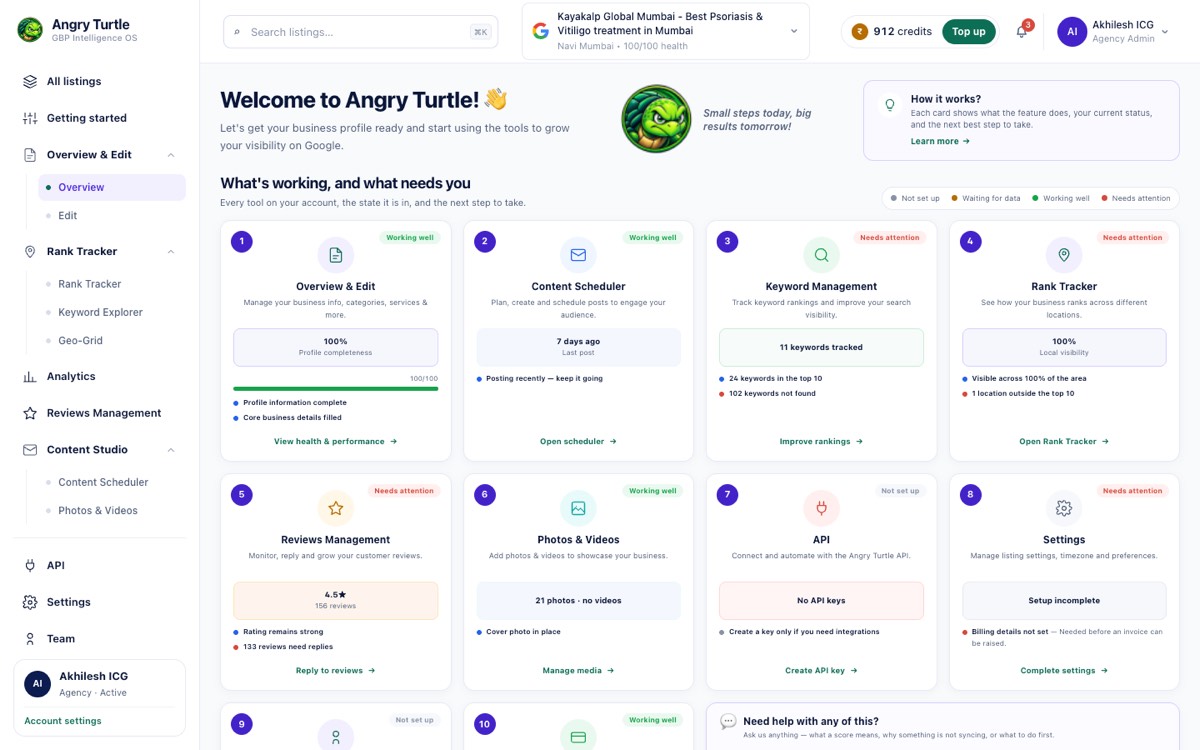

Related reading
Ready to have this run for you?
Book a free audit — we'll show you where you stand in 48 hours.