 Angryturtle
Healthcare SEO in Delhi
How patients search, how Practo sits alongside Google, and how to structure multi-doctor and multi-branch profiles, for hospitals, clinics and diagnostic centres in Delhi.
·
A patient in Sector 56, Gurgaon searches for a good orthopaedist, and the results that matter to her aren't confined to Gurgaon at all — she's just as likely to book with a Saket specialist forty minutes away if the reviews and availability look right, because "Delhi NCR" functions as one patient-flow region even though Google draws separate map-pack boundaries for Delhi, Gurgaon, and Noida. That cross-border flow is the single biggest thing a generic local SEO playbook misses about healthcare search in this region, and it's the starting point for this page: what actually moves a hospital, clinic, diagnostic centre, or individual practitioner up the local pack across Delhi and the NCR belt it feeds from, whether the phrase that led here was healthcare SEO in Delhi, a healthcare SEO agency in Delhi, healthcare SEO services in Delhi, or a healthcare SEO company in Delhi.
Delhi's own internal geography adds a second layer most guides skip. Addresses here run on sector, colony, and block naming — DDA colonies, Lajpat Nagar blocks, Vasant Kunj sectors — a system distinct enough from Mumbai's building-name convention or a numbered-street city that it needs its own fix, covered below. And search itself runs across Hindi, Punjabi, and English, often mixed in the same sentence, which changes what a clinic's GBP description and FAQ content need to contain to actually match what a patient types.
Contents
- Patient flow across Delhi, Gurgaon, and Noida
- Sector, colony, and block addressing, and where it breaks a listing
- Saket, Karol Bagh, Dwarka: three different patient bases
- Hindi, Punjabi, and English search
- Practo's role alongside Google here
- Multi-doctor and multi-branch structure
- Reviews and what medical-advertising rules allow
- A multi-branch dental chain across Delhi and Gurgaon
- What Angryturtle does here
- Where this isn't the right fit
- FAQ
Patient flow across Delhi, Gurgaon, and Noida
Google treats Delhi, Gurgaon, and Noida as separate cities for local-pack purposes, each with its own map boundary and its own competitive pool. Patients don't actually think in those boundaries for anything beyond routine, walk-in-distance care. A Gurgaon resident researching a cardiac procedure will cross into Delhi for a specialist with the right reputation without a second thought, and a Noida patient will do the same for a fertility clinic in South Delhi. A hospital or specialist clinic that only optimises for its own city's map pack, and ignores the fact that a meaningful share of its actual patients are searching from a neighbouring NCR city, is leaving real demand unaddressed — not because the SEO work is wrong, but because it's scoped to the wrong boundary for how NCR patients actually behave.
This matters most for specialist and tertiary care — cardiology, oncology, fertility, complex orthopaedics — where patients are willing to travel across the region for the right provider. It matters much less for routine general practice and walk-in-adjacent care, where proximity dominates and a Gurgaon patient genuinely isn't going to cross into Delhi for a common cold.
Sector, colony, and block addressing, and where it breaks a listing
An address like "H-45, Block C, Lajpat Nagar II" or "Plot 12, Sector 14, Dwarka" carries real information for a Delhi resident but gives Google's geocoder less to work with than a conventional street-number format. Google's own confidence score for the location drops accordingly, and the pin tends to settle on the pincode centroid rather than the actual building — a listing owner has no visibility into this happening unless they go and check the pin against the map themselves.
That check is worth doing branch by branch: open Google Maps, not the GBP dashboard preview, search the clinic by name, and see where the pin actually sits relative to the real entrance. If it's off, correcting it means dragging the marker to the true location inside Google Business Profile rather than re-typing the address and hoping the geocoder does better the second time — it usually won't. Keep the block and sector numbers in the address field exactly as locals would search them; dropping "Block C" in favour of a cleaner-looking address makes the listing harder to match against how a patient actually searches, not easier.
Because relevance and proximity are two of the three local ranking factors, a pin sitting even one sector over from its real location can quietly remove a clinic from every "near me" result within its actual walking radius, without any visible error anywhere in the dashboard to flag it.
Saket, Karol Bagh, Dwarka: three different patient bases
Saket carries a cluster of large multi-speciality hospitals and premium clinics, competing on specialist depth and often drawing patients from across the NCR region rather than the immediate neighbourhood — a fertility or oncology practice here is playing the region-wide game described above, not a hyperlocal one. Karol Bagh runs the opposite pattern: dense, older, single- and two-doctor practices with decades of accumulated local reputation, GPs and dentists mostly, where walk-in and word-of-mouth referral still carry real weight alongside search. Dwarka is newer and more residential, dominated by sector-based housing with a younger family demographic, where diagnostic centres and paediatric practices compete on convenience and consultation-fee transparency rather than legacy reputation.
A Karol Bagh GP isn't competing against a Saket hospital for any search that matters to either of them, even though both carry the same Delhi label on Google Maps. What each competes against is a tight radius of practices doing the same kind of care nearby, and a strategy built for one locality's competitive pattern rarely transfers cleanly to another within the same city.
Hindi, Punjabi, and English search
Delhi healthcare search runs across three languages, frequently mixed within a single query — "dant ka doctor near Karol Bagh," "achha gynecologist Dwarka mein," phrasing that blends English medical terms with Hindi or Punjabi sentence structure rather than staying in one language throughout. Most clinic GBP profiles are written entirely in formal English, which ranks fine for the English version of a query and does nothing for the mixed-language version, even though both represent the same patient intent.
The fix sits in the fields Google actually parses for matching: the business description can include one line naming the practice the way a patient would say it — a transliterated phrase alongside the formal English name — and FAQ content on the linked website page should answer questions phrased the way patients actually type them, not the way a copywriter would phrase them formally. The category and services list stay in standard English, since that's what Google's category picker requires; the language fix belongs in prose fields, not structured ones.
Practo's role alongside Google here
Practo carries meaningful weight across Delhi NCR for specialist appointment comparison, particularly for patients doing exactly the cross-city research described above — comparing a Saket cardiologist against a Gurgaon one by fee, availability, and Practo-specific reviews before ever opening Google Maps, a comparison pattern covered more generally in Google Business Profile versus Practo for healthcare. A clinic's Google presence can be flawless and still lose that specific comparison if its Practo profile is thin or its fee information hasn't been updated in months. Treating Practo as a secondary channel worth revisiting eventually, rather than core scope from month one, is the single most common gap in agency proposals covering this market.
Multi-doctor and multi-branch structure
A shared-address, multi-doctor practice needs one GBP listing with every doctor named in the description and services list, not a separate profile per doctor at the same address — a second listing there reads as a duplicate and risks getting flagged rather than helping anyone's visibility. Chains running branches across Delhi, Gurgaon, and Noida face the harder version: each branch needs its own accurate address and pin, its own review base scaled to its actual age, and a shared NAP standard held consistent across every directory that lists the business, the mechanics of which are in NAP consistency at scale. A hospital-scale operation with genuine multi-department complexity — cardiology, maternity, an emergency department under one roof — is a different structural problem again, covered in full in hospital SEO in India.
Reviews and what medical-advertising rules allow
Review volume and content matter here the way they do everywhere, detailed in reviews and AI search visibility. What doesn't change by city is the compliance boundary: a review reply can never confirm that a reviewer was a patient, can never discuss a specific condition or treatment, and can never make a comparative clinical claim against a named competitor, even in response to a negative review that gets facts wrong. Acknowledge, restate the general standard of care, move specifics offline to a named contact — that's the entire safe pattern, and no agency should present anything beyond it as a legitimate workaround.
It's worth being explicit here: listing and profile work of the kind described on this page affects how easily a practice gets found. It says nothing about, and makes no claim regarding, clinical outcomes or quality of care, and content built around this page shouldn't imply otherwise even by omission.
A multi-branch dental chain across Delhi and Gurgaon
A dental chain runs three branches — Karol Bagh, Dwarka, and a newer Gurgaon location opened fourteen months ago targeting the cross-border patient flow described earlier. All three share a single review-request script and an identical GBP description copied across locations. Karol Bagh, the oldest branch, sits comfortably ahead on review count. The Gurgaon branch, despite strong foot traffic from its location near a large residential sector, has a fraction of the reviews and a description that still refers to "our Delhi clinics" in a way that reads as an afterthought to a Gurgaon-based patient deciding where to book.
Fixing this doesn't take more advertising spend. It takes correcting the Gurgaon listing's own identity — a description that speaks to Gurgaon patients directly rather than treating the branch as a Delhi satellite — combined with a review-generation target scaled to fourteen months of operation rather than measured against a decade-old Karol Bagh branch. Pin accuracy gets checked branch by branch given Gurgaon's own sector-based addressing, and the front-desk review ask gets a Hindi option added specifically for the Karol Bagh branch's older patient demographic, where a Punjabi-speaking front desk staffer already handles that conversation informally but the digital review ask never followed suit.
What Angryturtle does here
Pinning a location, fixing a description, and adjusting a review script per branch are all things a practice manager can execute directly once the gaps are clear. Where a platform adds value across a Delhi NCR chain spanning multiple cities is in surfacing which branch is actually underperforming and why, rather than assuming the whole chain is fine because the flagship is. Angryturtle's Rank OS scores relevance, review health, freshness, entity authority, and AIO readiness per listing, and geo-grid tracking shows rank separately across Saket, Karol Bagh, Dwarka, or a Gurgaon branch instead of a single averaged NCR number.
For chains that want the work done rather than dashboarded, managed GBP services cover category audits, review workflows built around the compliance limits above, and citation cleanup across directories that carry weight in this region. For a suspended listing, the GBP reinstatement service and the guide on writing a GBP reinstatement appeal cover the evidence an appeal needs. See the healthcare industry page for the platform's cluster taxonomy for medical practices, the general Delhi GBP management guide for citywide fundamentals this page builds on, and local SEO agency selection in Delhi for what to check before hiring anyone. The programmatic hub at /local-seo/delhi/healthcare tracks Delhi-specific healthcare demand, alongside the citywide view at /local-seo/delhi. The listicles on local SEO tips for doctors in India and directories for doctors and clinics in India cover adjacent ground. See pricing for managed and self-serve options.
Where this isn't the right fit
A solo practitioner with a full patient roster and no plan to expand across NCR may not need most of this beyond an accurate pin and a correct category — both worth doing regardless, neither requiring an ongoing engagement. None of it substitutes for a practice actually being good at what it does; better discoverability brings the right patient to the door and nothing about it changes what happens once they're inside. This is general guidance, not medical or legal advice, and nothing here guarantees a specific ranking position — Google's local algorithm and healthcare review process are outside any tool's or agency's control. Book a demo or get in touch to talk through a specific NCR listing.
FAQ
Does a Gurgaon clinic need to worry about Delhi search results, or only its own city? It depends on the specialty. For routine and walk-in-adjacent care, proximity dominates and Gurgaon patients rarely cross into Delhi. For specialist and tertiary care, a real share of demand crosses city lines within NCR, so optimising only for one city's map pack under-serves that flow.
Why does my clinic's Delhi address confuse Google's map pin placement? Sector, colony, and block-based addressing gives Google's automatic geocoder less to work with than a numbered street address, which is why manually confirming the pin location in Google Business Profile is necessary rather than optional here.
Should a Delhi clinic prioritise Practo or Google Business Profile? Both, treated as one presence rather than a primary and a secondary channel. Google Maps still drives most walk-in "near me" search, while Practo carries real weight for the cross-city specialist comparison shopping common across NCR.
Can review replies mention a patient's condition to correct a negative review that got the facts wrong? No, never, even when the review is factually incorrect. The safe response acknowledges the review, states the practice's general standard of care, and moves specifics to a named offline contact.
Do Hindi and Punjabi reviews carry more or less weight than English ones? The same weight — Google's review signal doesn't score by language. Encouraging reviews in the language a patient is comfortable with increases total review volume from patients who'd otherwise skip leaving one, which is the actual value.
What should a hospital group look for in a healthcare SEO company in Delhi? Whether they treat Delhi NCR as one patient-flow region rather than three isolated cities, and whether they can name the sector-and-block addressing problem unprompted. A provider running the same plan for a Delhi clinic that it would for a Chennai one, without adjusting for NCR's cross-city patient behaviour, hasn't actually scoped the account correctly.
Stop guessing where you rank locally.
Rank OS scores your Google Business Profile the way Google's local algorithm does — relevance, review health, freshness, entity authority and AIO readiness — and shows you exactly what to fix.
Book a live demo →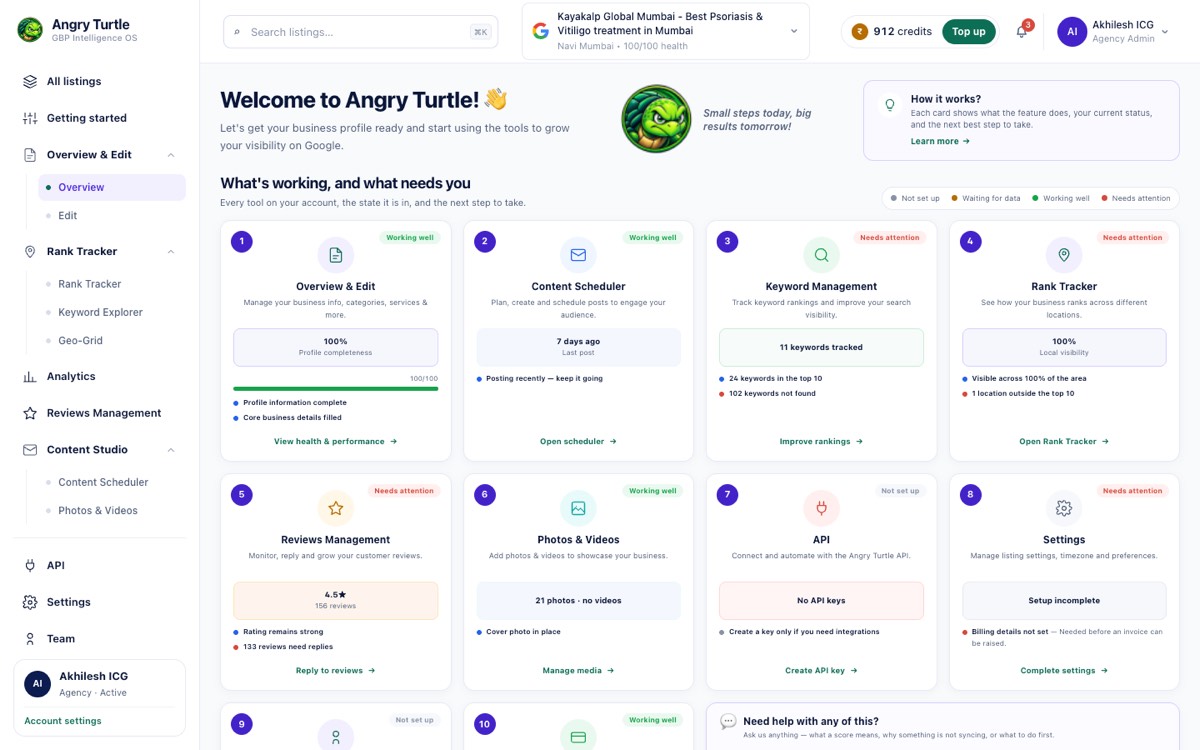

Related reading
Ready to have this run for you?
Book a free audit — we'll show you where you stand in 48 hours.