 Angryturtle
12 Local SEO Tactics That Actually Get Doctors Found in India
Practitioner listings behave differently from clinic listings. These are the moves that matter for an individual doctor, ranked by effort against return.
A doctor's Google Business Profile competes on different terms than a clinic's. It has one practitioner category, one set of chamber hours that often change by day, and a name that has to match what patients actually call the doctor, not the legal entity on the rent agreement. These twelve tactics are ranked by how much they move a solo or small-practice doctor's visibility against how much work each one takes.
Get the practitioner category right, not the closest one
A dermatologist listed under "Skin Care Clinic" instead of "Dermatologist" loses every specialty query that includes the word dermatologist, cosmetologist, or skin specialist, because Google's category system treats a facility type and a practitioner type as different entities for ranking purposes, not interchangeable synonyms. Patients search by the practitioner type far more often than by facility type — "best dermatologist in Koramangala" outnumbers "best skin clinic Koramangala" in ordinary patient behaviour. Check the primary category first on Google Business Profile itself — it's editable any time, not just at setup — then use secondary categories for procedures actually offered, like acne treatment or laser hair removal, rather than every procedure a dermatologist could theoretically perform. Getting this wrong doesn't just cost ranking; it means the profile appears in Google's category-based filters (the ones patients click when browsing a locality) under the wrong filter entirely, so even a patient physically browsing nearby dermatologists in Bengaluru or Mumbai never sees the listing surface.
This matters more for a solo doctor than for a hospital, because a hospital's brand name and department pages can absorb some of the category ambiguity — a patient who's heard of "Apollo" will find the cardiology department eventually even through a slightly wrong category. A single practitioner has one listing carrying the whole weight of that search, with no brand recognition to fall back on.
List chamber timings by day, honestly
Many doctors run different hours at different chambers on different days — Monday and Wednesday evenings at one clinic, Saturday mornings at a diagnostic centre, and so on. If the GBP hours say "9 AM to 6 PM" uniformly, a patient who drives over on a Tuesday finds a locked door, and Google itself starts working against the listing: repeated "closed when Google said open" signals from Popular Times and from patients marking a visit as unsuccessful quietly erode the trust score Google assigns the profile, on top of the immediate lost patient. Set exact per-day hours, mark holidays, and use the special-hours field around festivals rather than leaving it blank. This single fix reduces the single worst patient experience a local listing can cause: showing up to a shut clinic, which is also the fastest way to generate the kind of one-star "wasted my time" review that then sits at the top of the profile for months.
Match the listing name to what patients actually search
"Dr. Anjali Mehta — Gynaecologist" performs differently from "Anjali Mehta Clinic" in search, because most patients look for the doctor by name plus specialty, especially on a referral. If a friend says "go see Dr. Mehta, she's a gynaecologist in Indiranagar," the patient types roughly that phrase, and a listing name that doesn't include the specialty or the honorific the doctor actually uses in practice matches that query less precisely. Google's guidelines restrict adding keywords that aren't part of the real business name, so this is about naming the listing accurately — using the doctor's actual professional name and primary qualification, the way it appears on the practice's signage and prescription pad — not stuffing extra terms in. A mismatch here also creates a downstream NAP consistency problem the moment the doctor gets listed on Practo or Lybrate under a third variant of the name, which is exactly how entity confidence erodes over time.
Claim and verify before doing anything else
An unclaimed or unverified profile can't take posts, can't take photo uploads that render properly, and often carries stale, auto-generated information nobody controls — sometimes an old address from a previous tenant of the same commercial space, or a phone number scraped from an outdated directory. Verification for a healthcare practitioner sometimes runs through a phone or postcard step and can take longer than for a retail business, so start this early rather than mid-campaign. See the how-to on claiming and verifying a Google Business Profile for the exact flow, and treat verification failures as a reason to check the GBP reinstatement service rather than resubmitting the same request repeatedly, since repeated identical resubmissions can extend Google's review delay rather than shorten it.
Add every consultation detail patients actually need before calling
Consultation fee display isn't mandatory on GBP, but Indian medical advertising norms restrict what a clinic can claim about outcomes, so the safer and more useful lever is procedural clarity: whether an appointment is needed, whether walk-ins are seen, whether the doctor sees patients across two locations on alternating days, and what documents a first-time patient should bring. None of this touches efficacy claims. It just answers the questions that currently make people call the reception desk to ask, and every one of those calls that could have been answered by the listing itself is time the front desk doesn't have for patients who are actually there. This is also exactly the kind of concrete, checkable information that AIO readiness depends on — an assistant answering "does Dr. Mehta take walk-ins" needs that fact published somewhere, not implied.
Use the description field for what the doctor treats, in plain language
The 750-character business description is one of the few free-text fields on the whole profile, and most solo doctors leave it as a generic paragraph about "providing quality healthcare." Write instead about the actual conditions and age groups seen — a paediatrician who focuses on newborn care and vaccination schedules should say so, because that's the search intent a parent has at 11 PM, not a generic reassurance that could describe any paediatrician in the city. Keep every sentence within what the doctor is licensed and permitted to claim; do not describe outcomes, cure rates, or comparisons with other doctors. A description this specific also does double duty by feeding the relevance dimension of how a profile gets scored against category peers.
Photograph the actual chamber, not stock images
Patients researching a doctor, especially a first visit, look at photos to judge whether the clinic looks clean, whether there's a waiting area, and roughly how busy it gets. A single practitioner's biggest asset here is authenticity — an actual photo of the reception desk and the doctor's own consultation room outperforms any stock photo, because AI-generated or stock images are now easy for a patient to spot and instantly distrust, and a distrust reaction at this stage means the patient closes the tab before ever calling. Update these photos every few months; a five-year-old interior photo after a clinic renovation is its own small credibility problem, and it also stops feeding the freshness signal that keeps a profile from decaying after weeks of no activity.
Ask for reviews at the point the patient already feels good
The best moment to request a review is right after a positive interaction — after a follow-up call confirming the patient is recovering, or right as they leave a satisfactory consultation, not three weeks later via a bulk SMS blast that reads as a form letter. A front-desk WhatsApp message with a direct review link, sent same-day, converts far better than an automated one sent a week out, because the patient's specific, positive memory of the visit is still fresh enough to write about in detail rather than in a generic one-line thank-you. There is no published review count that unlocks anything in AI Overviews or the local pack — treat review velocity as a gradient that should simply keep climbing steadily against what comparable doctors in the same locality are earning, not a number to hit and stop at.
Reply to reviews without confirming anyone was a patient
This is the rule most solo doctors get wrong first. A reply that says "thank you for trusting us with your knee surgery, glad you're recovering well" confirms, in a public and searchable place, that a named person underwent a specific procedure with this doctor. Indian medical advertising and patient-confidentiality norms don't allow that, review or not — and once published, that reply sits there permanently, discoverable by anyone who searches the patient's name later. A safe reply thanks the patient generically for their feedback and invites them to reach out directly for any follow-up, without repeating any clinical detail they may have volunteered in their own review text. The full reasoning behind this, and how it applies across an entire clinic's review base, is covered in our compliant review habits guide.
Get listed correctly on Practo and Lybrate, and stop chasing the rest
For an individual doctor, Practo is the single highest-value directory beyond GBP itself — it's where patients compare specialists, read structured reviews, and often book directly, and it's increasingly a source AI answer engines pull from for healthcare queries specifically. Lybrate is a reasonable second listing for teleconsultation-friendly specialties. Beyond those two, most general directories (JustDial included) are worth a basic accurate listing for citation consistency but not worth active management time for a solo practice — that effort is better spent on GBP and Practo. The fourteen-directory landscape for clinics and doctors, including which ones are safe to skip entirely, is broken down in full in our directories guide.
Post about clinic changes, not generic health tips
GBP posts decay in relevance after roughly three weeks of inactivity as far as freshness signals go, but that doesn't mean posting generic "5 tips for healthy skin" content weekly. A solo doctor gets more value from posting about things that are actually news to a patient: a new chamber timing, a temporary closure for a conference, availability of a new procedure, or a festival holiday schedule. These posts also double as the kind of specific, checkable content that answer engines can lift, unlike generic wellness copy that every other clinic's account posts too — a post that says "closed October 2 for Gandhi Jayanti, back October 3" answers a real question an AI assistant might get asked, while a generic wellness tip answers nothing specific to that practice at all.
Keep NAP identical everywhere the doctor's name appears
A doctor who practices under a slightly different name spelling on Practo ("Dr A. Mehta") than on GBP ("Dr. Anjali Mehta") than on the clinic's own website footer creates the exact kind of entity confusion that weakens NAP consistency and, downstream, entity authority — Google and AI systems alike have to guess whether these are the same person, and a guess that goes wrong means the doctor's review history and citation weight get split across what look like two separate entities instead of consolidating behind one. This is a five-minute audit: pull up every listing where the doctor's name and phone number appear, and make every field character-for-character identical, including whether "Dr." has a period.
A doctor running one chamber with a stable schedule can stop at the practitioner category, the description, and consistent reviews — that alone typically outperforms a doctor with ten unmanaged listings. A doctor running multiple chambers across cities like Delhi, Hyderabad, or Chennai needs the full list, especially the per-day hours and the NAP audit, because that's exactly where multi-location confusion creeps in, and it compounds with every additional chamber added.
FAQ
Does a doctor need a separate GBP for each chamber location? Yes, if the doctor practices as an independent provider at genuinely separate addresses on different days — each physical location where patients are actually seen should have its own profile, correctly marked with that location's specific hours, rather than one profile listing multiple addresses.
Is JustDial worth the time for an individual doctor? A basic, accurate JustDial listing is worth having for consistency, but for a solo practitioner it rarely returns enough patient volume to justify active management — Practo and GBP account for most of what actually drives appointments.
Can a doctor mention procedure success rates in their GBP description? No. Indian medical advertising norms restrict outcome and efficacy claims, and a GBP description isn't exempt from that just because it's a Google field rather than a clinic brochure.
How often should GBP photos be refreshed? Every few months, or immediately after any visible change to the clinic — new signage, a renovated waiting area, new equipment — because patients use photos to judge whether the practice is current and well-kept, and stale photos stop contributing to the freshness component of how a profile ranks.
Do GBP posts actually help a doctor's ranking? They feed the freshness component of how a profile is scored, but their bigger value for a solo doctor is functional: they answer real, timely questions like "is the doctor available this week" in a place patients already check.
What is the fastest way to check if a doctor's listing has an entity authority problem? Search the doctor's name plus city and see whether Practo, Lybrate, and GBP all show the identical spelling, phone number, and address — any mismatch there is usually the root cause behind a listing that Google doesn't fully trust.
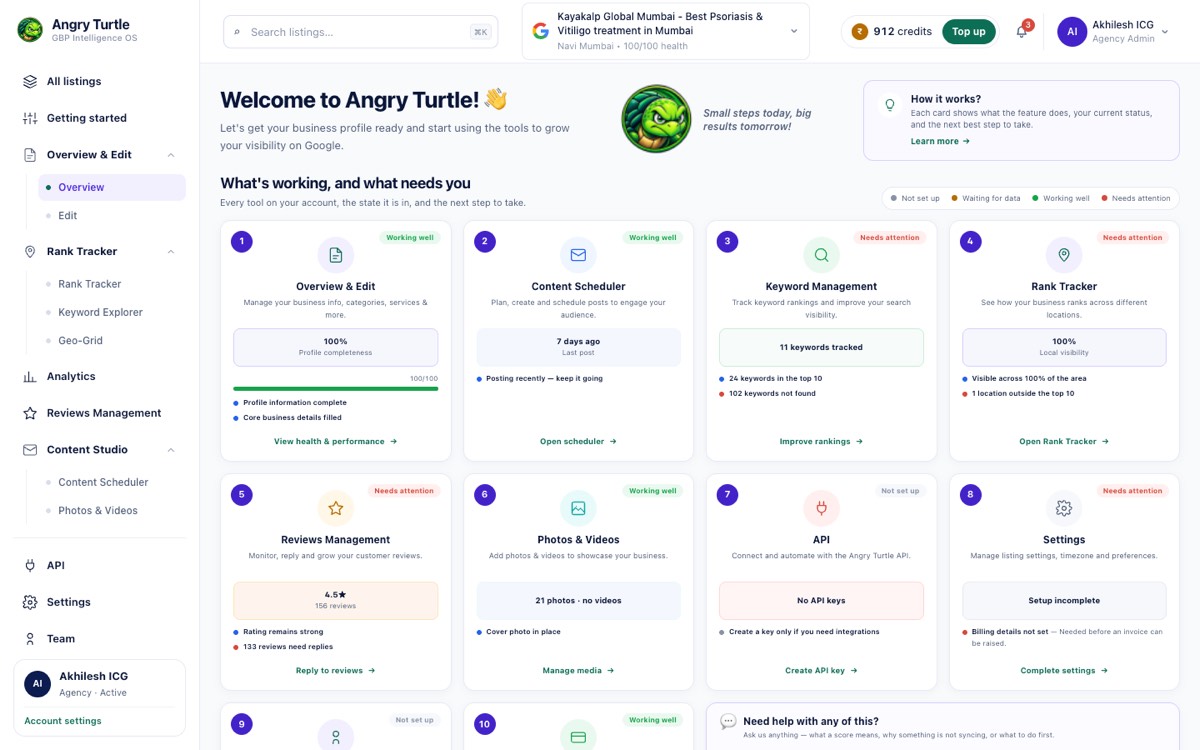
Angryturtle's Rank OS scores a profile like this across five weighted dimensions — relevance, review health, freshness, entity authority, and AIO readiness — and turns the gaps above into a ranked action list rather than a checklist to work through blind. The same engine also runs geo-grid checks to see how visibility actually varies across a service area, and citation sweeps across 20+ platforms to catch exactly the NAP drift described above. Related reading: GBP fixes for hospitals and diagnostic chains, the checklist built for dental clinics specifically, and what patients now ask AI before choosing a clinic. Book a free audit or see the pricing for a solo-practice plan.
More listicles and rankings
A score you can argue with, not a black box
Rank OS gives every profile a 0–100 score built from five weighted dimensions — Relevance, Review Health, Freshness, Entity Authority and AIO Readiness — and the weights are tunable. Underneath it sits a ranked list of the fixes that move the number, each with the point lift it unlocks.
Ready to have this run for you?
Book a free audit — we'll show you where you stand in 48 hours.