 Angryturtle
Local SEO in Coimbatore
Why RS Puram, Peelamedu and Avinashi Road need different fixes than a generic checklist.
·
A pump manufacturer near Peelamedu once asked why a business four kilometres away, with a worse review score, kept showing above them on Google Maps for "pump dealers near me." Their listing was correct. Their address was correct. Their phone number worked. The problem was that Google's map pin sat two streets off from their actual gate, on a cross road that shares a name with a completely different lane near Avinashi Road. That kind of mismatch is common in Coimbatore, and it is the single biggest reason local SEO efforts here stall before they start, well before a business even gets to the common mistakes that trip up most local SEO attempts generally.
Coimbatore's address system is built around a mix of numbered streets, named cross roads, and colony references, and it does not map cleanly onto how Google's geocoding engine expects addresses to work. A business in RS Puram might describe itself as being on "100 Feet Road, near Fire Station," which is exactly how a customer would find it on foot, but is nearly useless as a machine-readable address. Google's pin-placement logic wants a structured address with a distinguishable street number; Coimbatore's naming culture wants a landmark and a locality. The two systems talk past each other, and the pin lands wherever Google's best guess happens to be, which is frequently wrong by a lane or two, a distance that matters directly because proximity is one of the three core factors Google uses to decide who shows up in the map pack for a given search.
Why Coimbatore addresses defeat the map pin
Cross-road and main-road naming makes this worse. A single named road, say Avinashi Road, runs for kilometres and intersects dozens of numbered cross streets, many of which repeat their numbering in different sectors of the city. "12th Cross" exists in more than one part of Coimbatore. When a customer's GPS or a directory listing uses only the cross-road number without the main-road anchor, Google has to guess which 12th Cross is meant, and it guesses based on whatever data it has already indexed, correct or not.
Layout names compound the confusion. Saibaba Colony, for instance, is subdivided into sectors that longtime residents navigate by memory and landmark, not by formal address. A shop might be "opposite Variety Hall Road signal" to a local and an unresolvable string to a geocoding algorithm. None of this is a flaw in how Coimbatore residents communicate. It is a mismatch between an address culture built for humans and a ranking system built for machines, and businesses that don't actively correct their pin placement inherit whatever the algorithm assumed, which is exactly how a technically correct listing ends up behaving like one of the duplicate or conflicting listings that quietly cannibalize a business's own visibility.
The fix is mechanical, not creative: pin the location manually using Google's map-pin drag tool inside the Business Profile dashboard, cross-check it against at least two independent map sources, and keep the address field itself in the format Google's geocoder actually parses, structured street number and road name first, landmark second. Our pin-accuracy workflow inside Rank OS does this drag-and-verify step for every location we manage, because leaving it to the initial Google Maps API guess is how a correctly-run business ends up looking invisible next to a competitor with a worse profile.
The commercial map that matters
Coimbatore's searchable geography splits along fairly hard lines. RS Puram and Gandhipuram carry the city's retail and textile-trading weight, dense with saree shops, jewellery stores, and wholesale cloth merchants whose customers search by locality name specifically, "RS Puram silk shops," not just "silk shops Coimbatore." Peelamedu is a different animal entirely, home to engineering colleges, IT parks, and the pump and motor manufacturing cluster that gives the city its industrial reputation. Race Course is where the city's older money lives and where healthcare and hospitality concentrate. Avinashi Road is the commercial spine running toward the airport, lined with showrooms, auto dealerships, and increasingly, corporate offices. Saibaba Colony sits between residential and commercial, a locality search term in its own right for everything from tutoring centres to pediatric clinics, and it's the kind of neighbourhood where a coaching institute or school-focused local SEO approach genuinely differs from what works for a downtown retail shop.
A business that ignores which of these zones its customers associate it with is leaving locality-specific search volume on the table. A pump distributor in Peelamedu who never mentions "Peelamedu" anywhere in its Business Profile description, posts, or website content is competing purely on category terms against every pump dealer in the city, instead of also capturing the meaningful share of searchers who type the locality name because that's how they think about the area. This is also where the broader set of local ranking factors for 2026 matter, since Google weighs locality relevance in the description text itself, not just the address field.
Textiles, engineering, and how business searches actually happen here
Coimbatore's economy runs on three legs that search very differently from each other. Textile and spinning mill buyers, largely B2B, tend to search by product specification and known supplier names rather than "near me" phrasing, and they often arrive at a Business Profile after being referred by a trade contact, using the search purely to confirm the address and check current photos. Pump and engineering manufacturers see a mix, retail buyers searching "near me" for spares and urgent repairs, and B2B buyers searching by exact product terms like "submersible pump dealer Coimbatore" with far less locality dependence. Healthcare and education, meanwhile, behave like consumer local search anywhere else, heavy on review reading, heavy on "near me," heavy on comparison between two or three named options before a decision.
This matters for how a Business Profile should actually be filled in. A submersible pump distributor gains little from generic keyword stuffing in its business description and gains a lot from listing specific brands and specifications it carries, because that's what the B2B searcher is scanning for. A pediatric clinic in Saibaba Colony gains more from review volume and photo freshness than from product specificity. Treating every business type the same way, the way generic local SEO checklists do, wastes effort in the wrong direction for at least two of Coimbatore's three major industries, and it's part of why a flat, one-size estimate of local SEO cost in India rarely applies evenly across a manufacturing client and a clinic client.
Tamil, English, and the space in between
The query stream in Coimbatore runs through three overlapping channels. There's straightforward English search, "best CA firm Coimbatore," common among younger and more urban searchers. There's Tamil-script search, which shows up meaningfully in voice queries and in typed search from users more comfortable typing in Tamil on their phone keyboard. And there's transliterated Tamil, English letters spelling out Tamil words or phrases, which is arguably the largest and most overlooked segment, things like "coimbatore la nalla pump dealer" typed phonetically rather than in Tamil script.
Business descriptions and website content that exist only in formal English miss the transliterated layer almost entirely, and miss the Tamil-script layer completely. Google's Business Profile Q&A and posts sections are reasonable places to naturally include a Tamil-script phrase or two describing the service, since Google's systems do index and match against them for voice and script-based queries. It doesn't need to be extensive. A single well-placed line in Tamil script describing the core service does more for that query segment than an entire English paragraph.
When the listing was right and the map was wrong
Consider a hypothetical business, Kaveri Motor Winding Works, operating out of a workshop just off Trichy Road. The owner had claimed the Business Profile years earlier, kept the phone number current, and posted photos when equipment was upgraded. Search performance was flat for years despite genuinely good reviews. The cause turned out to be the map pin, which sat roughly 600 metres from the actual workshop, on a stretch of the same road that Google's geocoder had matched to an older, incorrect address entry from years before the business moved.
Customers searching "motor rewinding near me" within a one-kilometre radius of the actual workshop were being shown a competitor instead, because Google's proximity ranking factor was calculating distance from the wrong pin. The fix was a manual pin correction, verified against two independent map checks and resubmitted through the Business Profile dashboard, along with a fresh set of geotagged photos taken at the correct location to reinforce the update. Ranking for hyperlocal "near me" queries improved within the following few weeks, not because anything about the business itself changed, but because Google was finally measuring distance from the right point.
This is the kind of fix that a generic audit checklist will flag if it actually checks pin placement rather than just listing completeness, and it is exactly the sort of thing our GBP-suspension and listing-accuracy work is built to catch before it costs months of visibility, and something the what is a map pack explainer covers from the ranking-mechanics side.
Where a structured approach fits
For a single-location Coimbatore business, most of the value sits in exactly what's described above: correct pin placement, locality-aware description writing, category selection that matches how Google's own GBP categories system classifies the business (see our guide on choosing the right GBP category), and a review cadence that keeps photos and feedback current. For a textile or engineering business running multiple godowns, showrooms, or branch offices across the city, the bigger risk becomes duplicate or conflicting listings for the same business, something our NAP consistency and multi-location cleanup work exists specifically to catch, because Google increasingly treats inconsistent name-address-phone data across locations as a trust signal problem, not just a cosmetic one. A brand running enough locations to feel this pain, think a chain of coaching centres or pump-dealer branches, is closer to the situation covered in our guide to managing a hundred-plus GBP listings than to a single-shop setup.
Businesses managing profiles across several Coimbatore localities, RS Puram, Peelamedu, and an Avinashi Road showroom under one brand, run into a different set of problems than a single shop does, and our guide to managing multiple Google Business Profiles covers that specific case, alongside managed local SEO support for teams that would rather hand the ongoing maintenance off entirely.
Who shouldn't spend on this yet
Local SEO in Coimbatore, or anywhere, cannot manufacture demand that doesn't exist. A brand-new pump manufacturing unit with no reviews, no completed jobs, and no photos has nothing for local SEO to amplify yet; the honest first move there is doing the work that generates a track record, not paying for search optimization on an empty profile. It also can't override a genuinely bad customer experience. If review content consistently flags late delivery or poor service, fixing the map pin and the category tags will make more people find that feedback faster, not fewer. And it can't compete with paid map-pack ads if a competitor is running Local Services Ads aggressively in a low-volume category, since those placements sit above organic map results regardless of profile quality. Local SEO fixes visibility and accuracy problems. It doesn't fix a business that isn't ready to be found yet.
Local SEO in nearby cities
Addressing conventions, language mix and competitive density change from one city to the next, and a playbook tuned for Coimbatore will not transfer cleanly. We cover Bengaluru, Bangalore, Chennai, Hyderabad and Kochi separately for that reason. If you run locations in more than one of them, multi-location local SEO services covers how the work is coordinated across a network, and managed local SEO covers what running it for you actually involves.
FAQ
Why does my Coimbatore business show up in the wrong part of the map? Almost always because the map pin was placed automatically by Google's geocoding system rather than manually verified, and Coimbatore's mix of numbered cross roads and landmark-based addressing gives that system more room to guess wrong than a strictly numbered address system would.
Should I write my Google Business Profile description in Tamil or English? Both, in practice. English covers the searchers typing in English or using transliterated queries close enough to match, while a line or two in Tamil script helps match voice search and typed Tamil queries that an English-only description won't catch.
Does mentioning RS Puram or Peelamedu by name in my listing actually help? Yes, if the mention is accurate and natural. Locality names are how a meaningful share of Coimbatore searchers phrase their queries, and a profile or webpage that never uses the locality name it operates in is competing on category terms alone.
How long does it take to fix a wrong map pin? The correction itself is quick once verified, but Google's re-indexing of the corrected location for ranking purposes typically takes several weeks, not days, so results should be measured over a month or more, not immediately.
Is local SEO worth it for a B2B textile or pump manufacturing business? It's worth it for the portion of buyers who do search locally to confirm or discover a supplier, which is real but smaller than for consumer businesses. It's not a substitute for the trade relationships and referrals that drive most B2B volume in Coimbatore.
What's the single most common listing mistake in Coimbatore specifically? Leaving the address field in landmark format ("near Variety Hall signal") instead of a structured street-number format Google's geocoder can parse, which is exactly what causes the pin-placement errors described above.
Stop guessing where you rank locally.
Rank OS scores your Google Business Profile the way Google's local algorithm does — relevance, review health, freshness, entity authority and AIO readiness — and shows you exactly what to fix.
Book a live demo →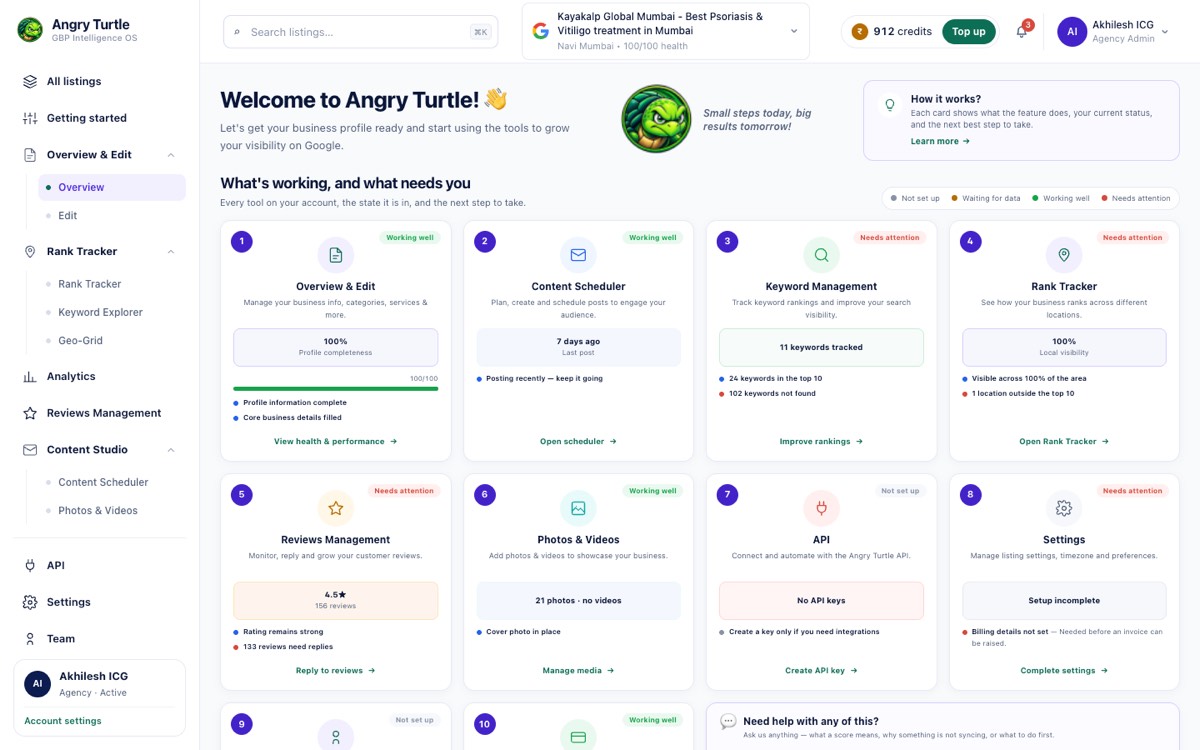

Related reading
Ready to have this run for you?
Book a free audit — we'll show you where you stand in 48 hours.