 Angryturtle
Local SEO for Law Firms and Legal Practices in India
·
A law firm rarely gets chosen the way a restaurant does. Nobody walks past three lawyers' offices comparing signage. The search that leads to a hired lawyer usually starts weeks before, with a specific, often anxious near-me search — "property dispute lawyer near me," "how to file for divorce in Bengaluru" — and ends after checking credentials, reading a few reviews carefully, and often a phone consultation before anyone commits. Local law firm SEO in India has to be built around that longer, higher-stakes research cycle, not around the fast, proximity-driven decisions that work for most local categories.
Bar Council of India advertising restrictions add a real constraint most other local categories don't face, and they shape what a legal practice can safely say in its Google Business Profile and content.
Advertising restrictions change what a law firm can actually write
The Bar Council of India's rules restrict lawyers from soliciting work or advertising in ways that other professions can. This doesn't mean a law firm can't have an optimized, informative Google Business Profile — it means the profile's language has to describe practice areas and experience factually, without soliciting clients directly or making promotional claims about outcomes. A description listing practice areas, years in practice, and court jurisdictions is safe territory. A description promising "we win every case" or offering discount-style promotional language is the kind of content that creates both a Bar Council compliance problem and a credibility problem with a searcher who's specifically checking for professionalism.
This constraint doesn't stop at the profile description — it should shape GBP posts and any blog content on a firm's own site too, favouring factual explanations of legal processes and practice area coverage over anything that reads as a sales pitch. The right primary category still matters as a baseline — "Lawyer," "Attorney," or a more specific legal-services category where one exists — but category alone does little of the actual persuasion work in this vertical.
Credentials and specialization drive the actual decision
Practice area specificity matters enormously here, more than in most local categories. "Lawyer" as a category, with no further detail, tells a searcher almost nothing useful when they're specifically looking for a property dispute specialist, a criminal defense lawyer, or someone experienced in matrimonial law. The services list and GBP attributes need to name actual practice areas plainly — property law, criminal defense, corporate litigation, family law — because that's the level of specificity someone doing pre-hire research is actually searching at.
Years in practice, court jurisdictions handled (district court, high court, specific tribunals), and firm size (solo practitioner versus a multi-partner firm) are the credential details that answer the questions a prospective client is silently asking before they'll pick up the phone. A profile that states these plainly does more work than one relying on a generic "trusted legal services" description.
Reviews for legal services need careful, honest framing
Client reviews for legal services carry more weight per review than in most categories, because so few clients leave one — legal matters are private, and many satisfied clients simply never think to review the firm once the matter closes. That scarcity means the reviews that do exist get read closely by the next prospective client. Getting more Google reviews applies, timed to case closure with a respectful, non-pressuring ask, but a law firm should be careful not to imply case outcomes in requesting or displaying reviews, given the advertising restrictions above — a review that names a case result is the client's own words, not the firm's claim, and that distinction matters for compliance.
Responding to negative reviews needs a different tone here too: a firm cannot discuss case specifics in a public reply, even to correct a client's account of events, which means responses have to stay general and professional rather than defensive or detailed — a constraint most other categories don't face when responding to a specific complaint. A firm's GBP Q&A section deserves the same caution, since prospective clients sometimes post specific situational questions there that shouldn't be answered publicly with anything resembling legal advice.
Where legal practices actually get found beyond Google
Legal-specific directories and general business listing sites in India both play a role for this category, and consistency across them matters as much as it does anywhere — a firm listed under a slightly different name or address on a legal directory than on Google creates the kind of entity ambiguity that undermines trust for a category where trust is the entire product. Entity authority — NAP consistency and citation coverage — is worth checking specifically for a legal practice, since directory presence for professional services often gets set up once at founding and never revisited as the firm grows or moves offices.
Common setup mistakes in this category
The recurring pattern is a profile filled in once at founding, correctly, and then left static for years while the firm's actual practice areas and partner roster changed. Common local SEO mistakes covers this generally; for law firms specifically, the compliance angle adds a second failure mode — an older description or review-response pattern that was fine under prior advertising guidance but wouldn't pass a current compliance review, simply because nobody revisited it.
Multi-partner and multi-office firms
A firm with multiple partners handling different practice areas, or offices in more than one city, benefits from being explicit about which lawyer or team handles which practice area, rather than presenting the firm as one undifferentiated entity. This is closer to the individual-level trust pattern seen in categories like salons than to a typical multi-location retail setup — a client searching for a corporate litigation specialist wants to know that specific expertise exists at this firm, not just that the firm broadly "does law." Multi-location local SEO strategies covers the general operational discipline for firms with more than one office; the legal-specific addition is that each office's profile should reflect which partners and practice areas are actually based there, not a copied firm-wide description. Firms weighing whether to manage this internally or bring in outside help often start with a local SEO agency conversation specifically because compliance and consistency both need ongoing attention, not a one-time setup.
Frequently asked questions
Can a law firm advertise discounts or promotional offers on its Google Business Profile? Generally no. Bar Council of India rules restrict solicitation and promotional advertising for legal services, and a Google Business Profile should stick to factual information about practice areas, experience, and contact details rather than promotional language.
How should a law firm respond to a negative review without discussing case details? Keep the response general, professional, and free of any specific case information, even to correct the client's account. A short acknowledgment inviting the reviewer to discuss the matter privately is safer than a detailed public rebuttal.
Why do law firms tend to have fewer reviews than other local businesses? Legal matters are private, and many clients simply don't think to leave a review once a matter closes, unlike a restaurant or salon visit. This makes each review carry more weight with prospective clients, which is worth factoring into how a firm asks for them.
Should a multi-partner firm list every partner's specialization separately? Where practice areas genuinely differ by partner, yes — naming specific expertise per partner or team gives a searcher the specificity they're looking for, rather than one generic description covering the whole firm.
Is local law firm SEO different from local SEO for other professional services? The mechanics overlap with any other local category, but the Bar Council advertising restrictions are the real dividing line — local law firm SEO has to work inside rules on solicitation and promotional claims that a dentist or a salon never has to think about.
Stop guessing where you rank locally.
Rank OS scores your Google Business Profile the way Google's local algorithm does — relevance, review health, freshness, entity authority and AIO readiness — and shows you exactly what to fix.
Book a live demo →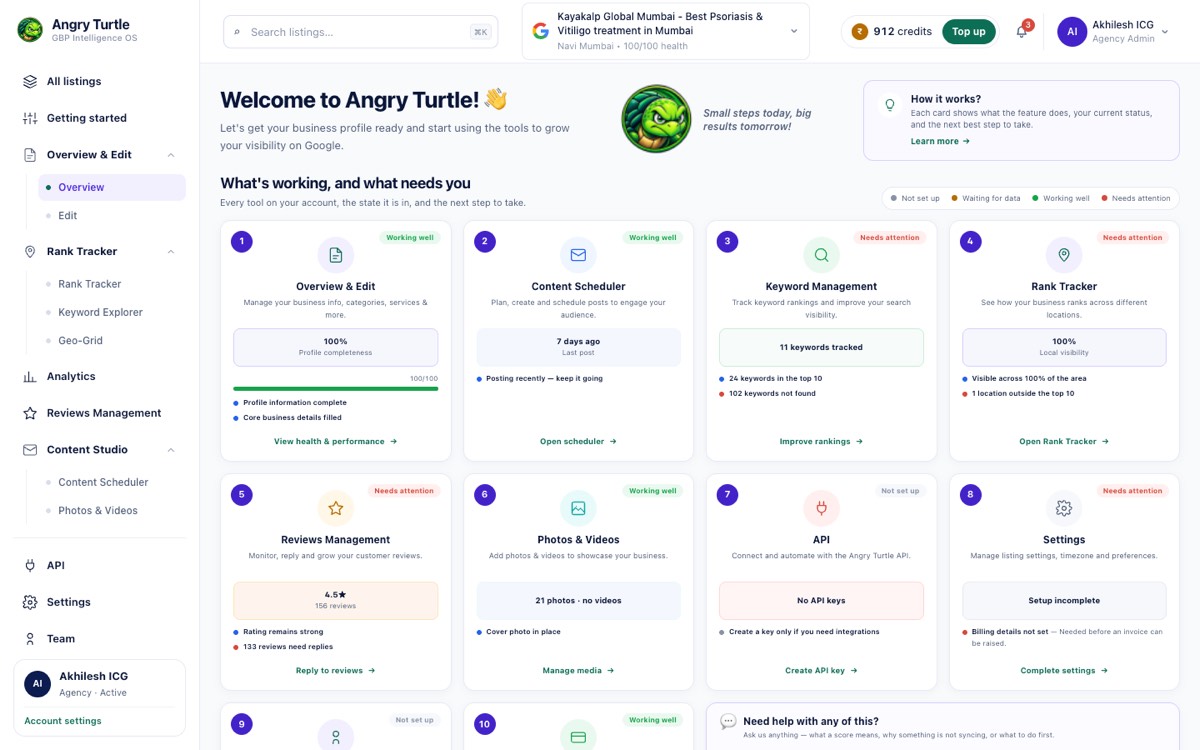

Related reading
Ready to have this run for you?
Book a free audit — we'll show you where you stand in 48 hours.