 Angryturtle
A belief doesn't have to be acted on to cost a business rank. Plenty of Indian business owners who've never touched a single GBP setting still hold ideas about how local search works that are simply wrong, and those ideas shape which advice they accept and which vendor pitches they trust. This is a different list from the local SEO mistakes that cost local pack positions — those are actions taken or skipped. These are beliefs, and a few of them are common enough in the Indian market specifically to be worth naming directly.
Myth: more citations always beats better citations
The belief that submitting to a hundred directories outperforms submitting correctly to fifteen relevant ones is common, and it's backwards. A citation with the wrong phone number or an outdated address on a high-traffic directory does active harm — it's a conflicting signal, not a neutral one. The full Indian business listing sites guide covers why Tier 1 accuracy beats Tier 3 volume, and NAP consistency at scale covers what actually happens when citations disagree with each other.
Myth: a paid verification badge or premium directory listing boosts Google rank
JustDial's paid tiers and various premium directory add-ons carry real value inside those specific platforms — better placement in JustDial's own search, sometimes a verified badge. None of that pays into Google's local pack ranking directly. Paying for visibility on a third-party directory and expecting it to move your Google Maps position conflates two entirely separate systems.
Myth: stuffing keywords into the business name is a shortcut, not a violation
"Best Dermatologist Gurgaon — Sharma Skin Clinic" gets defended by business owners as a smart move rather than recognised as a policy violation, because it's genuinely common practice across competitors in the same market. Widespread doesn't mean sanctioned. GBP suspension reasons covers this as one of the most frequent causes of profile suspension in India specifically, not a grey area that Google tolerates quietly.
Myth: review count matters more than review response
A business owner chasing a bigger review number while ignoring every incoming review is optimising the half of the equation that's visible and skipping the half that actually builds trust and engagement signal. Responding to reviews and review response management both cover why an unanswered review, positive or negative, is a missed signal — Google and prospective customers both notice a profile that never talks back.
Myth: there's a specific review count that unlocks AI citation
Some vendors sell the idea that crossing 50 reviews, or 100, flips a switch and gets a business cited by AI systems. There's no published threshold of that kind, from Google or from any AI provider. Review volume and review content both function as a gradient signal that AI systems and traditional search both weigh alongside everything else — a business with 40 detailed, recent reviews can outperform one with 90 old, thin ones. Treat any pitch built around a magic review number with real skepticism.
Myth: Google Ads spend improves organic map ranking
Running Google Ads for the local service ads or search ads doesn't move the organic local pack position, full stop — they're separate systems with separate ranking logic, and ad spend buys placement in the ad inventory, not in the algorithmic ranking beneath it. A business can spend heavily on ads and see zero organic rank movement, which is confusing until the separation is made explicit.
Myth: a duplicate listing for each service line helps visibility
Some businesses create a separate GBP for each service under one roof — a clinic listing "cardiology," "orthopaedics," and "general medicine" as three separate profiles at the same address — believing more listings means more visibility. It's the opposite. Removing a duplicate Google listing covers why this splits review authority and typically triggers a quality review from Google rather than multiplying reach.
Myth: local SEO is a one-time project
Set up the profile, fill in the fields, and it stays optimised — this belief persists particularly among businesses that had a single positive experience with an agency years ago and never revisited the account since. Google adds fields and attributes, competitors post and gather reviews continuously, and a profile frozen in the state it was left in gradually loses ground to ones that keep moving. The GBP management playbook treats this as ongoing operational discipline, not a setup task with an end date.
Myth: a website matters more than the GBP for local search
Businesses that invest heavily in their website while treating GBP as an afterthought are optimising the channel that matters less for local intent queries. For "near me" and local-pack-triggering searches, GBP data typically carries more direct weight than on-page website signals, and the specific near-me query patterns Indian searchers actually use lean on that GBP data even more heavily than the generic case — the two work together, but a beautifully built website sitting behind a thin, incomplete GBP doesn't compensate for what the profile itself is missing.
Myth: suspension means permanent loss of the listing
A suspended profile disappears from Maps, and that visible disappearance leads some owners to assume the listing is gone for good. In the large majority of documented cases, a suspension is recoverable once the actual violation is identified, corrected, and documented in an appeal — see GBP suspension reasons for the specific causes and the reinstatement service for what a recovery process actually involves.
Why these myths persist specifically in India
Several of these — the citation-volume belief, the keyword-stuffed name, the paid-badge confusion — trace back to advice that circulated widely among small-business owners and freelance consultants years ago and never got corrected, because most businesses don't have a feedback loop that tells them when a tactic stopped working, or never worked in the first place. A tactic that "worked" for a neighbour's shop three years ago gets repeated as settled wisdom, without anyone checking whether it was ever actually the cause of that shop's rank, or coincidental with it.
Frequently asked questions
Is there any truth at all to the idea that more citations help? Some — breadth across the relevant Tier 1 and vertical Tier 2 directories does help. The myth isn't that citations matter, it's that volume beats accuracy, which reverses the actual priority.
Why do so many of these myths involve suspension or violations specifically? Because the guidelines aren't always intuitive, and advice that circulates informally tends to optimise for what seems to work short-term without accounting for the policy risk sitting underneath it.
Should a business just distrust any local SEO advice that sounds like a shortcut? Not automatically, but a claim promising fast, effortless rank gains through a single tactic is worth checking against Google's own published guidelines before acting on it.
Angryturtle's managed local SEO is built on the documented mechanics, not the shortcuts — see how it's structured.
Stop guessing where you rank locally.
Rank OS scores your Google Business Profile the way Google's local algorithm does — relevance, review health, freshness, entity authority and AIO readiness — and shows you exactly what to fix.
Book a live demo →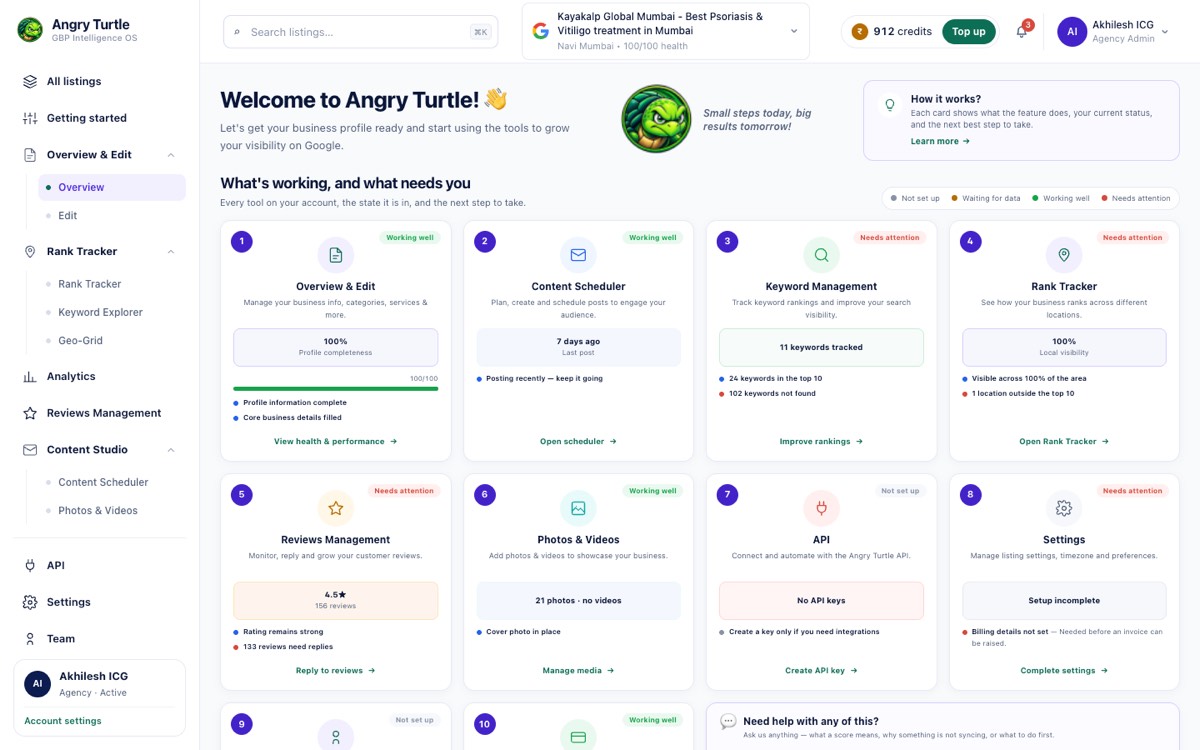

Ready to have this run for you?
Book a free audit — we'll show you where you stand in 48 hours.