 Angryturtle
How to Run a Local SEO Audit for a Client
An agency-facing checklist covering profile, citations, reviews, website and competitors.
A client audit is a different job than auditing your own listing. You're working with less context, no institutional memory of why the phone number changed last year, and a client who's going to ask what you found before you've finished checking. The structure has to hold up under that, a fixed sequence you run the same way every time, with findings that turn into a prioritized fix list rather than a pile of screenshots.
This playbook is written for agencies and freelancers running an audit on a client's Google Business Profile, citation footprint, reviews, website, and competitive position, in that order, with what to actually deliver at the end. It complements our general local SEO audit checklist, which is written for a business auditing its own single listing rather than an agency running this across a client book.
Step 1 — Get access before you touch anything
Request manager access to the client's Google Business Profile before the call where you'll present findings, not the day of. Access requests through Google can take time to clear, and showing up without the ability to demonstrate a fix live undercuts the whole meeting. While you wait, ask the client directly for their website CMS login or at minimum a way to view source on the pages that matter, since you'll need to check on-page NAP and schema later in the audit.
Also ask what's already been tried. A client who ran a previous agency's citation-building campaign two years ago has a different starting point than one who's never touched their profile, and knowing that upfront saves you from re-flagging something they already paid to fix once.
Step 2 — Audit the profile itself
Open the Google Business Profile and go through every field the client controls: name, primary and secondary categories, hours including holiday hours, phone, website link, attributes, service areas or address visibility, description, products or services, and photo activity over the last few months.
Check the primary category against what the business would actually call itself first, not the broadest label available, our guide on choosing a GBP category covers the research method if the client's current choice looks off. Check whether the profile is fully verified or sitting in a pending state nobody noticed. Note anything that looks like a suspension risk, keyword-stuffed names, an address that doesn't match a real staffed location, categories that don't reflect what the business does day to day, since these are worth flagging even if the profile hasn't been penalized yet.
Step 3 — Audit citations across directories
Pull the client's name, address, and phone number as it appears on their Google Business Profile, then check it against JustDial, Sulekha, IndiaMART, and Practo if the client is in healthcare, plus whatever sector-specific directories apply. Search the phone number in quotes on Google separately, this often surfaces old or duplicate listings the client forgot existed, sometimes from a previous business name or address. If you find one, note it as its own line item, our guide on merging duplicate Google listings covers the resolution path separately from the citation cleanup itself.
Log every mismatch you find, not just the obvious ones. A shortened business name on one directory and the full legal name on another looks trivial to a person and reads as an inconsistency to an entity-matching system. This is the same discipline covered in fixing NAP inconsistency across Indian directories, and it's worth running that full process rather than a quick spot check if the client has more than a handful of citations to review.
Step 4 — Audit review health
Pull four numbers: total review count, average rating, review velocity over the last three months, and response rate. A profile with a strong average sitting on old, sparse reviews reads differently than one with a slightly lower average and steady new reviews coming in every week, note both, don't just report the star average.
Check whether replies read as genuinely written for the specific review or as a copy-pasted line repeated under every entry, clients often don't realize how visible that pattern is once you point it out. If there are reviews that plausibly violate Google's policy, fake, off-topic, posted by a clear non-customer, note them separately as a removal candidate rather than folding them into the general review-health finding, since handling a fake negative review is a distinct workflow from general review health work.
Step 5 — Audit the client's website
Check the footer, contact page, and any location pages for NAP that matches the Google Business Profile exactly, format included. Look for LocalBusiness schema in the page source and confirm the address and phone fields inside it match what's visible on the page, a schema block that contradicts the visible NAP is a common and easy-to-miss finding.
If the client serves multiple neighborhoods or cities, check whether each has a genuinely distinct page or whether it's the same template with the city name swapped, thin, duplicated local pages tend to underperform even when everything else on the profile is strong, and it's worth cross-checking this against multi-location SEO practice if the client runs more than one branch.
Step 6 — Benchmark competitors
Pick the client's top four or five actual local rivals, the ones showing up when you search their own target terms, not an aspirational list of national brands. For each, note rating, review count, review velocity, and which citation directories list them that don't list the client. The citation gap specifically tends to be the most actionable finding in this whole section, a directory four of five competitors are on and the client isn't is a concrete task, not a vague recommendation.
Step 7 — Turn it into a report the client will actually read
A findings list with forty rows of raw data doesn't get read past the first page. Group what you found into a short set of priorities, ranked by how much it's likely costing visibility, not by the order you happened to check things in. Lead with the two or three fixes that matter most, then list the rest underneath for reference.
State plainly what none of this guarantees. No audit, from any agency, can promise a specific ranking outcome, and a client who's been sold that promise before will trust a report more, not less, if it's honest about that limit upfront. If the audit's scope grows into ongoing management rather than a one-off engagement, local SEO agency India covers how that broader relationship is usually structured.
How Angryturtle helps
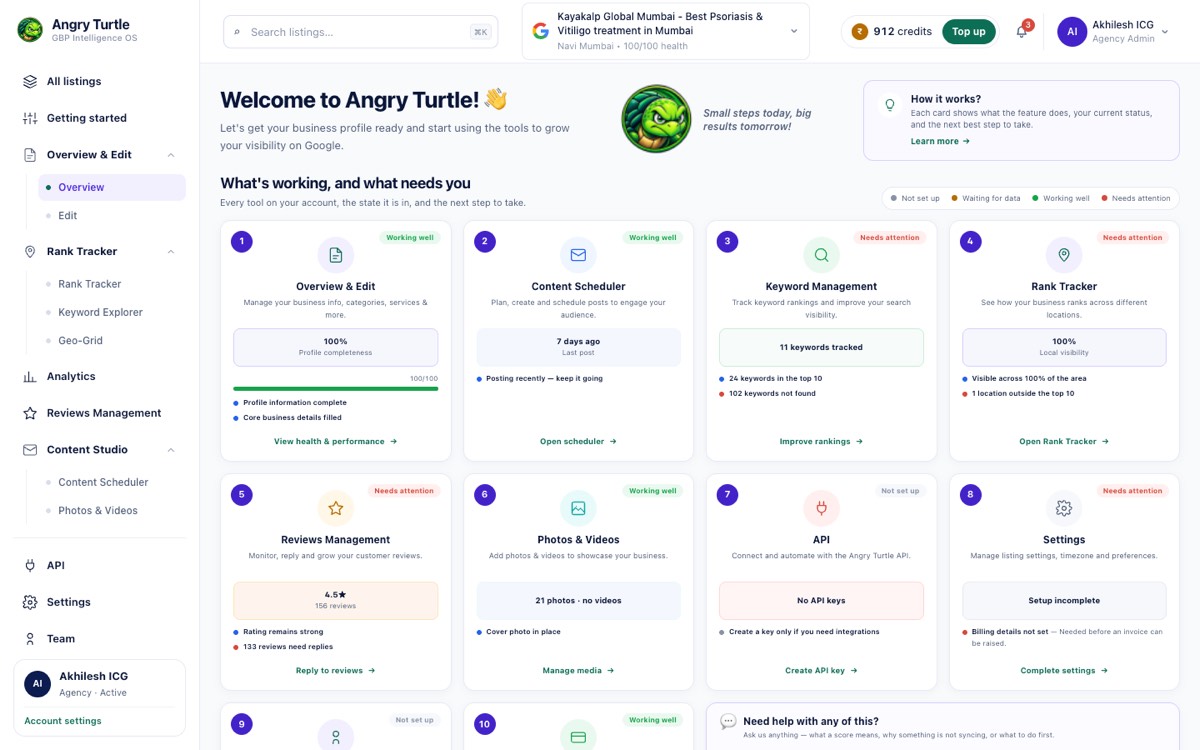
Running every step above by hand, across even a handful of listings, is realistically a full day per client. Rank OS collapses the profile and citation checks into a single score across relevance, review health, freshness, entity authority, and AI-answer readiness, with a ranked list of what to fix first instead of a flat checklist. Citations and NAP automates the directory cross-check in step three, and competitor benchmarking automates step six, including the citation-gap view, rather than having someone manually open five competitor profiles across nine directories.
For agencies running this across a book of clients, Agency OS applies the same scoring per client with white-label reporting, so the audit output is something you can hand a client directly rather than reformatting from scratch each time. If you'd rather run the audit process yourself but hand off the resulting fixes, the GBP management service can execute the citation cleanup, review response, and profile edits the audit surfaces.
FAQ
How long should a client local SEO audit take? Done manually, expect close to a full day per client for a thorough pass across profile, citations, reviews, website, and competitors. A scoring tool that automates the citation and profile checks brings that down significantly, though the competitor context and the final write-up still need a human.
Should I run this audit before or after getting client access to their GBP? Some of it, competitor benchmarking and public-facing website checks, doesn't need access and can start immediately. The profile-level checks and any live demonstration of fixes do need manager access, so request it as early as possible rather than waiting until the audit is otherwise complete.
What's the single most common finding in a client audit? NAP inconsistency across directories and an outdated or overly broad primary category show up more often than any other single issue, frequently on profiles that otherwise look complete and well maintained.
Should the audit report include a guaranteed timeline for ranking improvement? No. Presenting a specific ranking outcome or date as guaranteed misrepresents how Google's algorithm works and sets an expectation the client will hold you to later. State what the audit found and what fixing it is likely to improve, without attaching a promised number or date.
How often should an agency re-audit an existing client? Quarterly is reasonable for a single, stable location. Monthly makes more sense for a client managing several listings or competing in a category where rivals are actively updating their profiles.
More how-to playbooks
A score you can argue with, not a black box
Rank OS gives every profile a 0–100 score built from five weighted dimensions — Relevance, Review Health, Freshness, Entity Authority and AIO Readiness — and the weights are tunable. Underneath it sits a ranked list of the fixes that move the number, each with the point lift it unlocks.
Ready to have this run for you?
Book a free audit — we'll show you where you stand in 48 hours.