 Angryturtle
How to Handle a Fake Negative Review
Assessing whether it breaches policy, flagging with evidence, and what to do when removal fails.
A fake review isn't the same problem as a harsh one, and treating them the same way is how businesses waste weeks arguing with Google over something a genuine customer wrote out of frustration. The first job is telling them apart. After that, the process runs on two tracks at once: flag the review to Google with evidence, and reply to it publicly while that flag sits in the queue, because the flag might take weeks and the listing shouldn't look ignored in the meantime.
This playbook covers assessing whether a review actually breaches policy, building the evidence before you flag it, what to say publicly while you wait, and what to do if the review never comes down. It sits alongside the broader discipline of reputation management, since a single fake review is rarely worth the amount of attention it gets if the rest of the review profile isn't also being maintained.
Step 1 — Work out if it actually breaches policy
Google removes reviews for specific reasons: the reviewer never used the business, the content is spam or off-topic, it was posted by a competitor or a current or former employee, it contains hate speech, threats, or someone's private information, or it's part of a bulk or duplicated posting pattern. A genuine customer who had a bad experience and said so bluntly, even unfairly, doesn't qualify for removal no matter how much it stings.
Read the review again and ask one plain question: did this person plausibly interact with the business. Check your booking system, your point-of-sale records, your appointment log for the date and details the review mentions. If nothing matches a real transaction or visit, and the details are vague in a way a real customer's usually aren't, that's a strong candidate for the fake bucket. If the review names something specific and checkable that did happen, even framed harshly, it's a real review, and the right move is a reply, not a flag. This distinction is also part of what gets checked in a proper review health audit, since a business chasing removals on genuine reviews usually has a bigger review sentiment problem underneath.
Step 2 — Gather evidence before you flag anything
A flag with no supporting detail sits in a queue and often gets rejected on the first pass. Before you submit anything, pull together what actually supports the claim: a screenshot of the review as it currently reads (reviews sometimes get edited or deleted before a case resolves, so a timestamped copy matters), your records showing no matching customer or transaction, and, if relevant, anything showing the review came from a competitor or a former employee, a name match, a public profile, a pattern of similar reviews on other businesses' pages.
Write a one or two line summary of exactly which policy the review breaks and why, in plain language you could hand to someone with no context. "No customer named in this review appears in our booking system for the date mentioned" is specific enough to act on. "This review feels fake" isn't.
Step 3 — Flag it through Google's own tool
From your Google Business Profile or Google Maps, open the review, click the three-dot menu, and select "flag as inappropriate." Choose the category that actually matches the violation you identified in step one rather than the closest-sounding option, a mismatched category tends to get auto-rejected faster than an accurate one gets approved.
This first flag is a fire-and-forget submission into Google's moderation queue. You won't get a case number from it, and there's no dashboard showing where it sits in review. That's normal, not a sign something went wrong.
Step 4 — Reply publicly while the flag is pending
Don't wait for the flag to resolve before responding, and don't accuse the reviewer of lying in the public reply, even if you're confident they are. State the facts you can verify, calmly: "We don't have a record matching this visit under this name. If you can share more details at [contact], we'd like to look into it." That single line does two jobs at once, it signals to anyone reading the profile that the business is engaged rather than silent, and it puts a factual, checkable statement on record without escalating into an argument in public.
Avoid the temptation to write more than that. A long public rebuttal reads as defensive regardless of how justified it is, and it can hand the reviewer material to argue back with in the same thread. For genuine complaints that don't involve a fake-review question at all, our guide on responding to negative Google reviews covers the broader reply playbook this step borrows its tone from.
Step 5 — Escalate if nothing happens in a few weeks
If two or three weeks pass with no change and the review still looks like a clear policy violation, escalate through Google Business Profile support directly rather than resubmitting the same flag repeatedly, which doesn't speed anything up. Attach the evidence from step two, name the specific policy line, and keep the explanation factual rather than emotional. Cases with a specific, checkable claim get read faster than ones built on "this seems obviously fake."
If the review came from a direct competitor and you can show that, Google's separate policy-violation or legal request form sometimes moves faster than the standard flag, since it documents intent rather than just content. This is a slower, more formal route and worth using only when you have real evidence, not a suspicion.
Step 6 — Accept it if removal fails, and plan around that
There's no fixed timeline for any of this. Some clearly fake reviews vanish within days. A meaningful share of genuinely policy-violating reviews never get removed at all, even after escalation, because Google's moderation is inconsistent by nature, automated first and human-reviewed second, and neither layer catches everything.
If the review stays up after a real, evidenced attempt at removal, the reply you posted in step four is what most future readers will actually weigh alongside the review itself. Keep that reply visible and don't delete or edit it later out of frustration. If a genuine pattern of fake reviews is emerging, several suspicious entries clustering in a short window, document that pattern as a whole rather than treating each one as an isolated case, since a coordinated cluster is a stronger argument to Google than any single flagged review on its own. The healthiest long-term answer to one bad review sitting on the profile is usually more genuine review volume around it, see getting more Google reviews for that side of it, and removing a fake Google review for a deeper look at the removal mechanics and realistic timelines specifically.
How Angryturtle helps
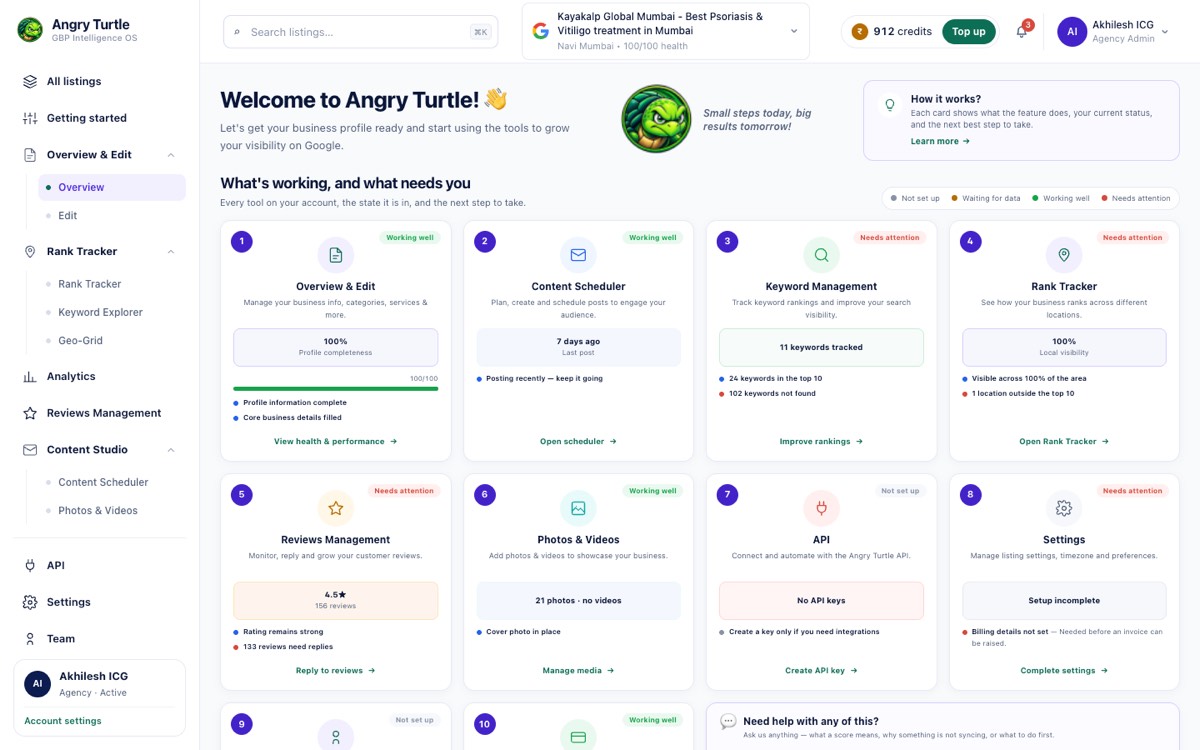
Angryturtle's review tools can't get a genuinely fake review deleted faster than Google's own process allows, nobody's can, but they cover the parts of this workflow that are easy to lose track of manually across more than one profile. Review integrity monitoring inside Reviews AI flags when a review disappears, gets edited, or a suspicious cluster appears, and keeps a timestamped record, useful if you need to show a timeline during an escalation. The platform also drafts the calm, factual public reply from step four, matched to the specific review's content, so a business isn't writing that line from scratch at 11pm. The same engine tracks review velocity alongside the fake-review workflow, since a slowdown in genuine reviews often shows up around the same time a fake one lands and is easy to miss if you're only looking at the one review in front of you. Rank OS folds review health into the wider profile score, so a fake-review dispute doesn't get treated in isolation from everything else the profile needs.
For agencies handling this across several client profiles, Agency OS routes flagged reviews and drafted replies for client approval before anything publishes, and the GBP management service can run the whole flag, reply, and escalation sequence end to end for businesses that would rather not own the back-and-forth themselves.
FAQ
Can I pay Google to remove a fake review faster? No. Nobody, including Angryturtle, can pay Google to prioritize or guarantee a review's removal. Any agency or tool offering guaranteed removal for a fee is either overselling what they control or planning something that risks your listing's standing.
Should I respond publicly if I'm confident the review is fake? Yes, but don't accuse the reviewer directly in the reply. State the facts you can verify and invite them to provide more detail. The public reply and the private flag to Google are two separate, parallel actions.
How long does Google typically take to review a flagged fake review? There's no fixed window. Clear spam sometimes disappears within a couple of days. More ambiguous cases can take weeks, and some flagged reviews, even ones that genuinely violate policy, are never removed.
What if the fake review is from a former employee? That's a conflict-of-interest violation Google's policy specifically covers. Flag it under that category and, if you can show the employment relationship (a termination date, an HR record), include that when you escalate.
Is it worth pursuing legal action if Google won't remove the review? Only as a last resort, and only if the review states a false fact as though true, not just a harsh opinion, and is doing real, measurable damage. It's slow, it costs money, and even a favorable legal outcome doesn't automatically force Google to remove the content.
More how-to playbooks
A score you can argue with, not a black box
Rank OS gives every profile a 0–100 score built from five weighted dimensions — Relevance, Review Health, Freshness, Entity Authority and AIO Readiness — and the weights are tunable. Underneath it sits a ranked list of the fixes that move the number, each with the point lift it unlocks.
Ready to have this run for you?
Book a free audit — we'll show you where you stand in 48 hours.