 Angryturtle
Red flags when hiring a local SEO agency
The warning signs that show up before a bad engagement does.
Ranking guarantees
No agency controls Google's algorithm, so no agency can honestly promise a specific ranking position by a specific date. "Guaranteed page one in 30 days" is the single most reliable tell that a pitch is selling confidence instead of capability. How to choose a local SEO agency covers what a credible pitch sounds like instead — usually a range of likely outcomes tied to a timeline, with the uncertainty stated plainly rather than smoothed over.
An agency that's honest about what it can't control is, counterintuitively, the safer bet. Local SEO timeline expectations is worth reading before any first call, so a guarantee gets recognized as a red flag rather than a selling point in the meeting itself.
Vague reporting or no reporting at all
An agency that can't explain, in specific terms, what work happened last month and what changed as a result is either not doing much work or not tracking it. Reports that show ranking charts with no context, or that arrive irregularly with no fixed cadence, are worth questioning early rather than after six months of unclear invoices. Reporting to clients and local SEO KPIs both describe what a legitimate report actually contains.
Ask specifically for a sample report from an existing client, redacted if needed, before signing anything. An agency confident in its work shows this without hesitation.
No access to the actual GBP dashboard
A business should retain ownership and admin access to its own Google Business Profile, full stop. An agency insisting on sole ownership, or refusing to add the business owner as a manager, is creating a dependency that makes switching agencies later expensive or impossible. GBP multiple owners and managers covers how ownership should actually be structured, and it's worth checking this before, not after, work begins.
This matters even more for businesses that eventually want to bring management in-house or switch providers. A locked-out GBP is a hostage situation, not a partnership.
Bulk, identical strategies across unrelated clients
An agency running the same generic keyword list, the same review-request template and the same content calendar across a dentist, a real estate agent and a gym isn't doing local SEO, it's running a template with the client's name swapped in. Local SEO myths in India covers a few of the assumptions this kind of one-size-fits-all approach relies on. A vertical-specific strategy should be visible from the first proposal, not something promised for "phase two."
Ask what's different about the strategy for your specific business versus a competitor in a different city or category. A vague answer here usually means the strategy is vague too.
Aggressive citation building without cleanup
Some agencies chase citation volume — hundreds of directory submissions — as a visible line item to justify the invoice, without checking whether the business's name, address and phone number stay consistent across all of them. Inconsistent NAP data across a large number of low-value directories creates more confusion than it resolves. NAP consistency at scale covers why this specific pattern actively works against a business rather than helping it.
A better sign is an agency that starts with an audit of existing citations and cleans up duplicates and inconsistencies before adding new ones, rather than treating volume as the deliverable.
Review manipulation tactics
Buying reviews, gating negative feedback before it reaches Google, or incentivizing reviews in ways that violate Google's policies puts a client's listing at direct suspension risk, and the agency doing it rarely wears the consequences the business does. Review gating policy covers what's actually compliant versus what looks similar but crosses a line. An agency proposing anything that sounds like "we'll make sure only good reviews show up" is proposing a policy violation, not a service.
Legitimate review generation asks every customer, doesn't filter who gets asked, and responds to negative reviews rather than suppressing them. Review generation strategy covers what the compliant version of this work looks like.
No clarity on who's actually doing the work
Agencies that resell work to an unnamed third-party vendor, with no visibility into who's actually touching the client's listings, create a chain of accountability nobody can trace when something goes wrong. This isn't automatically disqualifying — a lot of legitimate agencies use specialized subcontractors — but the business should know it's happening and know who to hold accountable if a listing gets suspended or a strategy underdelivers.
Ask directly whether the team pitching the work is the team executing it. A dodge here, rather than a clear answer, is itself informative.
Pressure to sign long contracts before any audit
An agency asking for a twelve-month commitment before doing any diagnostic work on the actual business has nothing to base that commitment on yet. A credible agency runs an audit first, shows what it found, and proposes a scope based on that — even if the eventual contract is still long-term. Local SEO audit checklist is worth requesting or running independently before agreeing to any multi-month engagement.
What good looks like instead
A trustworthy agency leads with an audit, sets expectations around timeline and uncertainty rather than guarantees, gives the client GBP ownership, reports specifically rather than vaguely, and tailors strategy by vertical rather than running the same playbook for every account. Questions to ask before hiring a GBP agency is a useful checklist to bring into a first call, and comparing in-house versus agency local SEO and agency versus freelancer local SEO helps frame whether an agency is even the right structure for a given business's size and stage.
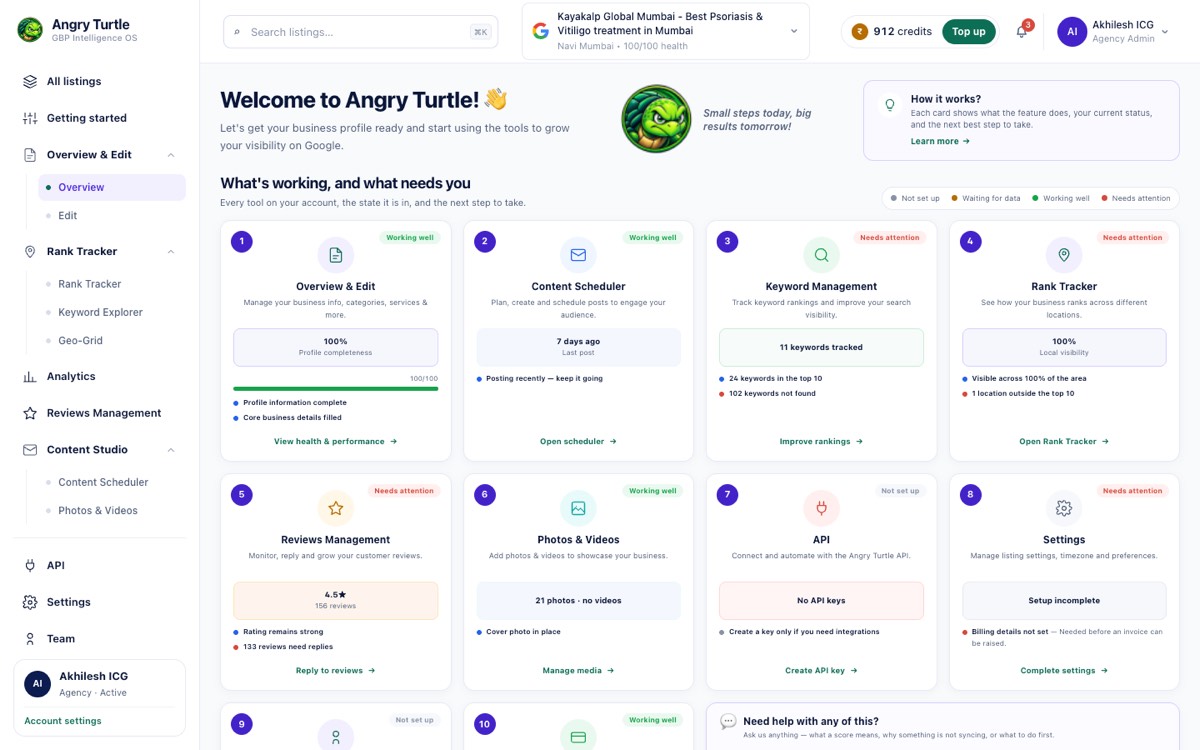
Angryturtle's own agency model is built around the opposite of most items on this list — client-retained GBP access, vertical-specific strategy through Rank OS scoring, and transparent reporting rather than vanity metrics. Whether a business wants a fully managed engagement through managed local SEO or wants to run things through the platform itself via Agency OS, the access and reporting model doesn't change based on which one is chosen.
FAQ
Is a ranking guarantee ever legitimate? No credible agency can guarantee a specific ranking position, because none of them control Google's algorithm. What a credible agency can commit to is the specific work it will do and how it will report on results.
Should a business always keep admin access to its own GBP? Yes. Retaining ownership or at least manager-level access protects a business from being locked out if it switches agencies or brings management in-house later.
How long should a local SEO contract be before results show? It varies by starting point and competition, and any fixed number claimed without context should be treated skeptically. Local SEO timeline expectations covers realistic ranges.
Is buying reviews ever safe? No. It violates Google's policies and puts a listing at real risk of suspension or permanent removal, regardless of how the agency frames the tactic.
What's the single most useful question to ask before hiring an agency? Asking to see a redacted sample report from an existing client reveals more than almost anything else in a pitch — it shows what the agency actually tracks and how honestly it communicates results.
More listicles and rankings
A score you can argue with, not a black box
Rank OS gives every profile a 0–100 score built from five weighted dimensions — Relevance, Review Health, Freshness, Entity Authority and AIO Readiness — and the weights are tunable. Underneath it sits a ranked list of the fixes that move the number, each with the point lift it unlocks.
Ready to have this run for you?
Book a free audit — we'll show you where you stand in 48 hours.