 Angryturtle
Location Data Management Tools for Indian Multi-Location Businesses
What separates a tool that reports listing errors from one that actually fixes them on Google.
The short answer
Location data management tools keep a business's name, address, phone number, hours and other Google Business Profile details accurate across every listing and directory a customer might see. For an Indian multi-location brand, the right tool has to do three things well: catch inconsistencies before a customer does, push corrections to Google and Indian directories without a two-week wait, and cover JustDial, Sulekha, Practo and IndiaMART, not just Western citation networks. Most global platforms are strong on the first job and weak on the third. That gap — see our location data management explainer for the fuller picture — is the whole reason this list exists.
A related question worth separating out first: location data management is not the same thing as local SEO. It is one input into local SEO, covered in more depth on the business location data management blog post. Ranking, review strategy, content and AI-search visibility sit on top of clean location data. A perfectly synced NAP record doesn't rank a listing by itself, but a broken one caps how high anything else can go.
What to actually look for
Start with source of truth. A location data tool should let a team edit once, centrally, and have that edit flow out to every connected profile. If a franchise coordinator is still updating Google separately from the citation tool, the software isn't doing its job — it's doing half of it and hoping someone remembers the other half.
Sync speed matters more than most vendors admit. A tool that detects a wrong phone number but takes days to push the fix is a monitoring tool wearing a management-tool label. Ask specifically how a correction gets from the dashboard to the live Google listing, and how long that takes. Vendors answer this question vaguely for a reason.
Duplicate detection is its own category of pain for multi-location brands in India, where a single clinic or showroom often has three or four duplicate GBP listings created by different staff, franchise partners, or old Google Maps suggestions. A tool that can't find and merge duplicates will keep reporting the same NAP error every month without ever closing it. The duplicate listings glossary entry covers the mechanics in short form, duplicate listings cleanup walks through the process end to end, and managing 100+ GBP listings shows what the problem looks like once it compounds across a large chain.
Audit depth is worth checking too. Does the tool just flag "NAP mismatch found," or does it show which field, on which directory, and what the correct value should be? Vague audits waste more time than they save, because someone still has to go find the actual discrepancy by hand.
Then there's the directory question, which is where this list gets genuinely uneven. Indian directory coverage — JustDial, Sulekha, Practo for healthcare, IndiaMART for B2B — isn't a nice-to-have for a business with more than a couple of Indian locations. It's often where local discovery actually happens, alongside Google. A tool built around a North American or European citation network treats these as an afterthought, if it treats them at all.
Last, ask whether the tool acts or reports. A dashboard that tells a business its listing health dropped is not the same as software that fixes the listing and pushes the change live. That distinction is the dividing line between most of the tools below, and it's the one question that separates a genuinely useful platform from an expensive alert system.
The global platforms
Yext built its reputation on a large, mostly Western citation network and a strong knowledge-graph model for enterprise brands with hundreds of locations across the US and Europe. Its structured-data approach to location listings is genuinely well engineered. The question for an Indian operator is how much of that published publisher network covers the directories their customers actually use here — worth checking against your own shortlist before committing, since Yext lists its network and pricing publicly. See the Yext alternative comparison for the detail.
Uberall takes a similar location-data-plus-store-locator approach, with decent multi-location sync and a franchise-friendly permission model. Its directory network has the same regional lean as Yext's — solid in Europe, thinner once checked against Indian-specific platforms. The Uberall comparison breaks down where it holds up and where it doesn't for an India-first business, and Uberall vs Yext covers how the two stack up against each other directly.
Moz Local is well known for citation building and NAP consistency checks, and it's a reasonable entry point for a business with a handful of locations that mostly needs clean, basic listings. It wasn't built with Indian directories in mind, and its reporting leans toward "here's what's wrong" rather than "here's the fix, already applied." The Moz Local comparison has specifics, and the India-specific angle is covered separately in Moz Local alternative for India.
Synup sits closer to the mid-market, with decent multi-location dashboards and review monitoring bundled in. Like the others on this list, its citation network is global-first, and Indian directory coverage is something to verify directly with them rather than assume — see the Synup comparison and Synup alternative for India for what it actually covers once verified.
None of these four is a bad product. They're built for a different map. A business running fifty locations across the US doesn't need JustDial coverage. A business running fifty locations across Mumbai, Pune and Bengaluru does, and that single fact reshapes which parts of each platform actually matter.
The local-SEO tool angle
Outside the big platforms, a lot of local-SEO agencies stitch together separate tools for rank tracking, citation building and review management, then layer a spreadsheet on top to track which listing needs what. It works, in the sense that most manual processes work, until a franchise partner changes a phone number in one place and forgets three others, and nobody notices until a customer complains. NAP consistency at scale walks through exactly how that failure mode plays out across a growing chain.
The practical fix isn't always a bigger platform. Sometimes it's a managed service that owns the process end to end — onboarding new locations correctly the first time is cheaper than cleaning up after the fact, a point the onboarding new business locations post covers in more detail. For businesses that don't want to run the software themselves, this is usually the better path. See the multi-location local SEO services page and the broader multi-location local SEO guide for what that looks like in practice, and franchise GBP management for the franchise-specific version of the same problem.
Where Angryturtle fits
Angryturtle is built around a different starting assumption: that a location data tool for an Indian business should treat JustDial, Sulekha, Practo and IndiaMART as first-class directories, not an afterthought bolted onto a Western citation engine. Coverage is India-first because the customers finding these businesses are searching India-first.
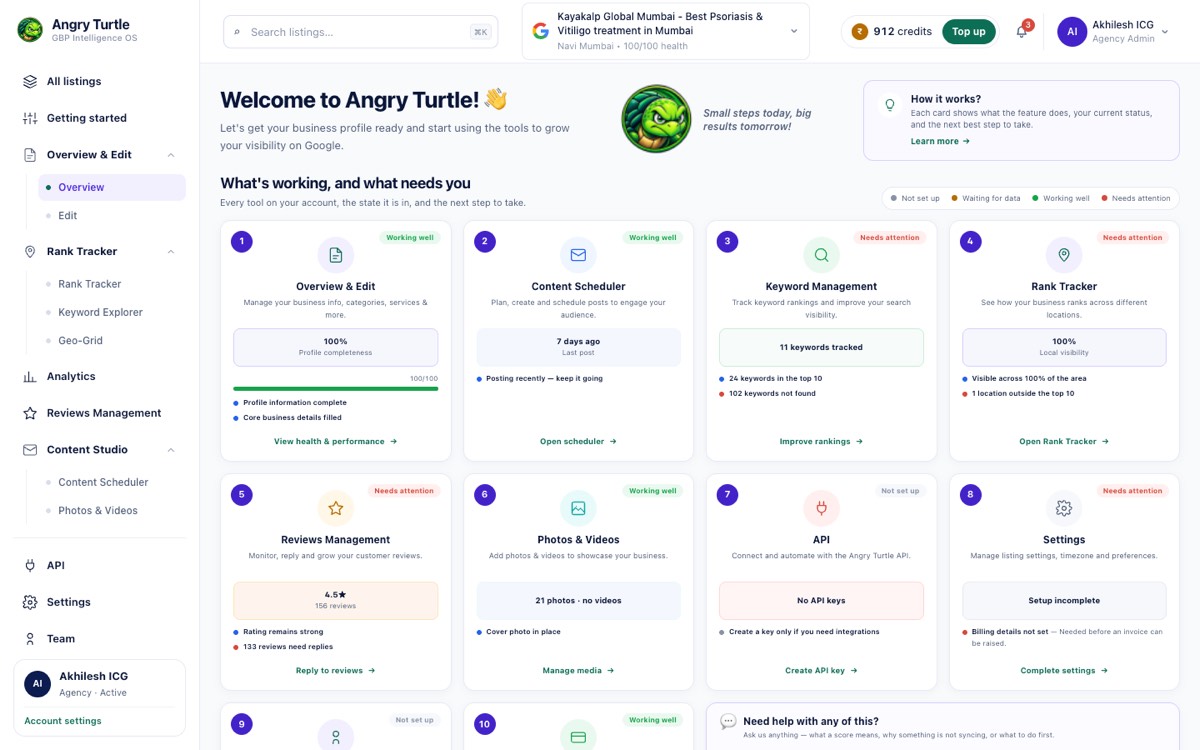
The bigger difference is what happens after an error is found. Angryturtle's Rank OS scores every profile across five weighted dimensions, including a specific measure of NAP and profile-element risk, and it doesn't stop at the score. Fixes get queued, reviewed, and pushed straight to Google through the same write-back loop that runs the platform's broader GBP management, not a separate module. A wrong address isn't just flagged; it gets corrected on the live listing, with a change history so an agency or in-house team can see what changed and when.
That matters more the more locations a business runs. A ten-location clinic chain and a two-location boutique agency both need clean, accurate profiles, but the ten-location chain needs someone, or something, actively finding the duplicate listings a well-meaning branch manager created last year. Angryturtle works either way — self-serve for a team that wants to run this itself through the Agency OS for multi-client operators, or enterprise and white-label managed for a team that would rather hand the whole process to specialists and just see the results. It's not one or the other. The platform underneath both models is the same.
FAQ
Is location data management the same as local SEO? No. Location data management is one input into local SEO — keeping listings accurate and consistent. Local SEO also covers ranking, review strategy, content and answer-engine visibility, which sit on top of clean location data rather than replacing the need for it.
Do I need Indian directory coverage if my business already ranks well on Google? Usually yes. JustDial, Sulekha and Practo, for healthcare, drive discovery independent of Google, and a listing that's wrong on those platforms creates confusion even when Google's version is correct.
Can location data tools guarantee better rankings? No credible tool can guarantee rankings; Google's algorithm isn't something any vendor controls. What a good tool can do is remove the specific, fixable errors — wrong hours, duplicate listings, inconsistent addresses — that are known to hurt local visibility.
How often should location data be audited? Monthly is a reasonable baseline for a business with more than a few locations, with an immediate re-check any time a location changes hands, moves, or updates its hours.
More listicles and rankings
A score you can argue with, not a black box
Rank OS gives every profile a 0–100 score built from five weighted dimensions — Relevance, Review Health, Freshness, Entity Authority and AIO Readiness — and the weights are tunable. Underneath it sits a ranked list of the fixes that move the number, each with the point lift it unlocks.
Ready to have this run for you?
Book a free audit — we'll show you where you stand in 48 hours.