 Angryturtle
Local SEO software for the Indian market.
Most local SEO tools are built for US directories and priced in dollars. This is what changes when the directories are JustDial, Practo and IndiaMART.
·
A restaurant chain in Pune signs up for a well-reviewed local SEO tool, points it at its five locations, and gets a rank tracker that has never heard of Zomato, a citation checker that doesn't know JustDial exists, and an invoice in dollars that changes every month with the exchange rate. That's the ordinary experience of buying local SEO software built for the US market and running it on an Indian business, and it's the reason this page exists.
In brief: Local SEO software for the Indian market needs to track rank across Indian cities, build citations on the directories Indian customers actually use, price in rupees, and — increasingly — show whether a business is visible when AI systems answer local questions. Angryturtle is built for that market specifically: geo-grid rank tracking across Indian cities, GBP write-back confirmed working, a citation engine that includes India-relevant platforms, and rupee pricing throughout.
What changes when the market is India
Local SEO software built for the US or UK market usually assumes a directory landscape anchored around Yelp, the Better Business Bureau, and a handful of national aggregators. None of that maps cleanly onto India. Indian consumers check JustDial for phone numbers and reviews, Practo for healthcare specifically, IndiaMART for B2B suppliers, and increasingly WhatsApp Business for direct contact rather than a website form. A tool built without India in mind either ignores these entirely or bolts them on as an afterthought, which shows up as thin, outdated, or missing coverage the moment you actually check.
Currency is the second gap, and it's more than an inconvenience. A tool priced in USD or GBP means every invoice is subject to exchange-rate movement, and annual contracts denominated in a foreign currency lock in that exposure for a year at a time. Rupee pricing removes that variable entirely — the ₹999 a Solo plan costs this month is the ₹999 it costs next month too.
Directory coverage — JustDial, Practo, IndiaMART and the rest
Citation building is the part of local SEO that most directly rewards knowing the market. Angryturtle's citation engine runs discovery and NAP consistency checks across 20+ platforms relevant to Indian businesses, with a duplicate finder for the listings that accumulate when different staff create profiles over the years, and a missing-citations view for gaps that need filling. Category matters here: a healthcare provider needs Practo coverage a retail shop doesn't, and a B2B supplier needs IndiaMART coverage a restaurant never will — the citation engine's relevance is category-aware rather than a flat checklist run against every business the same way.
Review management is the category most Indian businesses shop for first, and the one where the India-specific gap is widest — most tools handle Google reviews well and everything else here poorly. Review management in this platform means reading reviews, AI-drafting replies with a personalised greeting and the business's own signature, and publishing the reply to Google in one click, plus a Brand Identity vs Brand Image comparison that reads what reviews actually say against what the business claims about itself. See the review management software blog post and the reviews & AI product page for the full mechanics.
Geo-grid rank tracking for Indian cities
Rank tracking is where the gap between a tool built for the US and one built for India shows up fastest. Geo-grid rank tracking answers a specific failure mode of cheaper rank checkers: reporting a single rank number for a business with no indication of where that number was measured from. A pin checker lets you drop a point at any lat/long or pincode across a city and see the actual local-pack position from there, which matters enormously in Indian metros where a service area can span a dozen distinct neighbourhoods with very different competitive density — a plumber's rank in Gurgaon sector 14 and their rank six kilometres away in sector 56 can be entirely different numbers.
City coverage today spans Mumbai, Delhi, Bengaluru, Gurgaon, Hyderabad, Kolkata, Chennai, Pune and Ahmedabad, with a keyword explorer alongside the grid that suggests trackable keywords based on category and services rather than requiring manual keyword research from scratch. Full detail on the mechanics is on the geo-grid product page and the geo-grid glossary entry.
Rank OS — scoring built for multi-industry India
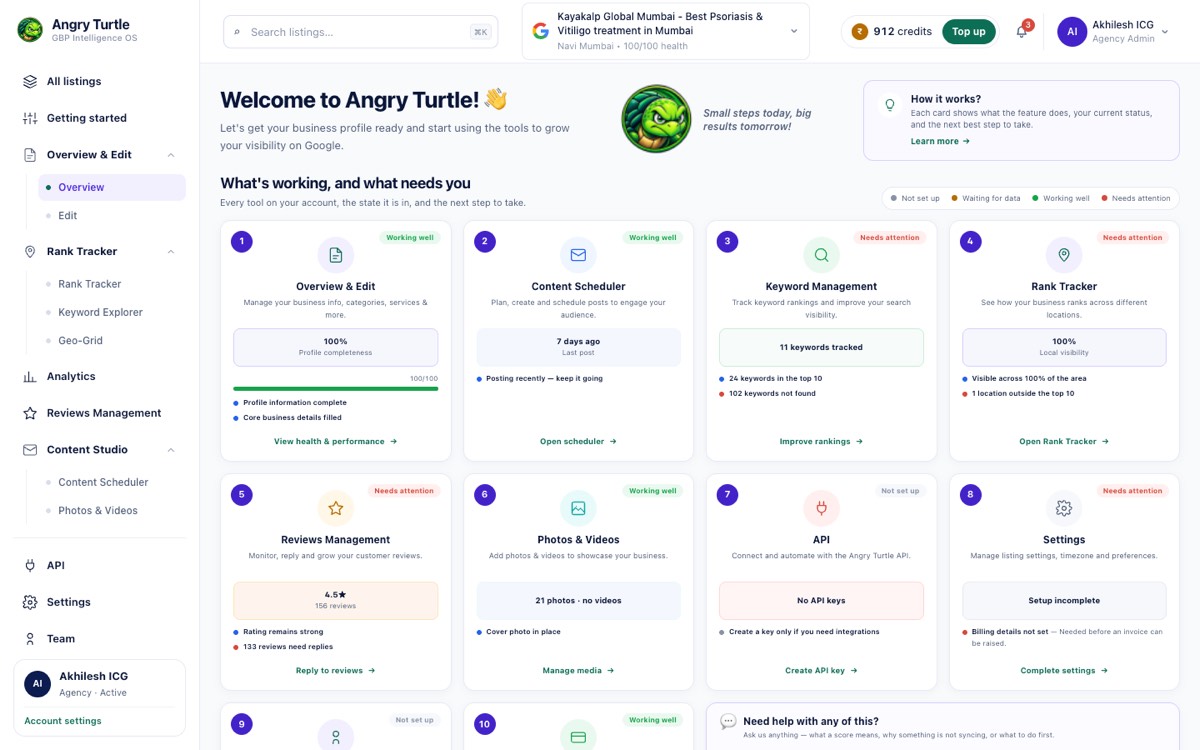
Underneath the rank tracking and citations sits Rank OS, a 0-100 score across five weighted dimensions: Relevance (25), Review Health (25), Freshness (20), Entity Authority (15) and AIO Readiness (15). These weights are Angryturtle's own tuning, transparent and adjustable, not a claim to have reverse-engineered Google's actual algorithm — nobody outside Google can honestly make that claim. What makes this relevant to the India question specifically is that the cluster taxonomy underneath Relevance adapts per industry: healthcare, lifesciences, real estate, hospitality, education, franchise groups, retail and banking each get a different demand-cluster model, because "what a good profile looks like" genuinely differs between a diagnostics chain and a real estate brokerage. See healthcare local SEO, real estate local SEO and retail local SEO for how that plays out by vertical, and the Rank OS glossary entry for the scoring model itself.
GBP write-back — confirmed working
Most local SEO tools, whatever market they're built for, report on a profile without letting you fix it from the same place. Angryturtle's editor sits over a visual preview of how the change will look on Google and lets you edit name, description, phone, website, address, hours, holiday hours, categories through the live Google category picker, and service areas — with the change pushing straight to the live profile rather than sitting in a local draft. This was confirmed working by the client team on 2026-08-02, and it's the single feature most likely to separate a real management platform from a rank-and-citation report generator, regardless of which country's market the software was originally built for.
Local SEO tools India — the five things buyers actually mean
"Local SEO software" and "local SEO tools India" get used to mean at least five distinct jobs online, and no single feature list serves all five equally well.
Rank and visibility tracking is the oldest of the five — geo-grid tools like the one described above, checking rank across a whole service area instead of one average number. GBP management sits next to it but isn't the same job: editing the profile, posting, and replying to reviews, distinct from tracking where the profile ranks. Citation building is a third function entirely, getting a business listed consistently across the directories that build entity authority. On-page and content tooling is a fourth — location pages, schema markup, the on-site half of local SEO that a GBP-only tool never touches, since this isn't a website SEO crawler by design. And AI-answer readiness is the fifth, newest category: whether a listing or page reads as a citable source when AI Overviews, ChatGPT or Gemini answer a local question, rather than just ranking in the classic map pack.
Anyone comparing best local SEO tools India options is really asking which of those five a given product covers, and which it quietly leaves for a second subscription. Angryturtle covers four of the five directly — rank tracking, GBP management, citations, and AI-answer readiness — and checks on-page NAP consistency without pretending to replace a dedicated website SEO crawler.
Review generation is one place the Indian market genuinely diverges from a checklist built for the US. WhatsApp is a routine business channel for a great many Indian customers in a way email often is not, so a review-request workflow that only sends email or SMS is missing a channel plenty of local businesses already use with their own customers every day. Angryturtle's review workflow doesn't dictate the channel — it drafts the reply, and the ask goes out however a business already reaches its customers, WhatsApp included.
Where a tool stack alone runs out
Software surfaces data and provides a workflow. Someone still has to act on what it shows, and that gap — between having the subscription and actually executing on what it reports, week after week — is where a fair amount of local SEO budget in India quietly goes to waste. A rank tracker nobody reads and a citation tool that flags gaps nobody fills cost the same as ones that get used.
Managed services tend to make more sense than a pure DIY stack in a few specific situations: multi-location businesses where coordinating updates across branches exceeds what one in-house person can absorb, regulated categories where every post or reply needs a compliance check before it publishes, competitive categories where consistent weekly execution is what actually moves rank, and any business without someone whose job it actually is to own the profile. None of that argues against self-serve software generally. It argues for matching the tool to whoever is actually going to run it.
The most common buying mistake is picking a platform on name recognition without checking its Indian directory or WhatsApp coverage first — that gap tends to surface only months in, once the subscription's already running and the results aren't showing up. A second is stacking two overlapping tools, a standalone rank tracker plus an all-in-one suite that also tracks rank, without checking for the overlap first. A third is treating the software's price as the whole cost of local SEO, when the labour to actually interpret and act on what it reports is usually the bigger line item.
How Angryturtle compares to other categories of tool
Comparing named vendors by feature or price invites disputes that can't be verified from outside, so the table below compares categories rather than specific competitors. Check any named vendor's own pricing and feature pages directly if you need their exact current specifics — including Angryturtle's.
| Criterion | Angryturtle | US-built enterprise platforms | DIY rank trackers | Review-only tools |
|---|---|---|---|---|
| India directory coverage | JustDial, Practo, IndiaMART and 20+ India-relevant platforms, category-aware | Usually optimised for US/UK directories first; India coverage varies by vendor | Not applicable — rank tracking only | Not applicable |
| Rupee pricing | Native, no currency conversion | Usually USD/GBP, converted at checkout | Varies by vendor | Varies by vendor |
| Write-back to Google | Confirmed — edits push live to the profile | Varies; several are reporting-only; check the vendor directly | Read-only by design | Reply-only, no profile edit |
| Geo-grid vs single-point rank | Heat map + pin checker at any lat/long or pincode, across Indian metros | Some offer geo-grid at higher tiers | Usually single-point or a fixed simple grid | Not applicable |
| AI-answer readiness | Scored inside Rank OS (AIO Readiness dimension) | An emerging feature category-wide; check the vendor's own claims | Not covered | Not covered |
| API access | GBP Business Information, Performance, Reviews and Posts, in-platform | Varies by vendor and tier | Rarely exposed | Rarely exposed |
| Agency / white-label support | Multi-tenant Agency OS, roles, pooled credits | Common at enterprise tiers | Rare | Sometimes, review-focused only |
Pricing models across categories differ in shape as well as amount — annual USD contracts, credit-based rank-tracking pricing, and per-seat review-tool pricing are three different commitments, and it's worth comparing the shape of the commitment, not just a headline number.
Who this is not for
This isn't a website builder or an on-page SEO crawler — it checks a site's NAP against the GBP listing but doesn't audit page speed, on-page content, or technical SEO the way a dedicated crawler would. It isn't a backlink tool: citations are NAP listings, a different discipline from link-building. It doesn't run a general social-media calendar — Google Posts only, not Instagram or Facebook. And a business operating exclusively outside India, with no Indian locations or Indian customer base at all, gets little from the India-specific parts of this platform and might be better served by a tool built primarily around its own market's directory landscape instead.
It also isn't real-time. GBP performance data lags roughly a month straight from Google's own API, a limit every tool in this category inherits identically, this one included.
Pricing
Solo runs ₹999/month for up to two profiles. Agency starts from ₹3,499/month for ten listings, scaling with pooled credits and unlimited seats. Enterprise pricing is custom, with unlimited profiles and SSO. On the managed side, where a team runs the platform for you, Managed Essentials is ₹1,499/month plus a ₹5,000 setup fee, Managed Growth is ₹3,999/month plus a ₹9,000 setup fee, and Agency Partner pricing starts from ₹6,999/month. Full breakdown on the pricing page.
How to start
Start the 15-day trial on Solo, with up to two profiles and 130 credits — enough to run a real Rank OS scan and see the geo-grid on your own city before paying anything. Agencies managing multiple clients across cities should book a demo instead, to see the Agency OS layer and pooled credits properly rather than evaluating them from a solo trial account. Contact us if you're not sure which entry point matches your situation.
Frequently asked questions
Why does a US-built rank tracker perform badly for an Indian business? Mostly because of directory and query-pattern mismatches. A tool built around US search behaviour and US directories won't have real coverage of JustDial, Practo or IndiaMART, and its default keyword suggestions tend to reflect US search phrasing rather than how Indian customers actually search.
Is rupee pricing actually cheaper, or just avoiding currency conversion? Both, depending on the vendor. Some USD-priced tools work out cheaper even after conversion; the more consistent benefit of rupee pricing is predictability — no exchange-rate exposure changing your bill month to month, which matters most on annual commitments.
Does this software cover regional-language reviews and listings? Review reading and reply drafting handle content as it appears, including regional-language reviews where present, though the depth of that handling depends on the specific language and platform. Directory coverage is India-wide rather than limited to English-language listings.
Can this replace a JustDial or Practo listing itself? No — those are directories where your business needs its own listing; Angryturtle discovers, checks and helps correct those listings rather than replacing the directories themselves. The citation engine tells you where you're listed, where you're missing, and where your NAP data doesn't match.
How many Indian cities does the geo-grid actually cover? Nine metros today — Mumbai, Delhi, Bengaluru, Gurgaon, Hyderabad, Kolkata, Chennai, Pune and Ahmedabad — with the pin checker letting you drop a point at any lat/long or pincode within a covered service area rather than being limited to city-centre defaults.
Is there a minimum number of reviews needed before AI systems will cite my business? No, and don't trust a vendor who tells you there is. Google has never published a review-count threshold for AI Overview citation, and no credible independent study establishes one either. Review signal is a gradient — being competitive with the businesses currently ranking top-three in your city for your query matters more than hitting any specific number.
What's the difference between this and a review-only platform? A review-only platform reads and replies to reviews but typically can't touch the rest of the profile. This platform's review layer sits alongside rank tracking, citation management and the GBP write-back editor, so a review insight — like a Brand Identity vs Image gap — can turn directly into a profile edit rather than staying a report nobody acts on.
Do I need the managed service, or can I run the software myself? Either works, and the platform is built for both. Solo owner-operators typically run it themselves; agencies and multi-location brands sometimes prefer the managed service so Angryturtle's own team executes the recommendations rather than an internal team doing it. Pricing differs accordingly between the self-serve tiers and the managed tiers above.
Supporting reading: local rank tracking software, citation building software, review management software, GMB management software for India, and white-label local SEO software. For the general product overview, see GBP management software; for the technical, API-first read, see GBP API management. Agencies should also see white-label local SEO and multi-location local SEO services; multi-branch brands should see location data management.
A score you can argue with, not a black box
Rank OS gives every profile a 0–100 score built from five weighted dimensions — Relevance, Review Health, Freshness, Entity Authority and AIO Readiness — and the weights are tunable. Underneath it sits a ranked list of the fixes that move the number, each with the point lift it unlocks.
Ready to have this run for you?
Book a free audit — we'll show you where you stand in 48 hours.