 Angryturtle
What Google's Profile Strength Indicator Actually Measures
·
Log into Google Business Profile and you'll sometimes see a number or a progress ring next to "Profile strength," with no real explanation of what feeds it. GBP profile strength is Google's own completeness indicator for a listing — it scores how much of the profile you have filled in, not how well that profile ranks. Google doesn't publish the formula. What follows is what's observable from actually using the interface and watching what moves the indicator, not a reverse-engineered algorithm.
What Google says, and what it doesn't say
Google's own help documentation describes profile strength as a rough measure of how complete a profile is, tied to filling in fields like hours, categories, photos, description, and attributes. It does not publish weights for each field, does not claim the score is a ranking factor, and does not guarantee any causal link between a higher strength score and better local pack visibility. Anyone who tells you the exact formula is either guessing or making it up, because Google hasn't released one.
What moves the indicator in practice
Watching the number change while editing a profile, a few patterns hold up consistently: an empty business description drags the score down, and filling it in with a real paragraph (not one line) moves it. Missing hours, missing a phone number, or missing at least one photo all show as gaps. Adding services or products with descriptions tends to move it further than adding one bare service name. Attributes contribute too, though less visibly than hours or photos.
None of this is a secret formula so much as a completeness checklist Google is walking a business through, one field at a time, and rendering as a single number so it feels more like a game than a form.
Completeness versus ranking, the actual distinction
This is where confusion sets in most often. Profile strength measures how much of the profile form is filled in. Local pack ranking, the thing that actually determines whether a business shows in the map pack, depends on relevance (category and content match to the query), distance, and prominence (reviews, links, overall web presence) — Google's own three stated ranking factors. A profile can score high on strength while ranking poorly because it's in a crowded category three kilometers from the searcher. A profile can score moderately on strength and still rank well because it's the closest relevant listing with strong reviews.
GBP ranking factors breaks down what Google has actually confirmed moves rank. Profile strength isn't on that list, and treating it as a proxy for rank is the single most common mistake business owners make with this indicator.
Why a complete profile still correlates with better outcomes
Even without a direct ranking mechanism, a complete profile tends to perform better for a mundane reason: it gives searchers more reasons to click, call, or visit, and it gives Google more structured content to match against a wider range of queries. A profile with ten services listed, each with a short description, can surface for ten different search intents that a bare-bones profile with no services section never gets a chance at. That's a relevance effect operating through content coverage, not a hidden strength-score boost.
GBP optimization checklist and optimize your Google Business Profile both walk through the same completeness work from that angle — do it because it broadens what you can be found for, not because a progress ring tells you to.
Fields that carry more practical weight than the score suggests
Category selection matters more to actual search matching than the strength indicator implies, since strength treats "picked a category" as done regardless of whether it's the right one. Choosing a GBP category covers getting that decision right, which the strength score has no way to check. Photos are similar — the score rewards having at least one photo, but GBP photos best practices shows that photo recency and volume affect searcher behavior well past the point where the score itself stops changing.
Reviews sit outside the strength score entirely in most versions of the interface, despite being one of the strongest actual prominence signals Google has confirmed. How to get Google reviews and review generation strategy cover work that won't move a strength number but will move rank.
Where this fits for multi-location businesses
A 30-location chain checking profile strength one listing at a time is a slow way to find the gaps. Angryturtle's Rank OS scores each location on five weighted dimensions — Relevance, Review Health, Freshness, Entity Authority, and AIO Readiness — as a transparent 0-100 number with the weighting shown, not hidden the way Google's own strength indicator is. It's a genuinely different kind of score: it's built to correlate with outcomes across the specific dimensions that drive local visibility, rather than measuring form completeness alone. For a chain managing this at scale, see managing 100+ GBP listings and enterprise local SEO reporting.
A caveat worth stating plainly
There's no independent, published study correlating Google's own profile strength score with ranking outcomes, and Angryturtle hasn't run one either. Everything above is drawn from watching the field-by-field behavior of the indicator and from Google's stated ranking factors, not from a controlled study of strength score against rank position. If a specific number is what you're after, it doesn't exist yet in any credible published form — describe the mechanism to a client instead of citing a number nobody has measured.
Is profile strength a Google ranking factor? Not according to anything Google has published. It measures form completeness, while Google's stated ranking factors are relevance, distance, and prominence.
Why does my profile strength stay the same after I added reviews? Reviews generally sit outside what the strength indicator tracks in most current interface versions, since it's built around profile fields rather than review activity.
Does a 100% profile strength score guarantee good rankings? No. A fully complete profile in a crowded category, far from the searcher, can still rank behind a less complete profile that's closer and more relevant to the specific query.
What's the fastest way to raise profile strength? Filling in the business description, adding services with real descriptions rather than bare names, and uploading at least a handful of photos tend to move it the most, based on how the field-by-field behavior looks in practice.
Related: GBP management best practices and GBP performance insights cover the reporting side of profile health beyond this one indicator, and local pack vs organic results covers the visibility split this score gets conflated with most.
What is GBP profile strength? GBP profile strength is the completeness indicator Google shows inside the Business Profile dashboard. It reflects how much of the available profile — categories, services, attributes, hours, photos, description — you have actually filled in. It is not a ranking score, and a profile at full strength can still rank poorly if relevance, reviews or proximity are working against it.
Does GBP profile strength affect rankings? Not directly. Google has never published a link between the strength indicator and local ranking. What the indicator tracks — completeness — does overlap with signals that matter, so a profile that scores badly usually has real gaps worth fixing. Treat it as a checklist prompt, not a rank predictor.
Stop guessing where you rank locally.
Rank OS scores your Google Business Profile the way Google's local algorithm does — relevance, review health, freshness, entity authority and AIO readiness — and shows you exactly what to fix.
Book a live demo →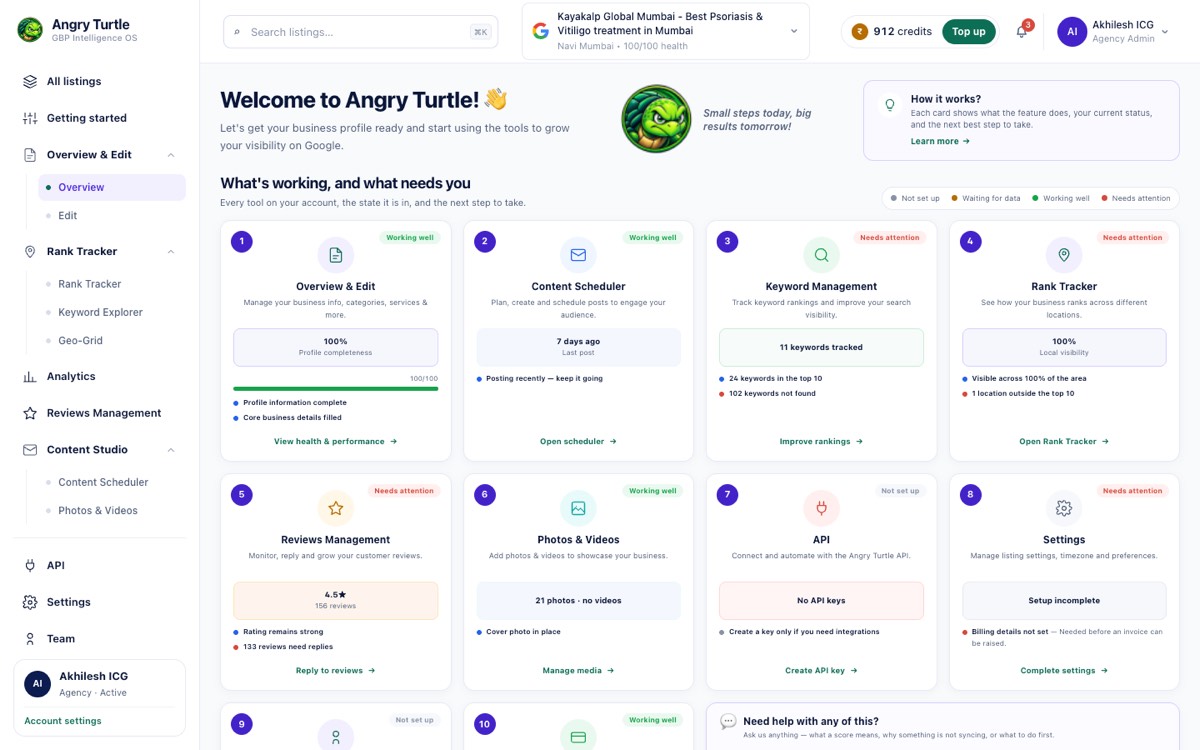

Related reading
Ready to have this run for you?
Book a free audit — we'll show you where you stand in 48 hours.