 Angryturtle
Getting Cited by ChatGPT & Gemini for Local Queries
Practical tactics for getting your Indian local business cited in ChatGPT, Gemini, and Perplexity responses to local recommendation queries.
·
Getting cited by ChatGPT, Gemini and Perplexity: a practical guide for Indian local businesses
"Which fertility clinic in Bengaluru has the best IVF success rates?" "Best chartered accountant firm in Connaught Place?" "Top coaching institutes for NEET preparation in Hyderabad?"
These are real questions Indian consumers are putting to AI assistants in 2026. The businesses that appear inside those answers get visibility before the searcher has opened a single website. This guide covers what determines who gets cited, and what a business can actually do about it.
Two different kinds of LLM citation
Training data citations happen when an LLM answers without browsing the web, drawing instead on text it learned from during training — web pages, directories, review platforms, publications crawled before the cutoff. Businesses with a long-standing, substantial web presence are more likely to already be baked into that training data.
Real-time citations happen when a browsing-enabled model — Perplexity, ChatGPT with browsing on, Google Gemini — actually crawls live web sources while answering a current query. For most Indian local businesses, this second kind is the more immediately actionable one, because you can improve your position in live sources starting today rather than waiting for the next training cycle.
What a browsing LLM actually does for a local recommendation
When a browsing LLM answers "best [category] in [city]," it typically searches Google or Bing for the query, crawls the top-ranking pages — local pack results, listicle articles, directory pages — extracts business information from what it finds, then synthesises that into a recommendation.
The practical implication is that your GBP, which underpins the structured data behind local pack listings, and your own website's content are the primary sources feeding browsing LLM citations. Directory pages on Practo, Zomato, and JustDial are secondary sources it pulls from when the primary ones are thin.
There's a direct knock-on effect here too: ranking in the local pack improves the odds of LLM citation, because a browsing model crawling the top 3 results as part of its source gathering will find your GBP and website in the process. LLM citation and local pack rank aren't two separate games — strong local SEO is the foundation the citation sits on top of.
Tactic one: structure your website for direct extraction
LLMs extract what's clearly stated, not what's implied. For a clinic wanting to be cited as "best IVF clinic in Bengaluru with high success rates," the difference between poor and citable content is stark. Poor: "Our team provides exceptional fertility care with a focus on patient outcomes." Citable: "Our IVF success rate for patients under 35 is 68% per fresh cycle (ICMR-audited data, 2024). We have completed 1,800+ IVF cycles since 2018 at our Bengaluru clinic." Specific numbers, a named source, direct statements — that's what gets lifted into an answer.
Tactic two: build a dedicated credentials and statistics page
A page titled "Our Outcomes & Credentials" or "Why Choose Us" should carry the founding year and years of operation, patient or client volume where disclosable, success rates or notable statistics with source attribution, team credentials including degrees, board certifications, and registration numbers, awards and accreditations, and any publications or media mentions. This is precisely the content LLMs pull from for "best of" queries — it's structured, factual, and self-contained.
Tactic three: get mentioned in listicle articles
Articles titled "Top 10 IVF Clinics in Bengaluru," "Best Chartered Accountants in Delhi," "Top Coaching Institutes for NEET in Hyderabad" are primary sources for LLM local recommendations. Getting into one starts with having content good enough to be cited in the first place — a complete services page, real outcomes data, verifiable credentials — and then actually reaching out to health, education, or real estate blogs to be considered, or responding to journalist queries the way HARO or Qwoted equivalents work for Indian media.
Tactic four: make directory profiles comprehensive, not thin
LLMs browsing for local recommendations often crawl platform pages directly. A complete Practo profile for a doctor — credentials, specialisation, patient volume, over 100 reviews — hands an LLM rich, structured data to extract from. A thin profile with just a name and phone number gives it nothing.
Tactic five: build external validation through press coverage
A mention in The Hindu, Mint, Economic Times, or an industry publication creates a credible web reference that LLMs treat as a validation signal. Even a brief quote — "Dr. Sharma of [clinic] commented on the trend..." — contributes to entity recognition over time, the same way it contributes to traditional E-E-A-T signals.
Monitoring what's actually being cited
Tracking LLM citations isn't yet a standardised practice with mature, universally trusted tools. The manual approach still works: monthly, query ChatGPT, Perplexity, and Gemini directly with the recommendation queries most relevant to the business — "best [category] in [city]," "top [specialty] clinic near [area]" — and note when and how the business is cited. Emerging platforms like Profound and Otterly.ai, along with LLM-visibility features being added to Semrush and Ahrefs, are worth watching as this space matures, but manual spot-checks remain the most reliable option available right now.
Why GBP write-back matters for this specifically
Since browsing LLMs frequently crawl the same local pack and GBP data that traditional search relies on, keeping a profile complete and current — services, attributes, fresh photos, review responses — directly feeds the source material an LLM might extract from. Angryturtle's platform publishes GBP edits, posts, and replies live (write-back to Google is confirmed working), which keeps that underlying source material current without relying on someone remembering to update it manually every month.
Common mistakes chasing LLM citation
Writing vague, aspirational copy on a credentials page instead of specific, checkable numbers — LLMs extract facts, not adjectives. Ignoring directory profiles because they feel secondary to the website, when they're often the thing an LLM actually crawls first. Chasing listicle mentions without first having citable content on the website to justify the mention. And treating this as separate from local SEO entirely, when the two reinforce each other directly.
Do I need to submit anything directly to ChatGPT or Perplexity to get cited? No — there's no submission process. Citation comes from what these models find crawling the open web and directories, not from anything submitted to the AI companies themselves.
Does having a GBP without a website hurt LLM citation chances? It limits it — a website gives an LLM a place to find the specific, detailed statistics and credentials that a GBP profile alone typically doesn't carry.
How often should I check whether my business is being cited? Monthly is a reasonable cadence for most local businesses, given how manual the current monitoring process still is.
Is LLM citation the same thing as appearing in a Google AI Overview? Related but not identical — AI Overviews are a Google Search feature, while ChatGPT, Perplexity, and Gemini citations happen inside those separate products. Similar source-gathering logic applies to both.
Related reading: AI overviews and local SEO covers the Google-specific version of this. Local business schema covers the structured data that helps both AI Overviews and LLMs extract facts reliably. Entity authority and SEO and generative engine optimization explained go deeper on the underlying mechanics. For the AEO service context, see AEO services and get cited by ChatGPT. The glossary entry on LLM citation covers terminology in more depth.
Angryturtle builds the entity infrastructure that supports LLM citations for managed clients →
Stop guessing where you rank locally.
Rank OS scores your Google Business Profile the way Google's local algorithm does — relevance, review health, freshness, entity authority and AIO readiness — and shows you exactly what to fix.
Book a live demo →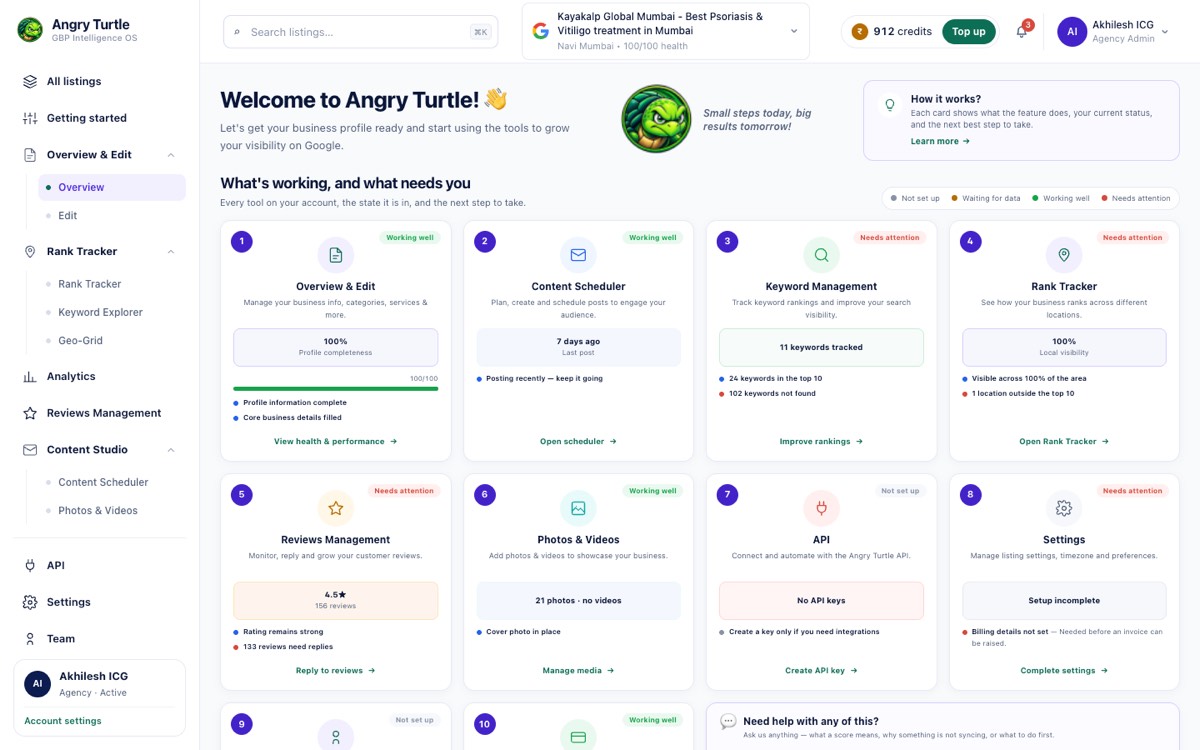

Related reading
Ready to have this run for you?
Book a free audit — we'll show you where you stand in 48 hours.