 Angryturtle
llms.txt for Local Businesses: Worth It or Not
·
Before setting one up, know this: no major AI company has confirmed that it reads llms.txt, and there's no evidence it changes whether your business gets cited by ChatGPT, Perplexity, or Gemini. If someone is selling you an llms.txt file as the thing that finally gets you into AI answers, that claim is ahead of the evidence.
That doesn't make it worthless. It just means the honest framing is narrower than the marketing around it, and a local business deciding whether to bother should understand what the file actually does before spending time on it.
What llms.txt actually is
llms.txt is a proposed convention — not a web standard ratified by any standards body — for a plain text file at the root of a domain that lists and briefly describes the pages an AI crawler might want to read, similar in spirit to a sitemap but written for language models rather than search engine crawlers. It's an idea proposed by a developer in the AI tooling community, and it's been adopted informally by some sites, mostly documentation-heavy ones for AI tools and APIs.
The key distinction from robots.txt: an AI crawler reads robots.txt to know what it's allowed or not allowed to fetch. llms.txt, as proposed, tries to do something more like curation — pointing a language model toward the pages that matter most and summarizing what's on them, on the theory that this saves the model from having to parse an entire site to find the useful parts.
A typical llms.txt file is short: a heading naming the business, a one-line description, and a list of links with brief annotations — "hours and location," "services and pricing," "booking." Nothing about the format requires developer effort beyond writing plain text and uploading it to the domain root, which is part of why it spreads faster than most technical SEO recommendations. There's little to lose by trying it and no build process to coordinate.
Why the evidence is thin
No confirmation exists from OpenAI, Anthropic, Google, or Perplexity that their systems specifically fetch and use llms.txt files as part of retrieval. Some AI tools that do heavy website crawling for coding or research tasks have shown interest in the concept, but "an AI coding assistant might read this when browsing a specific repo's docs" is a very different claim from "ChatGPT will cite my dental clinic because I added an llms.txt file." The two get conflated constantly in content written to sell llms.txt setup services.
What actually drives citation in general-purpose AI search, based on observable behavior, is closer to what a search engine has always rewarded: crawlable, clear, well-structured content, plus structured data markup that removes ambiguity, and the entity clarity that comes from consistent business details across the web. Schema markup for AI search covers a mechanism with a much stronger evidence base than llms.txt currently has.
Where it might still be worth doing
For a business with a website that's genuinely hard to navigate — deep, poorly linked, with the actual useful facts buried three clicks in — an llms.txt file that plainly lists "here's our hours page, here's our services page, here's our locations page" is a low-cost way to make the site easier to summarize correctly, for whichever systems do end up reading it. It's a cheap hedge, not a strategy.
It's a bigger relative win for a multi-location business with dozens of location pages than for a single-location business with five pages total, simply because there's more structural navigation to clarify. A multi-location SEO setup already has to think carefully about how pages relate to each other, and llms.txt is one more small piece of that same navigational clarity work, not a separate initiative.
A franchise network with, say, forty location pages across several cities has a genuinely different navigation problem than a single clinic with a five-page site. In that case, an llms.txt file that lists every location page with a one-line city and category tag at least removes the guesswork about which of forty near-identical pages matters for a given query — a small piece of housekeeping, not a growth lever.
What it definitely doesn't replace
It doesn't substitute for structured data, which has actual documented uptake by search and AI systems. It doesn't substitute for a complete, accurate Google Business Profile, which several AI systems — Gemini most directly — draw on regardless of what's on your website. It doesn't substitute for review quality or entity authority, both of which show up repeatedly as observable factors in how AI systems describe a business. And it doesn't substitute for the basic hygiene covered in GBP optimization for AI search, which affects visibility across every AI surface at once, not just the ones that might someday read a text file at your domain root.
A reasonable way to think about priority
If your website already has clean structured data, an accurate GBP, and no major navigation problems, adding an llms.txt file costs almost nothing and can't hurt. If you're choosing between spending an afternoon on llms.txt and spending that same afternoon fixing NAP consistency across your directory listings or filling in your GBP's missing attributes, the NAP and GBP work has a real, observable connection to how AI systems describe local businesses, the kind Rank OS actually scores. The text file has a plausible, unconfirmed one.
Angryturtle's llms.txt setup service treats it accordingly — as a small, quick addition alongside the work that actually has evidence behind it, not as a headline fix sold on its own.
Frequently asked questions
Does having an llms.txt file guarantee ChatGPT or Gemini will cite my business? No. There's no confirmation that either system reads the file at all, and no evidence connects its presence to citation likelihood.
Is llms.txt the same thing as a sitemap.xml file? No. A sitemap.xml is a long-established, search-engine-recognized format for listing every page on a site for crawling purposes. llms.txt is a much newer, informal proposal aimed specifically at language models, with far less confirmed adoption.
Should I prioritize llms.txt over schema markup? No. Schema markup has a documented connection to how both search engines and AI systems parse and use page content. llms.txt doesn't have that evidence base yet. Do the schema work first.
Will llms.txt hurt my SEO if I add it and nothing reads it? No. A correctly formatted, harmless text file at your domain root doesn't create any downside. The risk isn't in adding it — it's in believing it's doing more than it's confirmed to do.
Who should actually spend time on this? Mostly multi-location businesses with navigation-heavy sites, and only after the higher-evidence work — schema, GBP completeness, NAP consistency — is already done. For a small single-location business with a simple site, the time is better spent elsewhere.
Stop guessing where you rank locally.
Rank OS scores your Google Business Profile the way Google's local algorithm does — relevance, review health, freshness, entity authority and AIO readiness — and shows you exactly what to fix.
Book a live demo →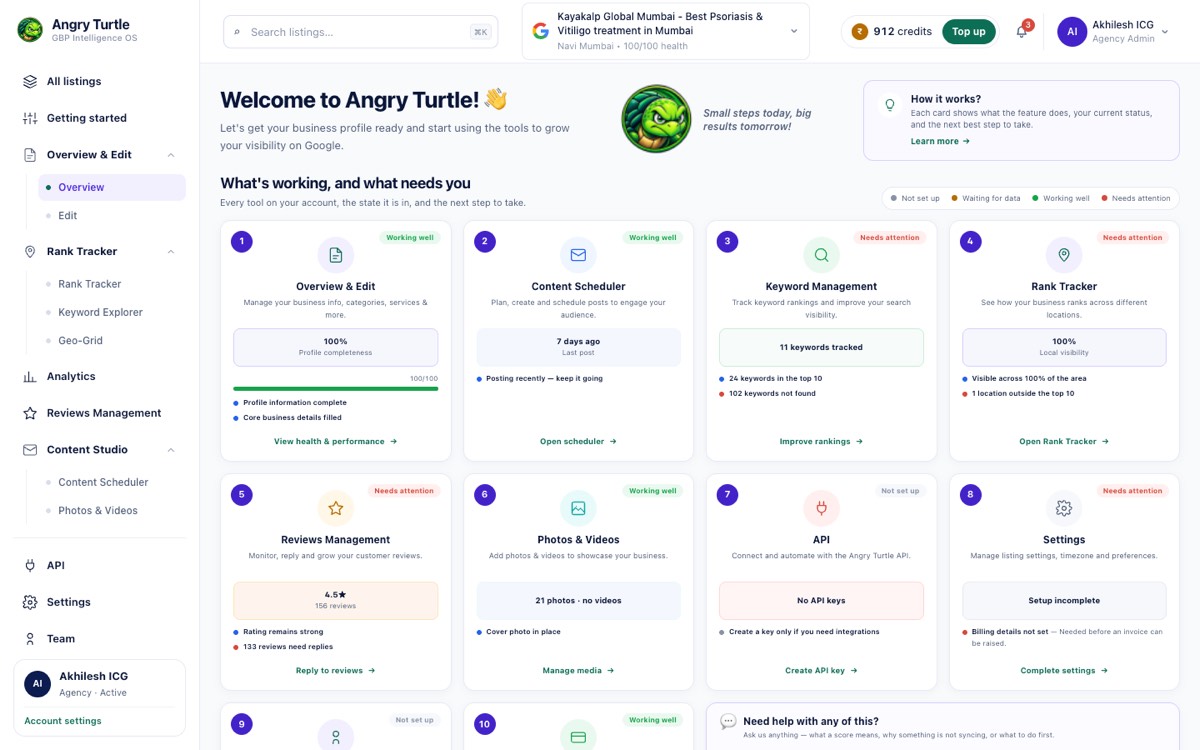

Related reading
Ready to have this run for you?
Book a free audit — we'll show you where you stand in 48 hours.