 Angryturtle
Local SEO for Ayurveda and Wellness Centres
·
Trust is the entire product for an Ayurveda or wellness centre before a single treatment happens. A customer choosing between a panchakarma centre and a general spa, or between an Ayurvedic physician and a wellness studio offering "Ayurvedic massage," is making a judgment about authenticity long before they walk in, and that judgment now happens on a phone screen scrolling through Google Business Profile listings. Local SEO for this category isn't primarily about ranking mechanics. It's about proving legitimacy fast enough that a skeptical searcher doesn't bounce to the next listing.
Get the category distinction right first
"Ayurveda Clinic," "Wellness Center," "Spa," and "Massage Therapist" are different GBP categories that attract different search intent and different levels of scrutiny. A centre run by a qualified Ayurvedic physician (BAMS-qualified) offering diagnosis and treatment should register as "Ayurvedic Clinic" or "Ayurvedic Practitioner," not "Spa" — mixing the two categories confuses both Google's classification and the searcher's expectations. Category selection mechanics apply the same way here as elsewhere →, but the stakes are higher for Ayurveda because a mismatched category signals to a discerning searcher that the business doesn't take its own credentials seriously. The broader GBP ranking factors guide → covers how category weighting fits into Google's system generally.
Credentials belong in the GBP description, not buried on a website page
A BAMS degree, years in practice, or a specific lineage of training (a centre trained in Kerala-style panchakarma, for instance) is the single strongest trust signal Ayurveda has, and it belongs in the first two lines of the GBP business description, where a searcher sees it without clicking through. Most centres bury this information on an "About" page nobody reads before booking. State it upfront: who is treating you, and what specifically qualifies them.
Photos need to show the treatment, not a stock-style wellness aesthetic
Generic "candles and stones" wellness photography is exactly what a skeptical searcher scrolls past, because it looks identical across a hundred listings and proves nothing. Photos of the actual treatment room, the herbal preparation process if the centre is comfortable sharing it, and the practitioner at work do more to convert than any amount of ambient lighting. General photo cadence and sequencing guidance → still applies, though Ayurveda specifically benefits from photos that read as clinical-authentic rather than spa-aesthetic.
Reviews need to name the treatment and the practitioner
A review that says "great experience, very relaxing" could be describing any spa in the city. A review that says "did a 14-day panchakarma program under Dr. [name], significant improvement in my joint stiffness by day ten" does the specificity work that separates an authentic Ayurveda centre from a generic wellness listing in a searcher's mind. Ask patients for this kind of detail when requesting reviews, and time the ask for the end of a treatment program rather than a single session, since that's when the outcome is clearest. The core review generation framework → covers timing and templates that adapt directly to a program-based service like this, and review response management → matters just as much here given how personally patients take a dismissive reply about a health outcome.
The festival and seasonal calendar runs differently for Ayurveda than for most categories
Ayurveda has its own seasonal logic — Ritucharya, the practice of adjusting care to the season, gives a centre genuine, non-generic content to post about monsoon detox programs, winter immunity-building packages, or pre-summer cleanses, tied to actual Ayurvedic principles rather than a generic "seasonal offer." Post ideas by category and seasonal cadence → generalise the mechanics; the content itself should stay specific to Ayurvedic seasonal practice rather than borrowing a spa's generic seasonal promotions.
Address the authenticity question directly in Q&A
Searchers researching Ayurveda centres in India are often quietly worried about being sold a diluted, spa-branded version of something that should be a real clinical practice. Use the GBP Q&A section to answer this directly: what qualifications the treating staff hold, whether herbs and oils are sourced or prepared in-house, and what a first consultation actually involves. Answering this proactively removes the single biggest hesitation before it becomes a reason to call a competitor instead.
Citation consistency across health and wellness directories
Ayurveda centres often appear across Practo, JustDial, and wellness-specific directories with inconsistent names — sometimes registered as the practitioner's name, sometimes as the centre's brand name, sometimes both on different platforms. The healthcare citation framework → applies here even though Ayurveda isn't allopathic, because the same directory ecosystem indexes it, and general business listing coverage across the broader Indian directory set → fills the gap for wellness-only or lifestyle directories that don't overlap with allopathic healthcare. NAP consistency principles at scale → explain why the practitioner-name-versus-brand-name split is a real ranking risk, not just a cosmetic inconsistency.
Entity authority matters more here than in almost any other category
Because Ayurveda sits in a space where credibility is contested — searchers genuinely can't always tell a legitimate BAMS-qualified clinic from a wellness studio borrowing Ayurvedic branding — building a strong entity presence (a practitioner's own professional profile, linked credentials, a consistent name across platforms) does more work here than for a category where legitimacy isn't in question. The entity authority and knowledge graph framework → and the pillar on entity SEO for AI search → both explain the mechanism: AI answer engines summarising "is this a real Ayurvedic clinic" style queries increasingly draw on exactly these signals.
Multi-centre Ayurveda brands need consistent credentials across every branch
Chains expanding across cities risk diluting the trust their flagship centre built if a new branch's GBP listing has thin credentials, no reviews, and generic photos while the original location looks established. The multi-location local SEO guide → covers the review-distribution problem generally; for Ayurveda specifically, each new branch needs its treating practitioner's credentials listed from day one, not backfilled months later.
Common mistakes specific to Ayurveda and wellness centres
The most damaging mistake is registering under "Spa" to appear in a broader search pool, which actively undercuts the authenticity a real Ayurveda practice should be leading with. A second is generic stock-style photography that makes an established clinic look identical to a pop-up wellness studio. A third is silence in the Q&A section on qualifications, leaving the exact question a skeptical searcher has unanswered and easy to resolve elsewhere.
When the wrong category hid two real physicians
Sannidhi Ayurveda Kendra had registered its Google Business Profile under "Spa" when it opened, back when the founder wanted to appear in the widest possible search pool. Two years in, with two BAMS-qualified physicians on staff running genuine panchakarma programs, the category was still "Spa," and the business description read like a relaxation-focused wellness listing with no mention of either physician's qualifications. A searcher specifically looking for a real Ayurvedic physician, not a massage session, skipped the listing entirely because nothing on it signalled clinical practice.
Recategorising to "Ayurvedic Clinic," moving both physicians' BAMS credentials into the first two lines of the description, and replacing three stock "candles and stones" photos with the actual consultation room fixed the mismatch — not by improving rank mechanically, but by making the listing legible to the exact searcher it was already showing up for.
What this can't do, and what it must never claim
None of this — category accuracy, photos, review prompts — should ever be used to claim or imply a cure, a guaranteed health outcome, or a comparative claim about clinical superiority over allopathic treatment. A GBP description or post that says a program "cures" a condition or "guarantees" recovery is not a stronger listing, it's a liability and a trust problem the moment a discerning searcher or a regulator notices it. The same discipline applies to reviews: a centre should never write or suggest wording for a patient review, and review-gating practices — prompting only satisfied customers or steering what a review says — carry the same risk here as anywhere else, amplified by the trust stakes.
A centre that's genuinely uncertain whether its own marketing language crosses this line should get that reviewed before spending anything on visibility, because a well-ranked listing making a claim it shouldn't just reaches more people with the same problem faster. Local SEO also can't fix a centre with a credentialing problem — a practitioner without genuine BAMS qualification claiming clinical authority — a stronger profile just gets that scrutinised faster too. And a profile that's been suspended for a policy violation tied to exactly this kind of overreach needs a reinstatement path sorted before anything else here is worth doing.
FAQ
Should a wellness studio offering Ayurvedic-style massage register as an Ayurvedic Clinic? Only if it employs BAMS-qualified practitioners and offers clinical treatment, not just massage services. Misclassifying erodes trust with the searchers who care most about the distinction and who are also the highest-value customers.
Do Ayurveda centres need English-language reviews, or do local-language reviews work too? Local-language reviews work fine and often read as more authentic to local searchers; Google indexes and displays reviews regardless of language, and mixed-language review bases reflect a real, rooted local practice rather than count against one.
How should a panchakarma centre handle reviews that mention program length and cost? Encourage them. Specificity about duration and pricing helps future patients self-select correctly and reduces mismatched expectations that lead to complaints later.
Can an Ayurveda centre mention specific health outcomes in a GBP post or description? No. Naming credentials, treatment types, and program structure is fine; naming or implying a guaranteed health outcome, a cure, or a comparative clinical claim is not, regardless of how accurate the centre believes the claim to be.
Should a centre ask patients to mention their specific condition in a review? It's better to ask for detail about the experience — practitioner attentiveness, program structure, facility cleanliness — than to prompt for or amplify a review naming a specific medical outcome, since that shifts from a service review into a clinical claim the centre didn't make itself but is now publicly associated with.
Angryturtle helps wellness and healthcare-adjacent brands build exactly this kind of entity and citation authority →, with citation management across 20+ platforms and duplicate-listing detection built to catch the practitioner-name-versus-brand-name inconsistencies this category runs into often.
Stop guessing where you rank locally.
Rank OS scores your Google Business Profile the way Google's local algorithm does — relevance, review health, freshness, entity authority and AIO readiness — and shows you exactly what to fix.
Book a live demo →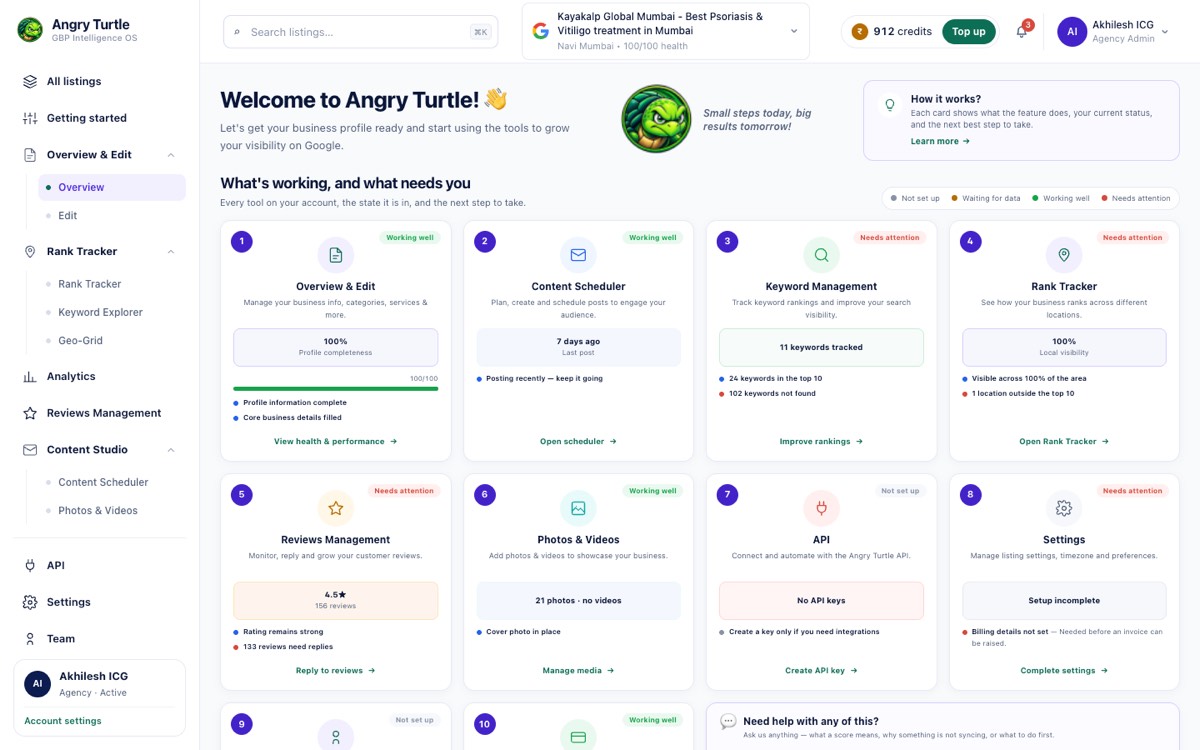

Ready to have this run for you?
Book a free audit — we'll show you where you stand in 48 hours.