 Angryturtle
A driving school's entire demand curve is set by the RTO licensing calendar, not by the school. Learner's licence slots, test dates, and document processing windows dictate when someone starts searching "driving school near me," and a school that treats every month the same way misses the two or three windows a year when search volume actually spikes.
Batch cycles drive the search calendar
Most Indian driving schools run in batches — a new learner's batch starting every week or two, test-prep batches timed around RTO test dates, and refresher batches for people who failed a test once already. Search demand tracks this closely: a spike right after RTO learner's licence camps or online LL test windows open, another spike around exam season when college students and young professionals suddenly need a licence before a job or move.
GBP posts should follow that calendar rather than running the same generic "join our driving school" message year-round. A post announcing "new batch starting Monday, LL test slots available" during an actual RTO camp window converts differently than the identical message posted in a quiet month. GBP post ideas and cadence covers the general mechanics of keeping posts fresh, and how often to post on GBP generally is worth checking against the RTO calendar specifically rather than a flat schedule.
The licence-outcome problem
A driving school's real product isn't lessons, it's passing the test — and that's genuinely hard to prove convincingly on a GBP profile. Unlike a coaching institute that can publish board exam percentages, a driving school's outcome data is scattered across individual students and rarely aggregated anywhere trustworthy.
The workaround is specificity in reviews rather than an aggregate claim. A review that says "passed my test on the first attempt after two weeks with them" does more credibility work than a business post claiming a generic high pass rate with no source. Encouraging students to mention specifics — number of lessons taken, whether it was their first attempt, which test centre — in the review request itself nudges toward this kind of detail. The review request playbook covers general timing and phrasing; for driving schools, the request should go out within a day or two of the actual test result, while the outcome and the specific experience are both still fresh enough to describe accurately. Reviews as content beyond just star ratings explains why the specific wording customers use matters as much as the rating itself.
Category and vehicle-type specificity
"Driving School" is the correct primary GBP category for nearly all of these businesses, but the services list is where most schools under-specify — see choosing the right GBP category for the general logic. Two-wheeler training, four-wheeler manual, four-wheeler automatic, commercial/heavy vehicle licence training, and refresher courses for lapsed drivers are functionally different products with different price points and different customer intent — someone searching "automatic car driving school" is filtered out entirely if a school only lists "car driving lessons" generically.
Attributes worth completing: whether pickup and drop is offered (a real differentiator for schools competing on convenience), women-only batches or instructors (a genuine demand segment in many Indian cities), and RTO test vehicle provision, since some students specifically need to practice in the same vehicle type they'll be tested in. GBP attributes that actually convert covers which attributes carry real weight versus which are cosmetic.
Reviews as the primary trust signal
Choosing a driving school is a low-frequency, high-anxiety decision — most people do it once every several years and have no personal reference point for what a "good" one looks like. That gap gets filled almost entirely by reviews, more so than in categories where the customer already has some baseline expectation from experience.
Review response management matters here specifically around complaints about instructor behaviour or vehicle condition, both common failure points that, left unanswered, read as ongoing and unresolved rather than as a single bad experience. A school that responds specifically — naming what changed, not issuing a form apology — signals it takes the complaint seriously rather than just wanting it to go away quietly. Responding to negative reviews has the general framework for tone.
Multi-branch schools and the same-city problem
Larger driving school chains often run several branches within the same city, each competing for overlapping searches. This is a direct case of the keyword cannibalization risk that affects any multi-location business — two branch GBP profiles both ranking weakly for "driving school Andheri" because Google can't confidently tell them apart, instead of one branch ranking strongly for its actual neighbourhood.
Managing 100-plus GBP listings is written for larger operators, but the underlying principle scales down: each branch profile needs a genuinely distinct service area, distinct photos of that specific branch's vehicles and instructors, and its own review base rather than a shared brand-level one. For schools expanding into new areas, onboarding new business locations properly avoids the common mistake of copy-pasting an existing branch's profile with the address changed, and the multi-location local SEO strategies guide covers the broader branch-competition problem.
Seasonal timing beyond the RTO calendar
Two additional windows matter beyond the pure RTO cycle: the run-up to festival travel season, when people want a licence before visiting family by car, and the period right before college terms end, when students who'll soon start working want a licence sorted before job pressure makes it harder to find the time. Posts timed to these windows, rather than spread evenly across the year, capture demand that a flat monthly schedule misses.
How Angryturtle helps
Angryturtle's demand clusters with momentum surface exactly this kind of seasonal spike before it peaks, so a driving school (or the agency managing several of them) can schedule posts ahead of the RTO camp window rather than reacting after search volume has already climbed. Demand clusters is the specific product feature for this. GBP write-back publishes those posts and any review replies straight to Google without a manual dashboard step, and Rank OS tracks review health as one of its five weighted dimensions, which is the single metric that matters most for a category this dependent on trust.
FAQ
How often should a driving school post on GBP? At minimum around RTO camp windows and batch start dates; a school that only posts once a quarter misses the specific timing that actually drives conversions.
Do women-only batches need a separate GBP profile? No — list it as an attribute and mention it in the services description; a separate profile would split reviews and dilute the main listing's ranking signal.
What matters more for a driving school, review count or review recency? Recency, generally, because a prospective student cares whether the school is actively operating well right now, not what it was doing three years ago.
Should each branch of a multi-branch driving school have its own GBP profile? Yes, provided each branch operates from a genuinely separate address and serves a distinct area — a shared profile for multiple physical branches usually backfires on local ranking for either location.
Stop guessing where you rank locally.
Rank OS scores your Google Business Profile the way Google's local algorithm does — relevance, review health, freshness, entity authority and AIO readiness — and shows you exactly what to fix.
Book a live demo →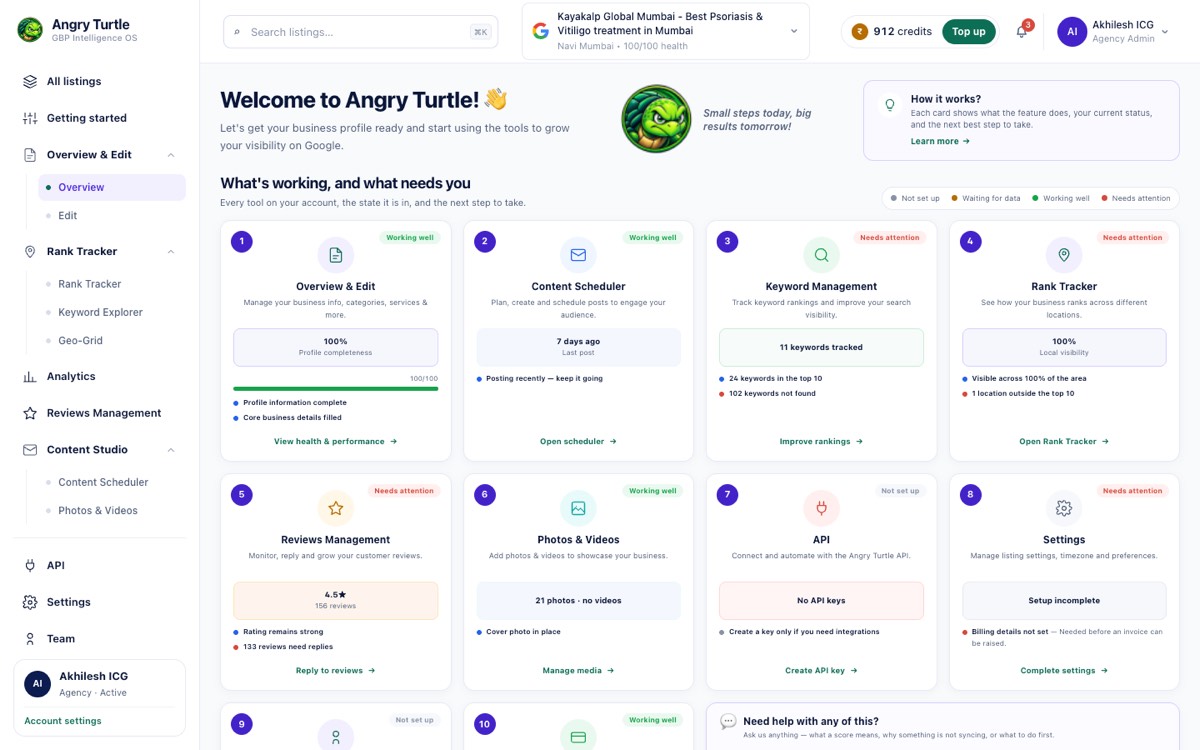

Related reading
Ready to have this run for you?
Book a free audit — we'll show you where you stand in 48 hours.