 Angryturtle
Local SEO for Jewellery Showrooms in India
·
A family shopping for a wedding set three weeks before Akshaya Tritiya doesn't decide on the first showroom they walk into. They shortlist four or five stores online first, cross-check making charges and purity certification, read reviews looking specifically for complaints about hallmarking or exchange disputes, and only then start visiting in person. Jewellery is one of the highest-consideration retail categories in India, and the research phase now happens almost entirely on a phone before a single showroom visit — which means a jewellery store's Google Business Profile is doing pre-sales work most other retail categories don't need.
Get certification and hallmarking into the GBP description, not just the showroom signage
BIS hallmarking, purity certification, and any additional certifications a store carries (a specific gemstone certification body, for instance) are the first things a trust-sensitive jewellery shopper looks for, and stating them directly in the business description answers the question before a customer has to ask. A store that assumes shoppers will discover this in person is losing the pre-visit trust-building window entirely.
Photos should show craftsmanship, not just finished pieces on a velvet tray
Every jewellery showroom's photos look similar when they're all just well-lit shots of finished necklaces and rings. Photos of the workshop, artisans at work, or the making process where a store is comfortable sharing it differentiate a showroom that actually manufactures from one that resells. General photo cadence and sequencing guidance → still applies as a baseline, but jewellery specifically benefits from process photography that a generic retail photo checklist wouldn't emphasise.
Reviews need to address making charges and exchange policy directly
The two most common jewellery-buying anxieties in India are getting overcharged on making charges and getting a bad deal on old-gold exchange. Reviews that mention transparent making charge disclosure or a fair exchange experience do more trust-building work than a generic five-star rating. When requesting reviews, prompt customers who mention price transparency or exchange fairness to include that detail. The core review generation framework → covers timing and templates that adapt to this kind of specificity ask.
Festival-driven demand needs a GBP posting calendar planned months ahead, not reactively
Akshaya Tritiya, Dhanteras, Diwali, and wedding season each drive distinct jewellery-buying spikes with different customer intent — auspicious-day gold buying versus wedding-set shopping versus gifting. A posting calendar planned around these dates in advance, with collection launches and limited-period offers timed to each, captures demand that a store scrambling to post reactively during the actual festival week misses. Post ideas by category, including seasonal cadence → cover the mechanics; the calendar itself needs to be jewellery-specific rather than a generic retail promotional schedule.
Entity authority: named designers and in-house manufacturing claims need backing
A store claiming "in-house design" or naming a specific master craftsman as part of its brand story builds a stronger entity presence than a generic showroom listing, especially as AI answer engines start summarising "best jewellery store for [occasion] near me" queries by drawing on exactly this kind of named, verifiable detail. The entity authority framework → and the AI-citation pillar → both explain why specific, attributable claims outperform generic ones in how these systems evaluate a business.
Citation consistency matters more for high-value purchases than for casual retail
A customer about to spend a significant amount checks a jewellery store's listing across multiple sources before committing, and any inconsistency in address, hours, or branch name across JustDial, IndiaMART, and Google reads as a red flag for a purchase this size in a way it wouldn't for a low-consideration retail category. NAP consistency at scale → and business listing coverage across the Indian directory set → both apply directly.
Multi-showroom jewellery brands need branch-specific proof, especially for exclusive collections
A flagship showroom's reputation doesn't automatically transfer to a newer branch in a customer's mind, particularly for a purchase this considered. Each branch needs its own review base, its own photos, and clarity on whether specific collections or bridal lines are available at that location or only at the flagship. The multi-location local SEO guide → covers the general mechanics; jewellery adds the collection-availability layer most retail categories don't need to think about.
Store locator and product schema help showrooms surface for collection-specific searches
A search like "bridal jewellery set showroom [city]" or "temple jewellery collection [city]" benefits from structured product and local business schema that names the specific collection type, not just generic jewellery. The schema markup pillar for AI search → explains the mechanism, and store locator SEO for multi-branch retail → covers the branch-discovery side for chains with several showrooms across a city or state.
Track geo-grid rank for occasion-specific searches, not just "jewellery shop near me"
"Jewellery shop near me" is one search; "bridal jewellery [city]," "gold coin Dhanteras [city]," and "temple jewellery [city]" are entirely different intent clusters with different seasonal timing. Tracking rank across these separately, rather than against one blended category term, shows a store exactly where to focus content and review-generation effort ahead of the next buying season. Metro-level benchmarks → give a useful sense of what's realistic given local competition.
Common mistakes specific to jewellery stores
The most damaging mistake is silence on making charges and certification in the GBP listing itself, leaving the exact anxiety a jewellery shopper has unaddressed until an in-person visit that may never happen. A second is treating every festival with the same generic "special offer" post instead of tailoring content to what each occasion's buyers are actually looking for. A third, in multi-branch chains, is letting a newer showroom launch with no reviews and no differentiated collection information, competing invisibly against its own flagship.
Should a jewellery store list making charges publicly on GBP? Stating a range or the general policy (fixed percentage, flat rate, or negotiable) builds trust even without exact per-item pricing, and reduces the volume of price-shopping calls asking the same question.
Do old-gold exchange policies belong in the GBP description? Yes, at least in summary — it's one of the most common pre-visit questions for Indian jewellery shoppers and answering it upfront removes friction before a visit.
How much does review volume matter for a purchase this considered? There's no fixed threshold. What matters more is recency and specificity — a handful of detailed, recent reviews addressing certification and pricing transparency reassure a high-value shopper more than a large volume of generic five-star ratings.
Angryturtle helps multi-showroom retail brands manage exactly this kind of branch-level proof and citation consistency →, with geo-grid tracking that splits occasion-specific query clusters the way jewellery demand actually moves through the year.
Stop guessing where you rank locally.
Rank OS scores your Google Business Profile the way Google's local algorithm does — relevance, review health, freshness, entity authority and AIO readiness — and shows you exactly what to fix.
Book a live demo →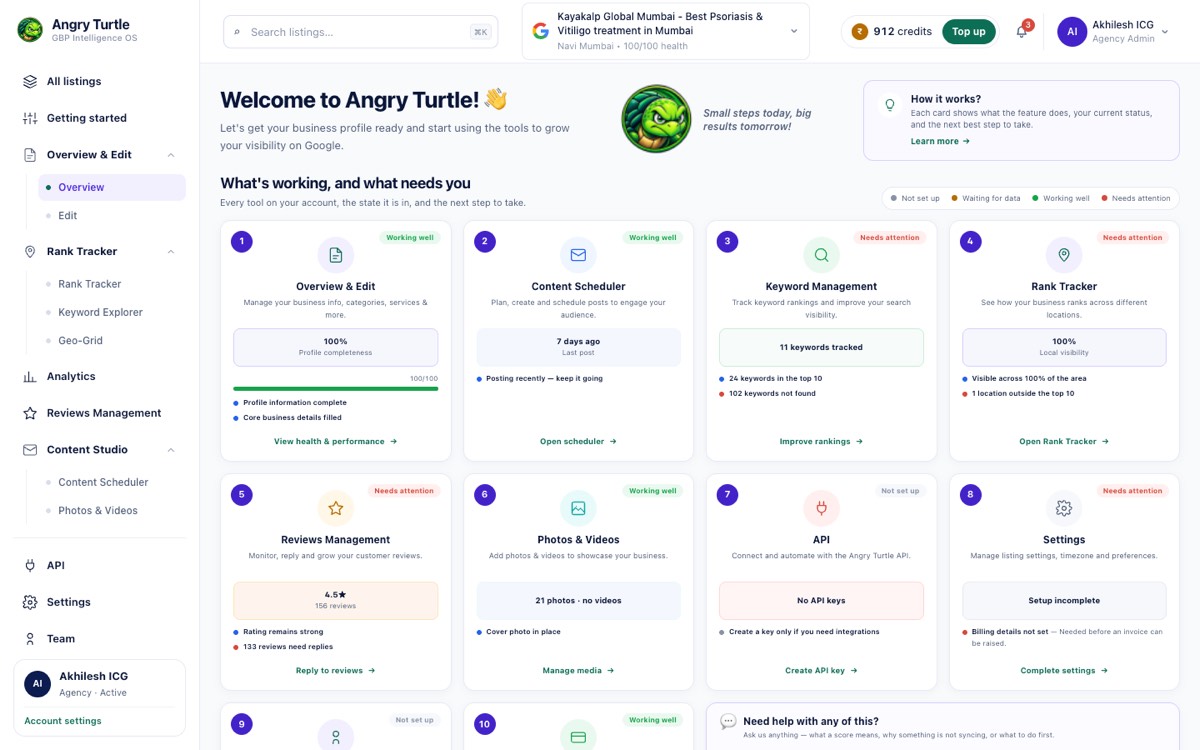

Related reading
Ready to have this run for you?
Book a free audit — we'll show you where you stand in 48 hours.