 Angryturtle
Running Local SEO Across Multiple Indian Cities
·
A ten-branch chain running local SEO the same way it ran local SEO with two branches usually finds out the hard way that the model breaks. Two branches don't compete with each other for the same searches. Ten branches spread across five cities can, quietly, for months, before anyone notices the traffic loss is self-inflicted.
The governance problem nobody plans for
Running local SEO across multiple Indian cities is mostly a governance problem wearing an SEO costume. Categories drift between branches when different staff members set up different GBPs at different times, sometimes pulling from the wrong entry in a GBP category list. Descriptions get copy-pasted with the wrong city name still in them. Review response templates go stale in one city while someone actively manages another. None of this shows up as a single dramatic failure — it shows up as slowly declining performance that's hard to diagnose branch by branch.
NAP consistency at scale is the foundational piece, and it gets harder, not easier, as city count grows, because inconsistency compounds across more surfaces: Google, JustDial, Practo, Sulekha, each with its own record of a business's name, address, and phone number that has to match everywhere or Google's trust signals for the whole entity take a hit.
Keyword cannibalization across cities
A specific and underrated multi-city failure mode is keyword cannibalization — two branches in the same metro, or even two cities' pages, competing for the same search terms instead of splitting the total demand between them. Our keyword cannibalization guide covers the diagnosis and fix in detail; the short version for a multi-city operator is that city pages need distinct keyword targets tied to geography, and branch pages beneath them need distinct targets tied to neighbourhood, with no two pages fighting for the identical phrase.
Reporting that actually rolls up
A five-city operation generates five sets of GBP insights, five review streams, and five sets of local pack rankings. Someone has to turn that into one number an owner or a board can act on. Enterprise local SEO reporting covers what that rollup should include — and a single weighted score across cities beats a stack of disconnected dashboards every time, because it forces a real prioritisation decision about which city needs attention this month rather than treating all five as equally urgent by default.
Angryturtle's Rank OS does this scoring at the individual-GBP level, 0 to 100 across five weighted dimensions, then rolls up across every location an account manages. A ten-city chain sees which specific city is dragging the group average down, not just that the group average moved, and geo-grid tracking shows whether a dip is city-wide or confined to one neighbourhood's search radius.
Running different cities on different playbooks
Delhi, Mumbai, and Bengaluru each need genuinely different tactics — our metro comparison guide breaks down why review velocity targets, citation priorities, and even language mix should shift city by city rather than run off one national template. A multi-city operator who runs the identical playbook everywhere is leaving performance on the table in whichever cities that template doesn't fit.
The centralised-versus-local tension
Central marketing teams want consistency; individual branch managers want local relevance. Both are right, and the resolution isn't picking one side — it's separating what has to be centrally controlled (category selection, brand voice, response-time SLAs, schema implementation) from what should flex locally (specific neighbourhood references, festival post timing, local partnership mentions). Managing multiple locations covers that split in more detail.
Franchise-specific multi-city complications
Franchise structures add a layer most corporate multi-location chains don't have: locations the brand doesn't directly operate but still needs consistent on Google. Our franchise GBP management guide covers the access and permissions model that keeps a franchisee's local edits from breaking brand-wide consistency, and Agency OS supports the pooled-credit, multi-seat access pattern this structure typically needs.
Multi-location SEO strategy, not just multi-location GBP
GBP management is the visible layer, but multi-location local SEO strategy needs to sit above it — deciding which cities get dedicated landing pages, how internal linking connects a city hub to its branch pages, and how the whole structure avoids the cannibalization problem above at the content layer, not just the GBP layer. The multi-location local SEO guide is the fuller version of that strategic layer, and enterprise accounts with heavier governance needs than a single spreadsheet can track should also look at enterprise local SEO for the account-level tooling that supports it.
A ten-city rollout, worked through
A clinic chain opening its tenth city faces a different problem than it faced opening its second. By city ten, category drift across the first nine has usually crept in somewhere, review response has usually lapsed in at least one city during a staffing gap, and the reporting stack has usually grown past what a single spreadsheet can track honestly. The fix generally isn't more manual effort per city — it's a system, geo-grid tracking, a single scoring model, centralised category governance, that scales the same way at city ten as it did at city two.
Frequently asked questions
How many cities before multi-city local SEO governance becomes necessary? Somewhere around four or five is where most operators start feeling category drift and reporting fragmentation, though it depends more on how decentralised the setup already is than on city count alone.
Can two branches in the same city cannibalise each other's rankings? Yes. Two GBPs in the same metro targeting identical categories and near-identical geography can split, rather than multiply, the total local pack visibility available to the brand in that city.
Should every city run the same GBP content strategy? No. Category selection and brand voice can stay centralised, but review velocity targets, citation priorities, and language mix should flex by city, since metros like Delhi, Mumbai, and Bengaluru genuinely differ in search behaviour.
What's the single biggest reporting mistake multi-city operators make? Tracking five or ten cities as separate dashboards with no unified score, which makes it hard to see which city actually needs attention this month versus which one is coasting on past momentum.
Stop guessing where you rank locally.
Rank OS scores your Google Business Profile the way Google's local algorithm does — relevance, review health, freshness, entity authority and AIO readiness — and shows you exactly what to fix.
Book a live demo →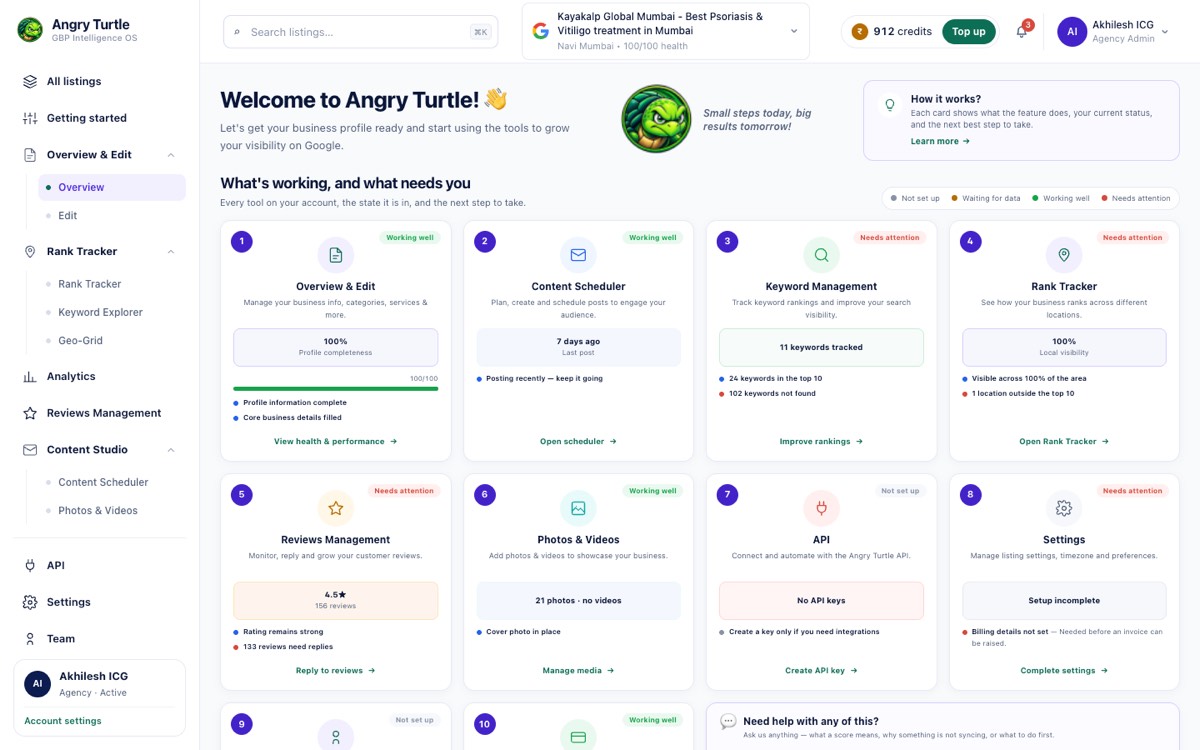

Related reading
Ready to have this run for you?
Book a free audit — we'll show you where you stand in 48 hours.