 Angryturtle
GBP categories Indian businesses pick wrong most often
The category choices that quietly narrow discoverability, and what to pick instead.
A five-minute fix most businesses never make
Google Business Profile category selection is one of the few local SEO levers a business owner can pull directly, for free, in under five minutes, and it's also one of the most consistently wrong. A category that's too broad narrows who Google shows the listing to for high-intent searches, and nobody revisits it after the profile was first set up, sometimes years earlier by whoever happened to be handling the paperwork that day. The GBP categories guide covers the mechanics of picking and changing a category; this list covers the specific categories Indian businesses pick wrong most often, and what to choose instead.
Google offers thousands of categories, most businesses use fewer than a dozen of them correctly, and the primary category carries more ranking weight than any secondary category attached afterward. Getting it wrong costs nothing to notice and nothing to fix, which is exactly why it's worth checking today rather than filing it under "eventually."
"Doctor" instead of the actual specialty
A dermatologist, a cardiologist and a general physician are three different searches, and "Doctor" as a primary category doesn't distinguish between them to Google's matching system the way "Dermatologist" does. A clinic that could be eligible for "skin specialist near me" instead competes in the much broader, much less qualified "doctor near me" pool. The fix is naming the specialty directly as the primary category, then adding "Doctor" or a related general category as secondary if it applies. GBP secondary categories covers how the primary/secondary split actually works.
Healthcare businesses should be careful here about what the category change implies. Selecting the right specialty category is a discoverability fix, not a claim about clinical quality or outcomes, and it shouldn't be described as one in any client-facing material.
"Educational Institution" instead of the specific program type
A test-prep center, a coaching institute for a specific competitive exam, and a full K-12 school are not the same search intent, but a lot of profiles default to the generic "Educational Institution" category because it was the first result that came up during setup. "Test Preparation Center," "Tutoring Service" or the specific exam-focused category available in Google's list narrows eligibility to the searches that actually convert. Local SEO for coaching institutes covers this in more depth for the exam-prep segment specifically, where the category mismatch shows up most often.
"Store" instead of the specific retail category
"Store" as a primary category is almost never right, because Google has specific retail categories for nearly every product type a shop actually sells — "Clothing Store," "Electronics Store," "Furniture Store," "Jewelry Store." A boutique using the generic "Store" category is invisible to a shopper searching for the specific product type it sells, even standing a few hundred meters away. Local SEO for jewellery stores, local SEO for furniture stores and local SEO for electronics retail each cover the category and search-behavior specifics for those segments.
"Restaurant" for a business that's really a cloud kitchen
A delivery-only kitchen with no dine-in space listed as "Restaurant" creates a mismatch the moment a customer tries to walk in and finds no seating, or worse, no public entrance at all. Google has a "Meal Delivery" category and related options built for exactly this business model. Getting the category wrong here isn't just a ranking issue, it risks a suspension flag for a listing that doesn't match the physical reality Google expects to verify. Local SEO for cloud kitchens covers the setup specifics, and reasons GBP profiles get suspended covers how a mismatch between category and actual operation shows up as a red flag during Google's review.
"Real Estate Agency" for a developer, not an agent
A real estate developer selling units in its own projects and an agent brokering resale or rental transactions across multiple builders are different businesses with different applicable categories, and treating them as interchangeable confuses both Google's matching and the customer reading the listing. Local SEO for real estate developers and the broader local SEO for real estate agents content cover the distinction. Whatever category a real estate business selects, RERA registration is worth naming on the profile as a fact — it isn't a quality signal to imply, just a registration status to state plainly.
"Gym" instead of the specific fitness format
Yoga studios, CrossFit-style functional training boxes, and traditional weight-training gyms all get lumped under "Gym" more often than they should, and each has its own more specific Google category. A studio offering only yoga classes competing under the generic "Gym" category is fighting for a search intent it doesn't actually match. Local SEO for gyms and fitness studios covers the category options by format.
Multiple locations sharing one category setup by copy-paste
A chain with locations in different cities sometimes copies the exact same category setup across every listing without checking whether each location's actual service mix matches. A branch that added a new specialty service six months ago but never updated its GBP categories is invisible for that specific search at that specific location, even though a sister location three cities away has the category set correctly. Franchise GBP management and managing 100+ GBP listings both cover the governance problem of keeping category accuracy consistent, and distinct, across a growing location count.
Checking and fixing category selection
Category changes take effect once Google re-crawls the listing, usually within a few days, and there's no reason to delay a fix once a mismatch is spotted. How to choose a Google Business Profile category walks through the selection process directly inside GBP, and GBP optimization quick wins covers this alongside the other no-cost fixes worth doing in the same sitting.
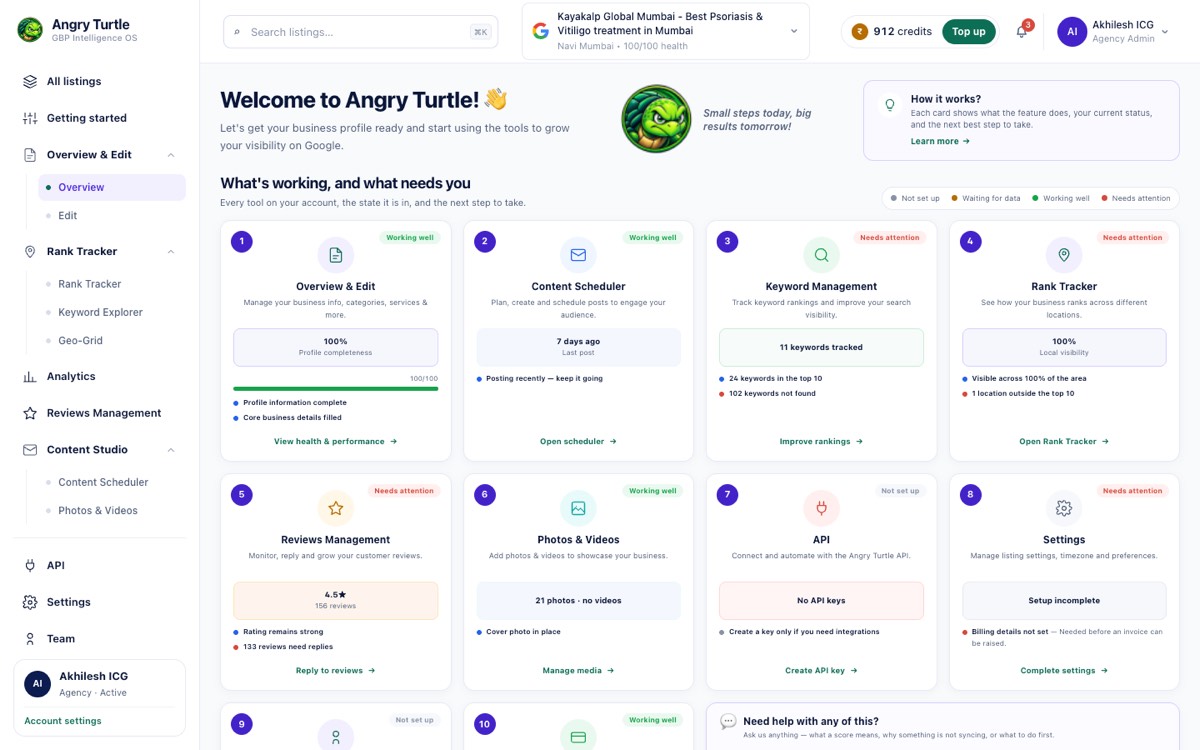
For a business managing this across many locations, Angryturtle's Rank OS flags category mismatches as part of its profile scoring, and fixes get queued and pushed live rather than left as an item on a report nobody actions. That matters more the more locations a business runs, because a category error at location twelve is just as invisible to head office as it is to Google, until something like a scoring pass surfaces it.
FAQ
How much does the wrong GBP category actually cost a business? It's not measured in a fixed number, but the effect is real: a broad category narrows which searches a listing is eligible to appear for, which limits the pool of high-intent customers who see it before more specifically categorized competitors.
Can a business have more than one category? Yes. GBP allows one primary category and up to nine secondary categories. The primary carries the most weight, so it should be the single most accurate description of what the business actually does, not the broadest one.
Does changing a category risk a suspension? Changing to a category that accurately reflects the business is safe. Changing to a category that doesn't match the actual operation, or changing repeatedly in a way that looks like manipulation, is the pattern that raises review flags.
How often should GBP categories be reviewed? At setup, then again any time the business adds or drops a service line, and at minimum once a year as a check, since categories are easy to set once and forget entirely.
Is there a difference between category selection for healthcare businesses and other verticals? The mechanics are the same, but healthcare and dental businesses should treat category selection strictly as a discoverability fix, not a claim about clinical quality, and should never describe a category change to patients or reviewers in terms of care outcomes.
More listicles and rankings
A score you can argue with, not a black box
Rank OS gives every profile a 0–100 score built from five weighted dimensions — Relevance, Review Health, Freshness, Entity Authority and AIO Readiness — and the weights are tunable. Underneath it sits a ranked list of the fixes that move the number, each with the point lift it unlocks.
Ready to have this run for you?
Book a free audit — we'll show you where you stand in 48 hours.