 Angryturtle
Bulk Verification for Multi-Location Google Business Profiles
·
Bulk verification for Google Business Profiles is the part of a multi-location rollout nobody plans for until it's already a problem. A single new listing verifies in a day or two through a postcard, phone call, or email. Forty new listings verifying at once, across five cities, with three different franchise owners submitting documents independently, turns into a queue of stuck, duplicate, and rejected profiles that can stall a launch for weeks. This is what that process actually looks like at scale, and where it breaks.
Why bulk verification is a different problem from single verification
Google's verification system is built around one business owner claiming one location. It was never designed around a franchise or enterprise rollout, and the friction shows up the moment volume increases. Claiming and verifying a single profile is a known, roughly predictable process, and our learning centre walkthrough covers it step by step. Do the same thing forty times in a compressed window and new failure modes appear that don't show up at all when you're only handling one.
Duplicate profiles surface far more often at volume, because more people — regional managers, franchisees, whoever set up the location's old listing years ago — have plausible claims to the same business. Verification method availability shifts too; postcard verification that works fine for a single request can queue unpredictably when dozens go out from related addresses close together. And document verification, increasingly common for categories Google treats as higher-risk, needs consistent paperwork across every location, which is its own coordination task if locations are franchisee-owned rather than corporate-owned.
Sequencing a bulk rollout
The instinct with forty new locations is to submit everything at once. That's usually the wrong move. A staggered rollout — batches of five to ten profiles submitted a few days apart — gives you room to catch a systemic issue, like a document format Google's rejecting across the board, before it's replicated across every single location in the batch.
Group the batches by verification method where possible. Locations likely to get postcard verification in one wave, locations needing document verification in another, since the two have different turnaround expectations and different failure points to watch for.
Before submitting any batch, run a duplicate check across Google Maps and Search for each address. This single step catches the most common bulk-verification failure — an old, unclaimed listing from a previous tenant or a prior ownership of the location that Google reads as a conflict once your new submission arrives. Angryturtle's citation engine's Duplicate Finder is built for exactly this kind of sweep before a location goes live, not just after something's already gone wrong.
The franchisee coordination problem
If locations are franchisee-owned, bulk verification adds a layer that pure corporate rollouts don't have: someone other than head office is the legal claimant on each profile, which means head office can plan the batch but can't submit it. This is where rollouts stall longest — not on Google's side, but waiting on a franchisee to check a postcard that arrived at their actual store, or to send back a scanned document three separate people have already asked for.
A written checklist handed to each franchisee before their location enters a batch — what document to have ready, what address the postcard will arrive at, who to notify the moment it arrives — cuts this delay more than any technical fix on the verification process itself. Franchise GBP management covers the ownership structure question in more depth if this is unresolved on your side, and managing multiple locations covers the coordination side more broadly.
What to track during a bulk verification wave
Run a simple status board across every location in the current batch: submitted date, verification method, expected turnaround, actual status, and any Google-side message received. This sounds basic and it is, but the failure mode we see most often in franchise rollouts is nobody having this in one place, so a stuck profile sits unnoticed for two weeks because it wasn't anybody's specific job to check it.
Angryturtle's Verification Tracker and Fix Queue, part of the same NAP and citations toolset, exist to give an ops team exactly this view — which profiles are pending, which have stalled past a normal turnaround window, and which need a specific action rather than just waiting.
Turnaround expectations vary by method and category, and how long GBP verification actually takes is worth reading if a location's already past what feels like a reasonable wait — some delay is normal, but a profile stuck for three weeks with no status update usually needs direct follow-up, not more patience.
Common rejection reasons at scale
A handful of rejection causes account for most bulk-verification failures. Address formatting mismatches between what's submitted and what's on record for the location — a suite number present on the lease but missing from the submission, for instance. Business name inconsistency between the verification submission and existing signage or older directory listings. Category selections that trigger Google's higher-scrutiny review for certain business types, which slows document-based verification specifically. And prior ownership history at the address that Google flags as a conflict even when the new business is entirely legitimate.
GBP verification problems in India covers these in more detail with country-specific context, since document requirements and postcard reliability both vary regionally in ways that matter for a rollout spanning multiple Indian cities.
Governance after verification, not just during it
Getting forty locations verified is the visible milestone, but it's not the finish line. Once verified, every profile needs the same ongoing NAP consistency and category maintenance any single location needs — and at this scale, that maintenance needs the same kind of structured ownership covered in our piece on the multi-location governance model, because a batch of freshly verified profiles with no defined owner tends to drift within months.
Bulk operations against the GBP API is what makes ongoing maintenance realistic once verification is done — the same API access that made the rollout trackable is what keeps forty profiles consistent afterward, rather than reverting to forty separate manual logins. The same infrastructure underpins Angryturtle's multi-location local SEO services once the rollout phase is over.
Enterprise-scale verification: SSO and role separation
Past a hundred locations, verification volume alone justifies a different operating structure — role-based access so a rollout team can submit and track verification without holding the same permissions as day-to-day content managers, and single sign-on so access doesn't depend on forty individual Google account logins with forty individual passwords someone has to manage. Enterprise local SEO covers what changes structurally at that scale, and verification is usually the first place the gap between a mid-size rollout and a genuinely enterprise one becomes obvious.
Frequently asked questions
How many locations can realistically be verified in a single batch? There's no fixed Google-side limit, but five to ten per batch keeps a rollout manageable enough to catch and fix a systemic issue before it repeats across the whole set. Larger batches trade visibility for speed.
What's the most common cause of a stuck bulk verification? Duplicate or conflicting prior listings at the same address, followed by document or address formatting mismatches. Both are largely avoidable with a pre-submission duplicate check and a standardized document checklist.
Should franchisees or head office submit verification for franchise locations? Whoever is the legal claimant on the business needs to submit, which is often the franchisee — but head office should own the checklist, the coordination, and the tracking, even when the actual submission happens on the franchisee's side.
Does bulk verification cost more than verifying locations individually? Not through Google directly — verification itself is free. Cost only enters through the operational overhead of coordinating a large rollout, which is where a managed service or platform with bulk tracking earns its cost back in time saved.
Angryturtle's managed GBP services handle multi-location verification rollouts end to end.
Stop guessing where you rank locally.
Rank OS scores your Google Business Profile the way Google's local algorithm does — relevance, review health, freshness, entity authority and AIO readiness — and shows you exactly what to fix.
Book a live demo →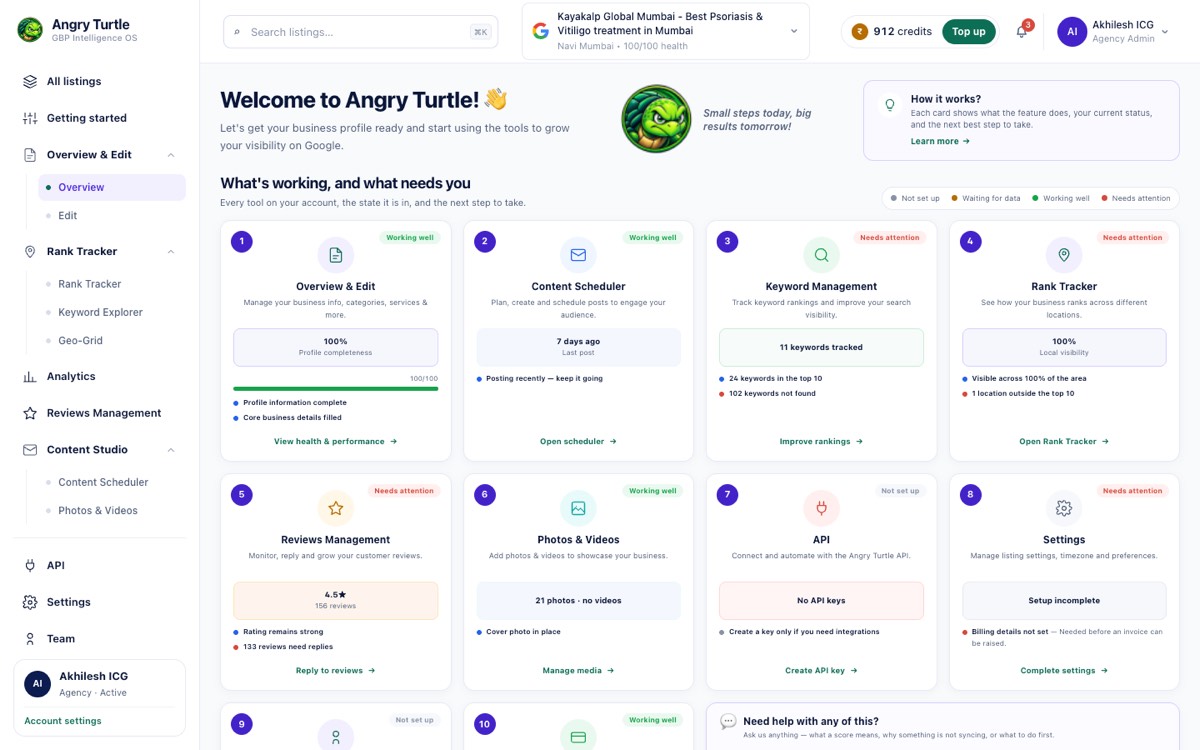

Related reading
Ready to have this run for you?
Book a free audit — we'll show you where you stand in 48 hours.